Evan Lee Salim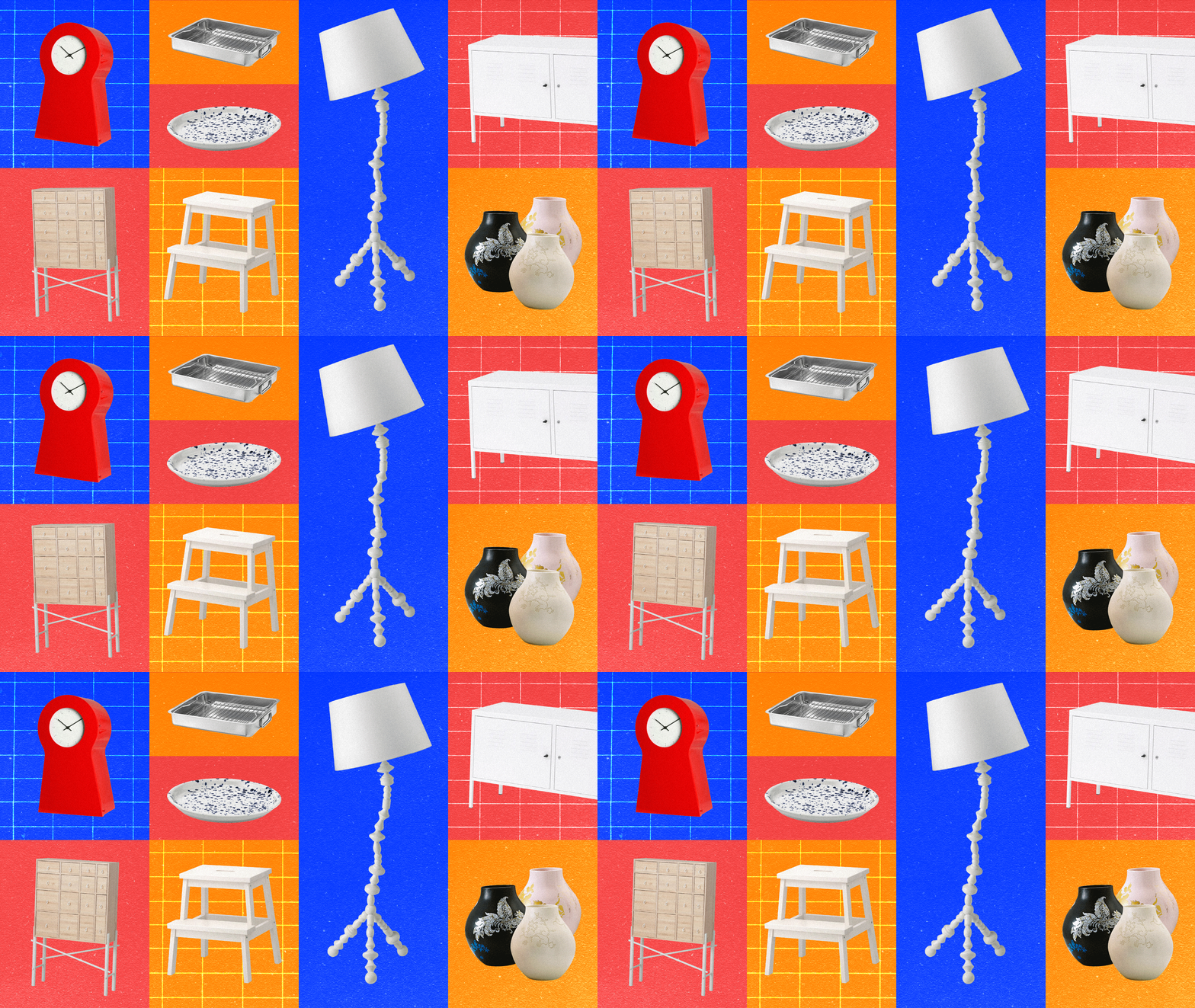
In the heart of Älmhult, a quiet Swedish town that serves as the global nerve center for the world’s most recognizable furniture empire, sits Johan Ejdemo. As the Design Manager for IKEA, Ejdemo holds a unique position in the global cultural landscape: he is, in many ways, the arbiter of domestic taste for more than 900 million shoppers annually.
Tasked with leading an internal team of 20 designers and a vast network of international freelancers, Ejdemo oversees the birth of 1,500 to 2,000 new products every year. It is a role that requires balancing the industrial efficiency of a retail titan with the nuanced, human-centric needs of a global population.

The Architect of Everyday Life: A Career Forged in Wood
Johan Ejdemo’s journey to the helm of IKEA design did not begin in a corporate boardroom, but at a workbench. Starting his career at age 15 as a trainee cabinetmaker, Ejdemo brought a craftsman’s sensibility to the industrial giant. Nearly three decades later, he remains an “IKEA lifer,” a rare breed of executive who understands both the macro-logistics of global supply chains and the tactile reality of a dovetail joint.
His most recent initiative, the launch of the PS 2026 collection, marks a return to the brand’s roots in experimental, budget-conscious design. After a nine-year hiatus, the series has returned with 44 pieces defined by “playful functionality.” From shape-shifting floor lamps to inflatable easy chairs—some of which have been rigorously tested by the office’s resident cats—the collection reinforces the company’s commitment to accessibility, with price points ranging from $5 to $500.

Chronology of an Icon: From Design Concept to Global Living Room
The evolution of IKEA’s design philosophy can be traced through its collections. Since the brand began collaborating with luminaries like Verner Panton and Tom Dixon, the company has successfully bridged the gap between mass-market utility and high-end aesthetic value.
- 1995: The introduction of the iconic PS Clock, a design that remains a benchmark for the brand’s commitment to form and function.
- 1999: The release of the PS Metal Cabinet, a piece so enduring it remains a staple in the modern catalog.
- 2005: Hella Jongerius’s Jonsberg Vases are released, demonstrating the potential for artisanal techniques in industrial production.
- 2009: The PS Svarva floor lamp and Sinka cabinet redefine modular storage and lighting, showcasing serendipitous engineering where components from different factories coalesce into cohesive products.
- 2024–2026: The revival of the PS series, focusing on circularity, recycled materials, and the return of the brand’s signature “playful” aesthetic.
Supporting Data: Why Vintage IKEA is Now High-End Decor
As global consumers look toward circularity and sustainable consumption, the secondary market for IKEA furniture has exploded. Vintage pieces are no longer viewed as disposable dorm-room furniture; they are increasingly treated as design investments. A complete set of the Jonsberg Vases, originally retailing for roughly $39, can now command upwards of $1,700 on the secondhand market. This shift suggests that Ejdemo’s design team is not merely filling homes—they are creating the heirlooms of the next generation.

The Personal Collection: A Cabinetmaker’s Curated Home
When asked what a man who helps design the world’s furniture keeps in his own home, Ejdemo offers a refreshing, often imperfect answer. He eschews the pristine, showroom-ready aesthetic in favor of items that have aged, chipped, and evolved alongside his life.
The Beauty of Imperfection: Silversida
Ejdemo is particularly fond of the Silversida series. “I picked this bowl specifically because the painter missed the mark, and the blue dot ended up on the outside,” he explains. For him, the industrial beauty of the recycled ceramic is secondary to the human error that makes his specific piece unique.

The Kitchen as a Laboratory
His kitchen serves as a living history of his career. Having installed his first IKEA kitchen 20 years ago, he has maintained the structural integrity of the Faktum/Metod systems while customizing them with his own hand-painted doors. “In over 20 years, I have one hinge that is starting to come loose, but I can easily fix that,” he says, underscoring the brand’s focus on durability over planned obsolescence.
His “party-ready” kitchen island features the humble Norbo folding table and the classic Bekväm step stool. These pieces are covered in paint spots and signs of wear, which Ejdemo views as a badge of honor. “It shows time,” he notes, arguing that the pursuit of a flawless home is a fool’s errand compared to the comfort of a lived-in space.

The PS Cabinet: A Lifetime Staple
If one item defines his home, it is the 1999 white metal PS cabinet. He keeps them in his dining room, his hallway, and his home office. These pieces have moved with him across multiple homes and decades, proving that mass-produced design can possess the longevity usually reserved for custom cabinetry.
Official Perspectives: The Philosophy of “Playful Functionality”
For Ejdemo, design is not about creating a finished product that must be kept in stasis; it is about providing the tools for living. He defends the “ugly stick” of a standard, high-design vase being used as a toilet paper holder, arguing that if a design is beautiful, it should be used in the most practical way possible.

His team’s process is deeply collaborative. The Svarva lamp, for instance, was born of “pure serendipity.” When his team discovered that a factory producing metal tubes for lamps was situated right next to a factory turning wooden beads, they realized they could construct the lamp like a necklace. This spirit of accidental innovation is what Ejdemo aims to foster within his department.
Implications: The Future of Mass-Market Design
The implications of Ejdemo’s approach are significant for the retail industry. As the climate crisis necessitates a shift away from fast-furniture models, the focus at IKEA has pivoted toward circularity. By ensuring that components are repairable, modular, and aesthetically versatile enough to outlast trends, the brand is attempting to pivot its reputation from “disposable” to “durable.”

Furthermore, Ejdemo’s willingness to embrace the “imperfect” is a subtle but powerful message to the consumer: you do not need to replace your furniture just because it has a scratch. You can paint it. You can move it. You can repurpose it.
As he notes, “Everything has a little bit of imperfection. You can spend your whole life bothering about that, but there should be some imperfection in life. Fix it? Then something else needs fixing. It just moves. Leave it, be proud.”

In a world obsessed with curated perfection and the constant cycle of buying, Johan Ejdemo offers a counter-narrative: the best piece of furniture is the one that stays with you, evolves with you, and ultimately, tells your story. Whether it’s a $5 bowl or a $500 wardrobe, the value is not in the price tag, but in the history you build around it. As IKEA moves toward 2026 and beyond, this philosophy of longevity and playfulness will likely remain the company’s most important, and perhaps its most enduring, product.


 Asep Darmawan
 Nana Muazin