Raul Delapena Setiawan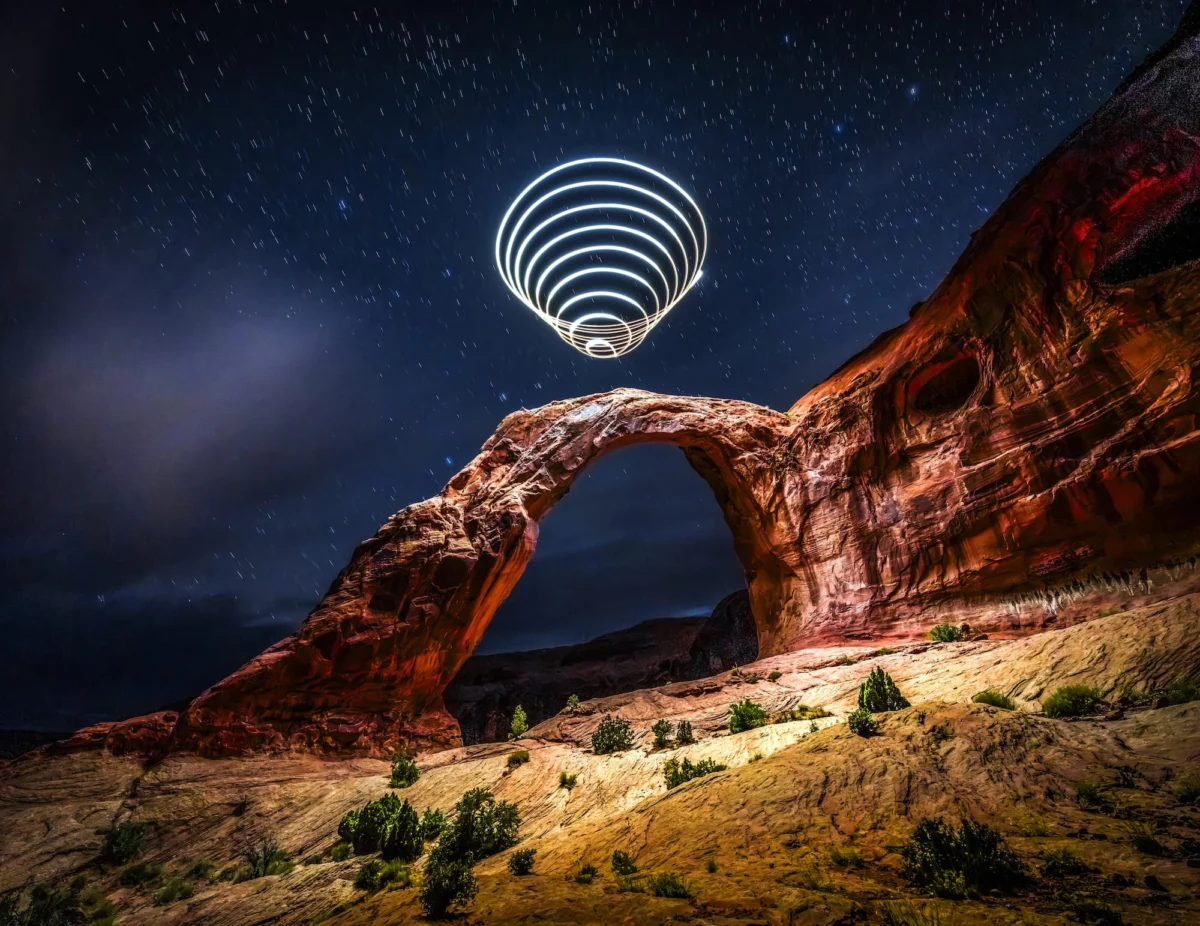
Albert Einstein once posited that "the most beautiful experience we can have is the mysterious." For physicist and photographer Dr. Elliot McGucken, this intersection of the inexplicable and the empirical serves as the cornerstone of his creative existence. By blurring the boundaries between rigorous scientific inquiry and the ethereal nature of light, McGucken has emerged as a singular voice in contemporary landscape photography—a man who maps the fourth dimension as deftly as he navigates the rugged wilderness of the American West.
The Intersection of Science and Aesthetics: Main Facts
Dr. Elliot McGucken occupies a rare space in the intellectual landscape. To the scientific community, he is a researcher dedicated to the development of artificial retina prosthetics, a noble pursuit aimed at restoring vision to the blind. To the art world, however, he is a virtuoso of long-exposure photography, known for his ability to transform the vast, silent expanses of North America into canvases for "light paintings."

His work is not merely decorative; it is a meditation on the fundamental physics of the universe. Utilizing drones as high-tech brushes, McGucken manipulates light within the frames of long-exposure shots to create the "light cones" famously described in Einstein’s 1922 treatise, The Meaning of Relativity. These light cones, which geometrically map the relationship between space, time, and the speed of light, are brought to life by McGucken against the backdrop of some of the most remote and dramatic topographies on Earth, from the ghostly, flood-carved sandstone of Antelope Canyon to the jagged, imposing silhouettes of the Rocky Mountains.
A Chronological Evolution: From the Lab to the Wilderness
The trajectory of Dr. McGucken’s career is one of constant synthesis. His early life was defined by the pursuit of physics—an obsession with the mechanics of the cosmos that eventually led him to explore how light interacts with the human eye and the digital lens alike.

- Formative Years: McGucken’s academic background in physics provided the bedrock for his visual philosophy. Understanding the optics of how light refracts and travels through space informed his early photographic experiments.
- The Pursuit of Nature: As he transitioned into professional photography, his focus remained on "the sublime." His documentation of the 2026 Death Valley wildflower superbloom served as a catalyst, drawing national attention to his ability to capture the fleeting, ephemeral shifts in natural beauty.
- The Drone Era: With the advent of advanced, programmable drone technology, McGucken found the bridge he needed to marry his physics research with his art. By piloting these devices, he could "paint" in three-dimensional space, capturing light patterns that represent the theoretical constructs of Einsteinian physics.
- Current Projects: His ongoing series, Spacetime Light Cone Sculptures dx4/dt=ic, represents the pinnacle of his work to date. Having traveled to the Trona Pinnacles in California and the Mobius Arch in the Alabama Hills, he continues to refine his technique, turning the desert night into a laboratory for the fourth dimension.
The Theoretical Framework: Supporting Data and Physics
At the heart of McGucken’s work is a profound respect for the "light cone." In special relativity, a light cone defines the path that a flash of light, emitted from a single event in spacetime, would take through space. It is the boundary that separates the "past" from the "future" for any given point in space.
McGucken’s photography interprets this mathematical hourglass shape through the physical medium of long-exposure drone light. When asked about the technical nature of his work, he describes it as "sculptures upon nature’s exalted easel." The drone acts as a particle moving through the landscape, leaving a "world-line" of light. By capturing these paths, he makes the invisible architecture of spacetime visible to the naked eye.

Beyond the theory, the data supporting the necessity of his work is found in the reaction of the viewer. His photographs have been lauded for their technical precision, often featuring perfectly symmetrical cones that require an intimate understanding of velocity, timing, and atmospheric conditions. It is a process that requires the rigor of an engineer and the eye of an Impressionist.
Perspectives and Official Responses: The Artist’s View
In interviews, McGucken often reflects on the dual nature of his endeavors. He rejects the notion that art and science are disparate disciplines. "Scientific inquiry," he argues, "is as much a creative endeavor as photography is a technical one."

His peers in the scientific community have noted the significance of his ability to visualize complex concepts. While his prosthetic retina research focuses on the biological hardware of sight, his photography focuses on the philosophy of sight—the way we perceive the cosmos and our place within it. The artistic community, meanwhile, has praised his work for its ability to strip away the distractions of the modern world, leaving behind only the interaction of light, time, and earth. Critics have frequently compared his work to that of other masters of light painting, such as Reuben Wu, yet McGucken’s work remains distinct for its heavy reliance on the mathematical foundations of physics rather than simple aesthetic improvisation.
Implications: The Future of Photographic Science
The implications of Dr. McGucken’s work are twofold. Firstly, he is pushing the boundaries of what landscape photography can achieve. By introducing motion-controlled lighting (the drones) into the landscape, he is moving beyond the "passive" documentation of nature toward a "participatory" form of photography. He is not just photographing the world; he is interacting with it.

Secondly, his work serves as a powerful bridge for public scientific literacy. By visualizing the concepts of relativity—the very fabric of our universe—in a way that is hauntingly beautiful, he makes high-level physics accessible to the general public. He invites the viewer to look at a photograph of a desert and see not just a landscape, but a representation of the spacetime that governs every atom in existence.
As he continues to travel and document these "sculptures," the scope of his project seems limitless. Whether he is capturing the brown bears of Alaska or the stillness of the California night, McGucken’s mission remains constant: to illustrate the "fundamental emotion" that Einstein identified as the cradle of all true art and science.

Conclusion: The Mysterious Remains
In an age of digital saturation, Dr. Elliot McGucken’s work stands out as a testament to the power of the "mysterious." He reminds us that the world is more than what meets the eye; it is a complex, swirling interplay of light and time, waiting to be captured by those with the curiosity to look closer. His work is a bridge—a long-exposure, illuminated pathway—between the rigid, objective laws of physics and the subjective, emotional experience of the human spirit.
For those interested in following his journey, his work is consistently updated via his Instagram, and those looking to bring the fourth dimension into their own homes can find prints available on his official website. In the end, McGucken’s art is an invitation to look up at the night sky—or down at the desert floor—and see the hidden, mathematical beauty that binds us all to the cosmos.

 Laily UPN
 Ali Ikhwan