Dwi Wanna
For nearly a decade, the name Faraday Future has been synonymous with the turbulent promise of the electric vehicle (EV) revolution. Once hailed as a potential “Tesla killer,” the company’s history has been defined more by financial volatility, leadership turmoil, and production bottlenecks than by the cars it actually managed to place on the road. Now, in a move that signals a dramatic strategic pivot, the embattled automaker is looking to reinvent itself once again—this time by pivoting toward the high-stakes world of robotics and artificial intelligence.
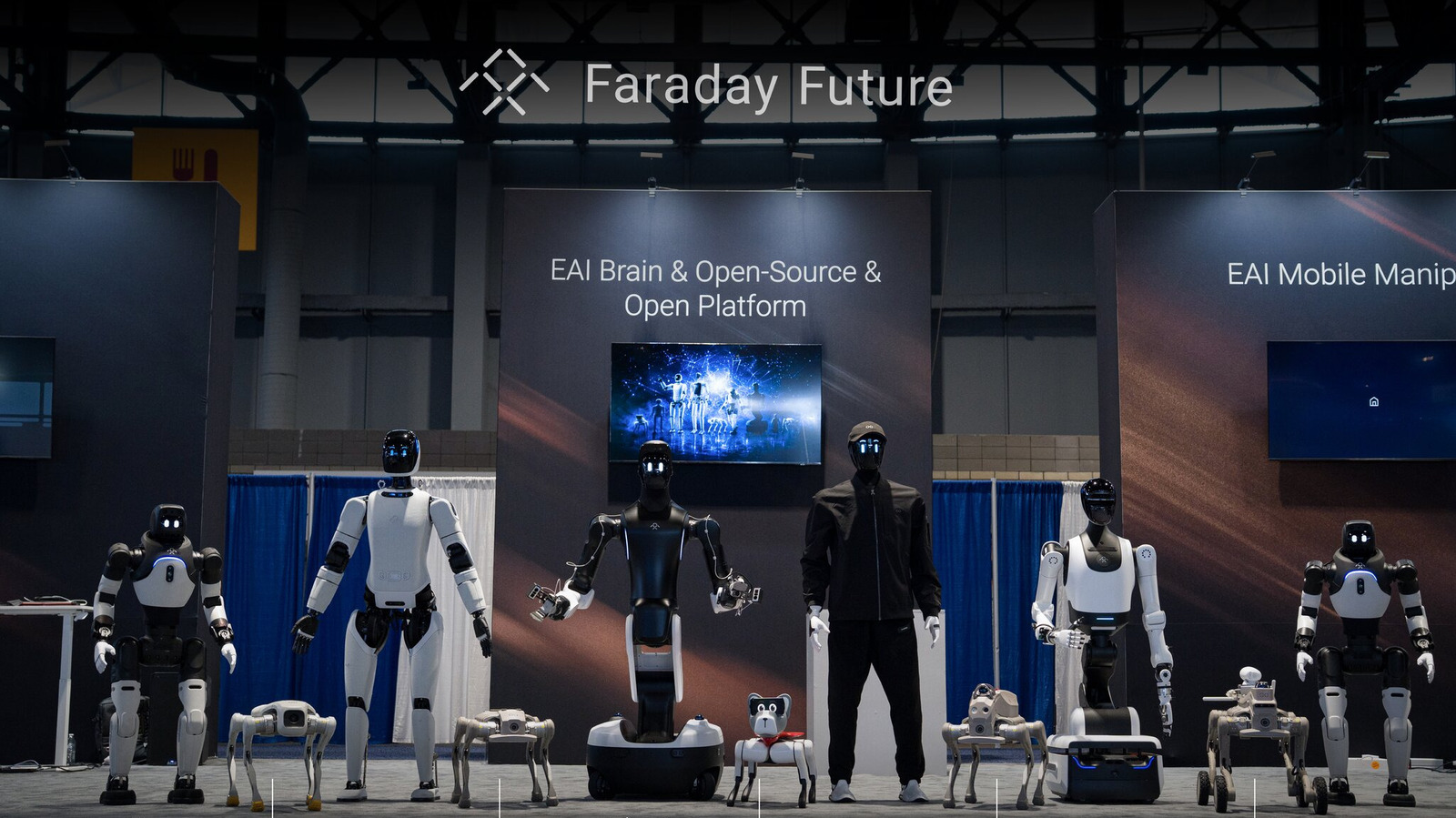
Faraday Future (FF) has officially unveiled a new lineup of "FF EAI" (Embodied AI) robots, including a humanoid model with a price tag approaching $90,000. For a company that only recently managed to reach the milestone of delivering its 15th or 16th luxury electric vehicle, the transition from mass-market automotive manufacturing to advanced robotics is as ambitious as it is controversial.
The Core Facts: A New Business Identity
Faraday Future’s recent announcement details an ambitious expansion into the robotics ecosystem. The company is positioning its "FF EAI" brand as a comprehensive hardware and software suite designed for both educational and industrial applications.
The centerpiece of this launch is the "Futurist," a 5-foot-8-inch humanoid robot. Powered by NVIDIA’s Sonic full-body motion control system, the Futurist is being marketed as a sophisticated piece of hardware for a price point just shy of $90,000. Beyond the humanoid, the company is introducing "Navi," a quadrupedal robotic companion aimed at the education market—specifically for students learning the fundamentals of embodied AI. With a starting price of roughly $2,000, Navi offers a more accessible entry point into the company’s ecosystem, though users looking for a more "canine" aesthetic will need to pay a premium for 3D-printed modular attachments.
Furthermore, Faraday is entering the industrial automation space with a "mobile manipulator"—a sophisticated robotic arm designed for enterprise use. While the company has opted to keep pricing for this unit under wraps, industry analysts suggest the cost is likely to be substantial, placing it firmly in the category of specialized B2B hardware.
A Chronology of Turbulence: The Road to the Pivot
To understand the significance of this pivot, one must look at the chaotic history of Faraday Future. The company burst onto the scene with immense fanfare, promising to revolutionize the automotive industry with a high-performance EV that could rival the best of Silicon Valley.
The Early Hype (2014–2017)
Faraday Future’s debut at the 2017 Consumer Electronics Show (CES) was intended to be its coming-out party. It showcased a production-ready EV that boasted impressive specifications. However, the internal reality was far less polished. Years of "lofty goals" were met with increasing skepticism from investors and the media as the company struggled to move from prototype to assembly line.
The Era of Instability (2018–2023)
The subsequent years were marked by a laundry list of corporate crises. Founder YT Jia faced intense scrutiny as his assets were frozen, and the company was beset by a dozen lawsuits, allegations of internal misconduct, and significant layoffs. Throughout this period, the dream of mass-producing the FF 91 EV stalled repeatedly. By January 2025, the company’s total output was a staggeringly low "15 or 16" vehicles, a figure that underscored the severity of their manufacturing struggles.
The "Fresh Start" and the Pivot (2025–Present)
In a bid to survive, Faraday Future returned to the CES stage in 2025, pitching a "fresh start" centered on a new electric minivan and a broader technological refocus. The return of YT Jia as the sole global CEO in May 2025 signaled a consolidation of power, yet the company’s pivot toward robotics suggests a realization that the traditional EV market may be too crowded and capital-intensive for a company with such a fractured track record. By late 2025, they completed the first pre-production model of their FX Super One MPV, but by mid-2026, the primary focus of their communications shifted toward the FF EAI robotics line.
Supporting Data: Can Robotics Save the Bottom Line?
The pivot to robotics is not entirely unique; it mirrors the recent strategic shifts of industry giants like Tesla, which has similarly de-emphasized legacy automotive lines to focus on the development of the "Optimus" humanoid. However, Faraday Future operates under a different set of financial constraints.
The company claims that its shift is already yielding results. In its most recent investor communication, Faraday stated that it expects to ship more than 100 robotics units in June alone. Furthermore, the company reported that its cumulative shipments for the first half of the year are projected to exceed their original target of 220 units.
While these numbers are small in the context of global manufacturing, they represent a significant increase in output compared to their previous efforts in the automotive sector. For a company that has spent years struggling to assemble individual luxury vehicles, the ability to produce and ship hundreds of robotic units—even at a lower complexity—could provide the much-needed cash flow to stabilize operations.
Official Responses and Strategic Rationale
Faraday Future maintains that the "FF EAI" strategy is not a departure from their mission, but an evolution of it. The company emphasizes that the core technologies developed for their EVs—such as battery management, motion control, and AI-driven autonomous systems—are directly transferable to robotics.
In official statements, the leadership has highlighted the "industrial ecosystem" that they are building. By positioning the humanoid Futurist and the industrial robotic arm within a single software architecture, they aim to offer businesses a comprehensive automation solution. However, the lack of public pricing for the industrial arm and the high cost of the Futurist suggest that the company is still testing the appetite of a very specific, high-end niche market.
Investors are currently waiting to see if these units are actually being deployed in real-world environments or if they are largely being utilized for research and development purposes within the company’s own facilities.
Implications: The High-Stakes Gamble
The implications of this shift are profound for the company’s future.
1. The Credibility Gap
Faraday Future’s greatest obstacle remains its history. Having promised a vehicle revolution that largely failed to materialize, the company must now convince the market that its robotics division is more than just a marketing pivot designed to attract venture capital. Investors are wary, and the company’s stock price has historically reflected that volatility.
2. Market Competition
The robotics market is currently dominated by entrenched players and well-funded tech titans. Entering this space as a boutique manufacturer is a high-risk endeavor. The company’s ability to provide support, software updates, and hardware reliability—none of which have been their strong suit historically—will be critical to their success in the B2B sector.
3. The "Tesla Effect"
By mirroring Tesla’s move into robotics, Faraday is attempting to capture the same valuation multipliers that investors have granted to AI-integrated hardware companies. If they can successfully scale their robotics production, they may be able to pivot away from the capital-intensive nature of car manufacturing, which requires massive factories and supply chain networks.
4. Long-Term Viability
Ultimately, the success of the FF EAI line will depend on whether the company can move beyond the "boutique" phase. If the 220 units shipped in the first half of the year remain the ceiling, the company will likely continue to face financial pressure. However, if they can prove that their robots offer tangible efficiency gains for their clients, they may carve out a small but profitable niche in the growing landscape of embodied AI.
As Faraday Future enters this new chapter, the industry is watching closely. The shift from selling 15 cars to selling hundreds of robots is, on paper, a step forward. But for a company defined by its past, the true test will be whether it can finally deliver on its promises—not just in the glitzy atmosphere of a convention floor, but in the grueling, day-to-day reality of the commercial market. Whether this is a legitimate path to salvation or another desperate maneuver remains to be seen.


 Siti Muinah
 Layla Zulfa