Reynand Wu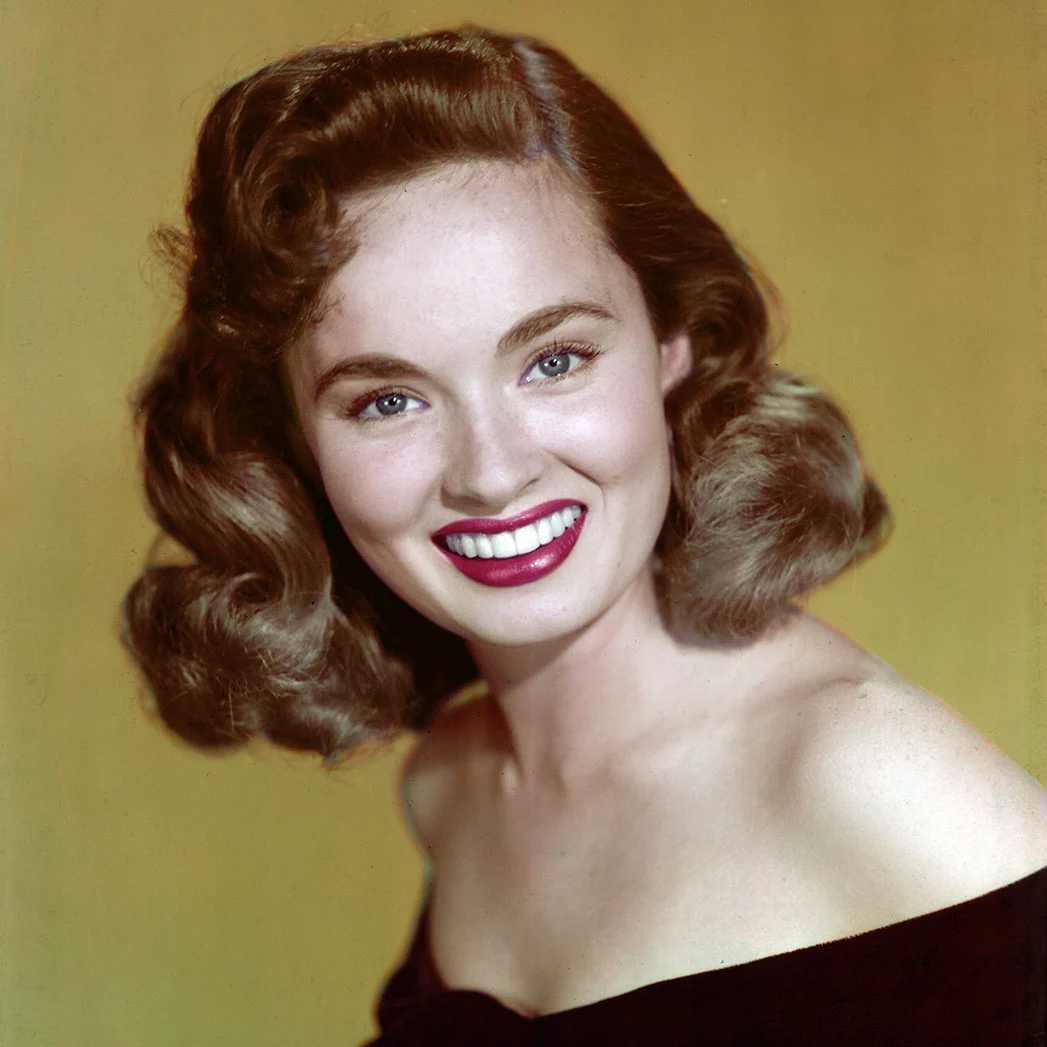
Ann Blyth, the versatile actress and operatic soprano whose career spanned the transition from the height of the studio system to the advent of modern television, has died. She was 98. Her passing, confirmed by George Pennacchio of KABC, marks the loss of one of the final links to Hollywood’s “Golden Age,” a performer who famously held her own against the industry’s most formidable icons while maintaining a quiet, enduring grace.
While she graced the screen in a variety of roles—from musical ingénue to dramatic lead—Blyth remains etched in cinematic history for her chilling, career-defining performance as Veda Pierce, the spoiled, manipulative daughter of Joan Crawford in the 1945 noir masterpiece Mildred Pierce.
A Legacy Defined by “Mildred Pierce”
In 1945, at the age of just 16, Blyth was on loan from Universal Pictures to Warner Bros. for what would become her defining role. The casting of Veda was a high-stakes endeavor; the film was crucial for Joan Crawford, who had recently departed MGM with her reputation in flux. Hundreds of teenagers auditioned for the pivotal role of the demon daughter, yet it was Blyth’s raw, precocious talent that caught Crawford’s eye.
In a rare move that solidified their onscreen chemistry, Crawford insisted on performing the screen test with the young newcomer. "I knew that other people wanted the part as well, but I was the lucky one because Joan Crawford did the test with me, and it made a world of difference," Blyth recounted to The Hollywood Reporter in 2013. "People just didn’t do that—not people of her stature."
The risk paid off. While Crawford famously secured the Best Actress Oscar for her portrayal of the self-sacrificing mother, Blyth earned an Academy Award nomination for Best Supporting Actress. Her performance as the “beautiful brat” who would stop at nothing—even murder—for social standing was lauded as a triumph of psychological depth. The Hollywood Reporter noted at the time, "This Blyth child is exquisite in her understanding of one of the most difficult roles ever written."
A Life of Resilience: From Broadway to the Silver Screen
Born Anne Marie Blythe on August 16, 1927, in Mount Kisco, New York, she was raised in the humble surroundings of Manhattan’s Lower East Side. Her early life was defined by the absence of her father and her mother’s tireless efforts to provide for her and her older sister. By the age of six, Blyth was already performing on radio, reciting poetry and singing, eventually finding her way to the San Carlos Opera Company.
Her talent was evident early on; she was discovered by playwright Lillian Hellman and producer-director Herman Shumlin while in school, leading to a role in the anti-Nazi Broadway drama Watch on the Rhine. She spent her early teenage years touring with the production, an experience that included a dinner at the White House with President Franklin D. Roosevelt.
The Path to Hollywood
Universal Pictures signed the young starlet in 1943, initially viewing her as a rival to their established musical star, Deanna Durbin. This led to a flurry of musical activity in 1944, including Chip Off the Old Block and Babes on Swing Street. However, the shadow of Mildred Pierce loomed large over her early career.
Tragedy nearly derailed her rise just days after the film wrapped. During a sledding trip near Lake Arrowhead, California, a horrific accident resulted in a broken back. Blyth recounted the harrowing experience in a 1954 retrospective: "One minute we were sailing down the hard-packed icy hillside like snowbirds, then there was a crash and I fell on my back with a sickening thud. I didn’t cry out. The feeling was too big for that."
She spent seven months in a body cast and additional time confined to a wheelchair. Demonstrating the grit that would define her career, she made an appearance at the 1946 Academy Awards, wearing a custom-designed gown specifically tailored to conceal her back brace.

Musical Stardom and Genre Versatility
Following her recovery, Blyth transitioned from the dark, brooding melodrama of the 1940s into the vibrant technicolor world of the 1950s musical. Her operatic background made her a natural fit for MGM’s high-budget productions. In 1951, she starred alongside Mario Lanza in The Great Caruso, introducing the world to the classic rendition of "The Loveliest Night of the Year."
Her musical credits continued to grow with Rose Marie (1954), The Student Prince (1954), and Vincente Minnelli’s Kismet (1955). Yet, she refused to be pigeonholed. She displayed range in the gritty prison drama Brute Force (1947) with Burt Lancaster and charmed audiences in the whimsical fantasy Mr. Peabody and the Mermaid (1948).
Her career reached another peak in 1957 with two high-profile biopics: The Buster Keaton Story, where she reunited with her teenage dancing partner Donald O’Connor, and The Helen Morgan Story, in which she played the troubled torch singer opposite Paul Newman.
The Later Years and Cultural Impact
As the studio system began to fracture in the late 1950s, Blyth made a conscious decision to step away from feature films, despite being in consideration for prestige roles like The Three Faces of Eve. She pivoted toward theater, nightclub acts in Las Vegas, and a prolific television career.
To a later generation, she became a familiar face in the 1970s as the maternal figure in a series of ubiquitous commercials for Hostess, where she pitched Twinkies, Crumb Cakes, and Ding Dongs. Her television credits included appearances on Wagon Train, The Twilight Zone—where she played a star who never aged—and Murder, She Wrote.
Personal Life and Family
In 1953, at the height of her fame, Blyth married James McNulty, an obstetrician and brother of singer Dennis Day. The couple shared a life of stability that was rare for Hollywood, raising five children: Timothy, Maureen, Kathleen, Terence, and Eileen. They remained together until McNulty’s death in 2007 at the age of 89.
Blyth’s life was a testament to the idea that one could survive the "Hollywood machine" while maintaining a distinct personal identity. Whether she was the villainous Veda or the operatic soprano, she brought a level of craft and professional integrity that commanded respect from peers and critics alike.
Reflections on a Bygone Era
The loss of Ann Blyth serves as a poignant reminder of the passage of time. As the last of the stars from the 1940s fade, the industry is left to reflect on a period where talent was cultivated through rigorous training and intense, collaborative screen-testing.
Blyth was, by all accounts, a woman of deep substance. Her ability to endure a devastating physical injury at 16, rise to an Oscar nomination, and successfully navigate the treacherous waters of celebrity without losing her sense of self, remains an inspiration. She did not merely play the roles of the era; she helped define them.
In the final assessment, her legacy is not just in the celluloid of Mildred Pierce or the operatic notes of The Great Caruso, but in the quiet endurance she displayed throughout her nearly century-long life. As her contemporaries have all moved on, Blyth remains a permanent fixture of cinematic history—an “exquisite” talent who left an indelible mark on the screen and in the hearts of those who remember the true grandeur of the golden age of Hollywood.


 Suro Senen
 Nana
Nana