Pevita Pearce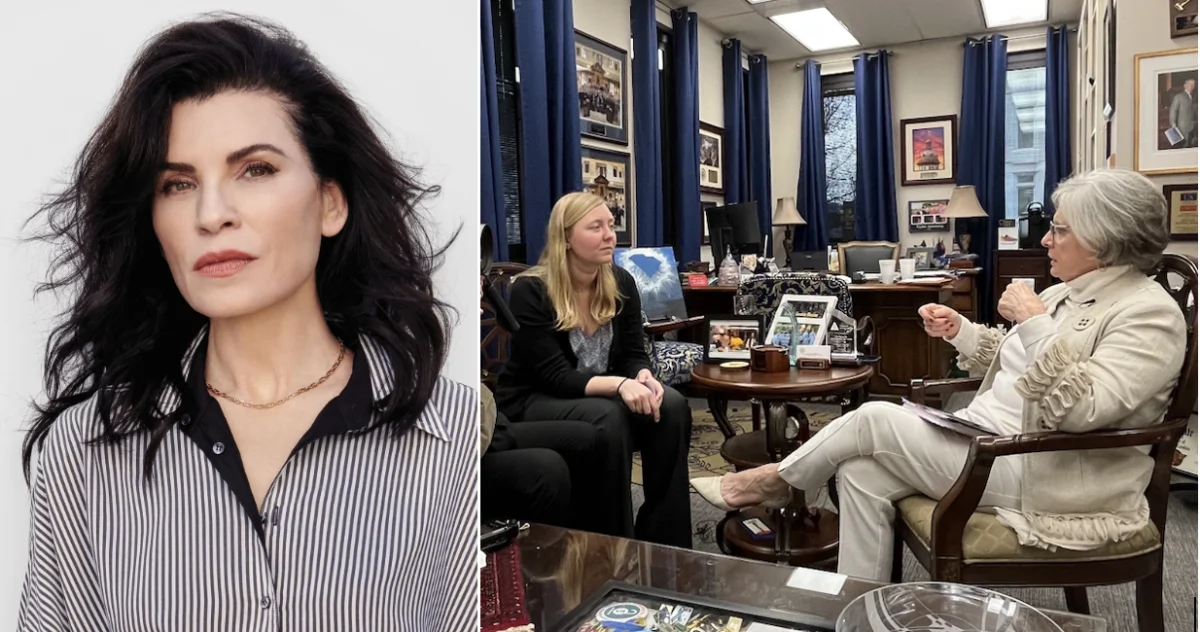
In a political landscape defined by deepening trenches and widening ideological chasms, a forthcoming documentary feature, Sister Senators, promises to provide a rare, fly-on-the-wall perspective into the mechanics of legislative courage. Emmy-winning actress and activist Julianna Margulies has officially signed on as an executive producer for the project, which chronicles the historic, cross-party alliance of five women serving in the overwhelmingly male-dominated South Carolina State Senate.
Directed by acclaimed filmmaker Emily Harrold, the documentary captures the high-stakes maneuverings of a diverse coalition of lawmakers—Republicans Katrina Shealy, Sandy Senn, and Penry Gustafson; Democrat Margie Bright Matthews; and Independent Mia McLeod—who united in a singular, urgent mission: to block a near-total abortion ban in their state. As the film moves through post-production, it stands not merely as a record of a political skirmish, but as a potential blueprint for bipartisan cooperation in an era of intense polarization.
The Genesis of an Unlikely Alliance: Chronology of the Struggle
The narrative of Sister Senators is rooted in the aftermath of the 2022 U.S. Supreme Court decision to overturn Roe v. Wade. The ruling effectively stripped away federal protections for abortion access, returning the authority to regulate or ban the procedure to individual state legislatures. In South Carolina, the push for a total or near-total abortion ban accelerated rapidly, placing the state at the epicenter of the national reproductive rights debate.
The "Sister Senators," as they became known, emerged as an unexpected bulwark against this tide. The chronology of their collaboration began as a pragmatic response to the political realities of the chamber. With only five women serving in the Senate, their influence was statistically marginal, yet their presence became essential as they navigated the complexities of legislative procedure.
The film documents their journey as they leveraged their positions to stall, debate, and ultimately shift the trajectory of proposed bans. By bridging the gap between conservative, progressive, Black, and white legislators, these women defied the standard political script. Their alliance was not born of total ideological alignment—they remain separated by significant differences in policy and philosophy—but rather by a shared recognition of the impact that sweeping, restrictive legislation would have on their constituents and the autonomy of women across the state.
The Power of the Minority: Analyzing the Political Landscape
To understand the significance of Sister Senators, one must first examine the environment in which these women operate. South Carolina’s State Senate is a microcosm of the broader American political climate: male-dominated, increasingly partisan, and resistant to deviation from party lines.
According to the production team, the film captures the "ramifications of their actions in a state and country that has become increasingly partisan." In a legislative body where local media coverage has significantly waned, the ability of these women to command international attention was a strategic triumph. By forcing a dialogue that moved beyond soundbites and into the granular, often exhausting work of committee hearings and floor debates, the group transformed the chamber into a laboratory for political survival.

Supporting data regarding female representation in state legislatures remains a sobering backdrop for this narrative. While women have made gains in legislative participation, the transition from "token" representation to meaningful, structural influence is slow. The Sister Senators case study serves as a poignant reminder that numerical parity is only the first step; the true measure of legislative effectiveness lies in the ability to form coalitions that can transcend the artificial barriers of party affiliation.
Official Responses and Creative Vision
The decision by Julianna Margulies to join the project marks a significant endorsement of its cultural and political importance. Best known for her iconic roles in ER and The Good Wife, Margulies has increasingly pivoted toward documentary work that centers on human resilience and justice.
"After seeing just a few minutes of footage from this project, I knew I had to do anything I could to be involved," Margulies stated in an official release. She underscored the gravity of the current moment, noting, "At a moment when women’s rights are being trampled upon, we need examples of powerful women who are willing to put people before partisan politics. How can 41 men decide what a woman can and cannot do with her own body? Without women in legislative bodies, how can we protect ourselves? We must have female voices defending our rights."
Director Emily Harrold, whose previous work includes Meltdown in Dixie and While I Breathe, I Hope, has spent months embedding herself within the lives of these five senators. Her directorial approach emphasizes intimacy, moving away from the typical "talking head" documentary style in favor of an immersive, observational aesthetic.
"Having Julianna join this project means the world to us," Harrold said. "She brings a passion for telling complex, nuanced stories of women fighting against immeasurable odds. We’re so excited to be working with her to bring this project into the world."
The production team also includes producer Robin Hessman, who recently served as an executive producer on the Oscar-winning documentary Mr. Nobody Against Putin. The depth of experience behind the camera suggests that Sister Senators will be as much a masterclass in documentary storytelling as it is a political exposé.
Implications for Democracy and Representation
The implications of Sister Senators extend far beyond the borders of South Carolina. The film challenges the audience to consider the "blueprint" of modern governance. As local newspapers continue to shutter and social media algorithms drive citizens toward increasingly radicalized echo chambers, the ability of elected officials to act in good faith across the aisle is often dismissed as a relic of a bygone era.

By focusing on the "Sister Senators," the documentary asks a foundational question: What happens to democracy when the people in power refuse to communicate with their opposition? The film posits that the answer is stagnation and the loss of individual rights. Conversely, the work of these five women suggests that when representatives are forced to look their colleagues in the eye—and recognize the humanity of those who disagree with them—they can occasionally produce results that defy the expectations of their respective party leaderships.
The film’s producers describe the project as "a story about gender equity, women’s leadership, and democracy." It is a narrative that highlights the "ground zero" nature of state legislatures, where the most consequential battles for the future of the United States are currently being fought. In these rooms, far from the national spotlight of Washington, the granular decisions that define daily life are made.
Conclusion: A Testament to Persistence
As Sister Senators nears completion, it stands as a testament to the persistence of individuals in a system designed for their exclusion. For Julianna Margulies and the entire production team, the project is more than just a piece of journalism; it is a call to action. It serves as a reminder that the democratic process is not a passive system, but one that requires the constant, active intervention of those willing to risk their political standing for the sake of principle.
The collaboration between Republican, Democratic, and Independent women in the South Carolina State Senate provides a rare glimmer of hope. It suggests that even in a climate of intense hostility, the human capacity for cooperation remains a potent, if underutilized, tool for change. Whether or not the model established by these five women can be replicated elsewhere remains an open question—one that the documentary invites its audience to explore, debate, and ultimately answer for themselves.
With the film currently in early post-production, viewers can expect an unfiltered look at the halls of power in South Carolina. The story of the Sister Senators is not just about a single legislative session or a specific abortion bill; it is a story about the endurance of the female voice in the American political experiment. In the words of the production team, the film is "a blueprint for what true collaboration looks like when politicians put principles over parties," and it arrives at a time when that lesson is perhaps more vital than ever.


 Suro Senen
 Nana
Nana