Muslim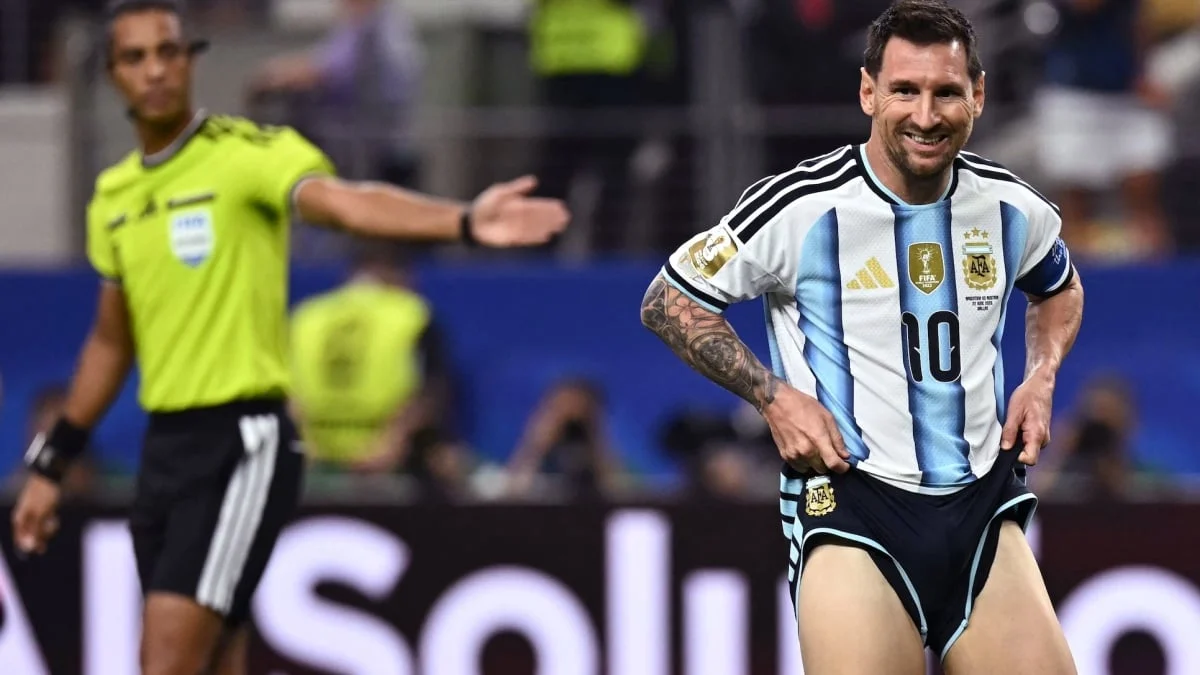
In a career defined by superlatives, Lionel Messi has once again redefined the boundaries of footballing greatness. Just days shy of his 39th birthday, the Argentine maestro delivered an early gift to his nation and to the sport itself, officially ascending to the summit of the FIFA World Cup all-time goalscoring list. With a dramatic, late-game brace against Austria, Messi surpassed German legend Miroslav Klose to claim the title of the most prolific marksman in the history of the tournament, cementing a legacy that has spanned nearly two decades.
The Milestone: A New Peak in an Illustrious Career
The stage was set for history as Argentina faced Austria in a high-stakes fixture. Entering the match, Messi stood at 16 World Cup goals, needing just one to tie and two to overtake Miroslav Klose’s long-standing record of 17. The tension was palpable; every touch of the ball by the Argentine captain was met with a mixture of anticipation and reverence from the stadium crowd.
The breakthrough came with characteristic flair, but it was the conclusion of the match that will be etched into the annals of football history. With the clock ticking deep into stoppage time and the match hanging in the balance, Messi found the back of the net for the second time, pushing his career World Cup tally to 18. This 18th goal was not merely a statistic; it was a defiant statement of longevity and skill. By surpassing Klose—whose record had stood since the 2014 tournament—Messi has arguably closed the book on one of the most significant statistical debates in modern football.
Chronology of a Record-Breaking Night
The match was a rollercoaster of emotions for the Argentine faithful. Early in the proceedings, Messi demonstrated his human side, missing a penalty kick that silenced the stadium. This miss was significant in its own right, marking the third time in his World Cup career that he has failed to convert from the spot—a unique record that highlights both his immense volume of play and the unrelenting pressure placed upon his shoulders.
Social media was quick to react to the miss, with many fans engaging in a lighthearted debate over whether the "GOAT" (Greatest of All Time) simply refused to claim such a monumental record through a penalty kick, preferring instead to secure it through open play.
The momentum shifted in the second half. As the match progressed, Messi’s movement off the ball became sharper, and his interplay with teammates intensified. As the game entered the dying minutes, a precise buildup allowed Messi the space he needed to strike. When the ball crossed the line in the final moments of added time, the stadium erupted. Google mirrored the global celebration, as a search for "Messi" triggered a cascade of virtual confetti across user screens, a digital salute to a living legend.
Supporting Data: The Anatomy of a Record
To understand the magnitude of Messi’s 18 goals, one must look at the historical context of the World Cup. For years, Miroslav Klose’s record of 17 goals was viewed as a "mountain" that might never be climbed. Klose, a clinical finisher who relied on positioning and opportunistic play, represented a specific era of efficiency.
Messi’s path, however, has been one of evolution. Starting as a raw, explosive winger in 2006, he has transitioned into a deep-lying playmaker and a ruthless clinical striker. His 18 goals have come across multiple tournaments, demonstrating a level of consistency that is statistically unprecedented.
| Player | World Cup Goals |
|---|---|
| Lionel Messi (ARG) | 18 |
| Miroslav Klose (GER) | 17 |
| Ronaldo Nazário (BRA) | 15 |
| Gerd Müller (GER) | 14 |
| Kylian Mbappé (FRA) | 14 |
The inclusion of Kylian Mbappé in the top echelon of current goalscorers adds a layer of narrative intrigue to the record. With 14 goals, the young French superstar is currently on the fastest trajectory in history. Should Mbappé maintain his current form, the footballing world may find itself watching another "race to the top" in the coming years. Yet, for now, the throne belongs to Messi.
The Psychological and Tactical Implications
The discourse surrounding Messi’s performance often transcends mere goals. Fans have noted a curious repetition in his play—his ability to score the "same goal" multiple times, a testament to his tactical mastery. By identifying specific zones of the pitch where he is most effective, Messi has optimized his output to a degree that makes his predictability irrelevant; even when defenders know what is coming, they cannot stop it.
His height—a modest 5 ft. 7 in.—is frequently cited as a point of inspiration. In a sport increasingly dominated by physical specimens and athletic giants, Messi’s reliance on center of gravity, vision, and ball control serves as a powerful counter-narrative. He is not the most physically imposing player on the pitch, yet he is, statistically, the most impactful.
Official Responses and the "Mbappé Factor"
The sporting world has been unified in its praise. Even his fiercest on-pitch rivals have been quick to acknowledge the shifting of the guard. Kylian Mbappé, who is often positioned as Messi’s successor, has been remarkably humble in the wake of the record. Recent reports highlight Mbappé’s public admiration for the Argentine, with the Frenchman going as far as to label Messi the superior player—a sentiment that speaks volumes about the respect commanded by the 39-year-old.
The prospect of an Argentina vs. France World Cup final, pitting the record-breaking veteran against his high-scoring heir, has become the "dream scenario" for football fans globally. Such a match would not only be a clash of nations but a symbolic passing of the torch, framed by the two most potent scorers in the tournament’s history.
Legacy and Future Outlook
As Messi approaches his 39th birthday, questions regarding his retirement naturally arise. However, if this recent performance is any indication, he has no intention of fading into the background. The hunger that propelled him to 18 goals remains undiminished.
The implications of this record are profound. It shifts the baseline for what future generations of players will be expected to achieve. To be considered among the greats, one must now look at the "Messi Benchmark." He has transformed the World Cup from a mere competition into a stage where he has performed a career-long performance piece on the limits of human capability.
Whether or not one subscribes to the "GOAT" debate, the numbers are objective. Lionel Messi has conquered the world’s most difficult tournament, not just with a single burst of brilliance, but through two decades of relentless, intelligent, and masterful football.
As we look toward the remainder of the tournament, the focus remains on the man in the number 10 shirt. He has given his fans the gift of history, and as the confetti settles—both on Google and in the hearts of his supporters—one thing is certain: we are witnessing the final, most glorious chapters of the greatest story ever told in the world of sport.
Final Reflections
The atmosphere in the stadium following the record-breaking goal was one of pure, unadulterated awe. Fans who had traveled across the globe were joined by those watching in cafes, living rooms, and on mobile screens, all tethered to the same moment of realization. Records in sports are meant to be broken, but some records carry a weight that goes beyond the ink on a stat sheet. Messi’s 18th goal represents a bridge between the legends of the past and the possibilities of the future.
As the footballing community digests this achievement, the narrative now shifts to what comes next. Can Messi extend his lead? Will Mbappé catch him? Or will this be the definitive moment of the 2026 era? Regardless of the answers, the record is set. Lionel Messi has done more than just score goals; he has authored a legacy that will be debated, analyzed, and celebrated for as long as the game is played.


 Neng Nana
 Siti Muinah