Raul Delapena Setiawan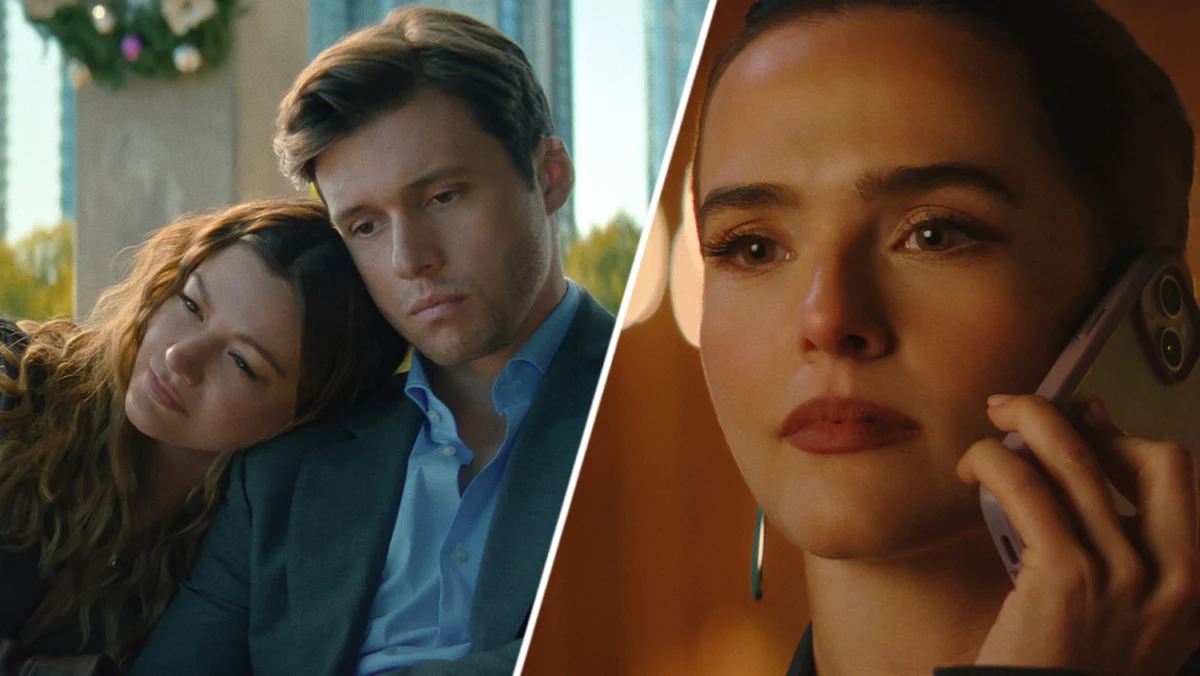
The romantic comedy has long been defined by its rigid structural integrity—the meet-cute, the misunderstanding, the grand gesture, and the inevitable reunion. Yet, beneath the familiar architecture of the genre, some films harbor a decade’s worth of personal history, creative evolution, and sheer perseverance. Voicemails for Isabelle, the latest directorial effort from multifaceted filmmaker Leah McKendrick, is one such project. Now streaming on Netflix, the film arrives after an eight-year odyssey, transforming from a screenplay that lived on the prestigious Black List to a vibrant, emotional, and deeply personal feature film.
The Genesis of a Story: From Script to Screen
At its heart, Voicemails for Isabelle is a poignant exploration of grief, connection, and the unexpected ways we hold onto those we have lost. The narrative centers on Jill, played with characteristic charm by Zoey Deutch. A woman with dreams of culinary greatness in San Francisco, Jill finds herself trapped as a prep cook under the thumb of a volatile boss, Chef Bastien (Nick Offerman).
Jill’s emotional anchor is her sister, Isabelle (Ciara Bravo), who has lived with cystic fibrosis since childhood. Their bond is maintained through a constant stream of phone calls—Jill reporting the absurdities of her professional life and the highs and lows of her dating world. The narrative shifts abruptly when Isabelle passes away. In a cruel twist of technological fate, her phone number is reassigned to the work cell of Wes (Nick Robinson), a real estate agent based in Jill’s hometown of Austin, Texas. Wes, initially unaware of the previous owner’s tragedy, begins to listen to these voicemails, eventually becoming a silent, supportive observer of Jill’s life, eventually orchestrating an in-person meeting under the guise of a business trip.
The script, which earned six votes on the 2019 Black List, was never intended to be a mere exercise in genre tropes. For McKendrick, it was a deeply personal excavation of her own life. "To me, the Black List was something that happened to the big writers, the fancy writers," McKendrick shared in a recent interview. "I’ve always viewed myself as an actor that writes, a singer that writes. I had a lot of imposter syndrome. But I knew I had written this straight from my heart. It was the film I wanted to see—authentic to me and my sister."
A Chronology of Creative Evolution
The journey from page to screen was anything but linear. When McKendrick first penned the script, she was an emerging voice in the industry, and the project served as her first sold feature. Over the course of eight years, the script underwent significant transformations, particularly after Netflix boarded the project.

Originally, the story was slated to take place in the dual epicenters of Los Angeles and New York. However, as the production team refined the vision, the geographical stakes shifted. McKendrick, who is known for her work on Scrambled and as an actress in I Know What You Did Last Summer, insisted on locations that would function as characters themselves. "Everything I write has to be personal for me to latch on," she explained. "When Netflix suggested moving away from LA and New York, I fought to bring in my own aesthetic. I wanted a city that felt like a character—like Sleepless in Seattle. I fought for the iconic San Francisco spots: Fisherman’s Wharf, Golden Gate Park, Battery Spencer. It was a logistical nightmare, but it was necessary for the soul of the film."
The casting process also saw evolution. Initially, Hailee Steinfeld was attached to play the role of Jill, who was then envisioned as an aspiring television writer hoping to break into the world of Shonda Rhimes. As the project pivoted toward the culinary world and McKendrick took the director’s chair, the search shifted to Zoey Deutch. Deutch, a veteran of food-centric rom-coms like Set It Up and Something From Tiffany’s, brought a specific groundedness to the role of a woman struggling with the "culinary waterboarding" of a high-pressure kitchen.
Supporting Data: The Craft Behind the Comedy
One of the most distinct elements of Voicemails for Isabelle is its commitment to specific, visceral detail. The inclusion of the kumquat as a recurring, antagonistic motif in the kitchen is a testament to McKendrick’s research. Seeking to capture the specific misery of a low-level prep cook, she consulted Robbeen Martin, a real-life pastry chef and friend of her sister.
"I asked him, ‘What is a job that is like culinary waterboarding?’" McKendrick recalled. "He told me, ‘Kumquats. They’re the worst.’ It was so visual, so beautiful, and it didn’t require the audience to be a chef to understand the frustration."
This attention to detail extends to the film’s "Easter eggs," which serve as nods to the actors’ previous works. Nick Robinson’s jean jacket, for instance, is a subtle callback to his breakout role in Love, Simon. These references are not just for show; they are part of a broader, meta-textual conversation between the filmmaker, the cast, and the audience, establishing a sense of shared pop-culture DNA.

Official Responses and Musical Integration
Perhaps the most ambitious aspect of the production was the music supervision. For McKendrick, the songs were not "needle drops" meant to fill silence; they were narrative drivers. The use of Taylor Swift’s "Marjorie"—a song about the artist’s late grandmother—was a point of personal passion for the director.
"I write my scenes to my songs," McKendrick noted. "When I was at the Eras Tour, I cried holding other fans during that song. It was a spiritual experience. I wrote a letter to Taylor explaining that, for this scene regarding my sister’s death, there was no other song. It had to be that one. Luckily, Netflix was full of Swifties who supported the fight."
A similar approach was taken with Robyn’s "Dancing On My Own." McKendrick created a deck and wrote a letter to the artist, explaining that Robyn was, in effect, a character in the film. The result is a climactic, spontaneous-feeling dance sequence that captures the raw, kinetic energy of the characters—a scene that famously had only one take to be captured before the sun set.
Implications: The Future of the Rom-Com
Despite comparisons to other films with similar conceits, such as Love, Again, McKendrick is confident in the unique perspective of her film. "People latch on to the romance, and that exists 100%," she said. "But at its core, this is about sisterhood and family. It’s about realizing that your soulmates can be found in a variety of places."
The success of Voicemails for Isabelle has solidified McKendrick’s reputation as a director with a distinct, empathetic voice. Her next project, a biopic of country music icon Shania Twain for Sony Pictures, promises to bring that same level of reverence and "pure love" to a new subject.

"When you’re bringing an icon’s story to the screen, you have to see them as a human being," she said of the upcoming project. "I feel very close to Shania—to Eileen, the woman behind the name. I’m ready for the challenge. I think it’s going to blow the fans’ minds."
As Voicemails for Isabelle continues to find its audience on Netflix, it serves as a reminder that the best stories are often those that take the longest to tell. By leaning into the personal, the specific, and the deeply felt, McKendrick has managed to inject fresh life into the romantic comedy, proving that even a "formula" can be a masterpiece when it is composed with the right amount of heart.

 Asep Darmawan
 Layla Zulfa