Laily UPN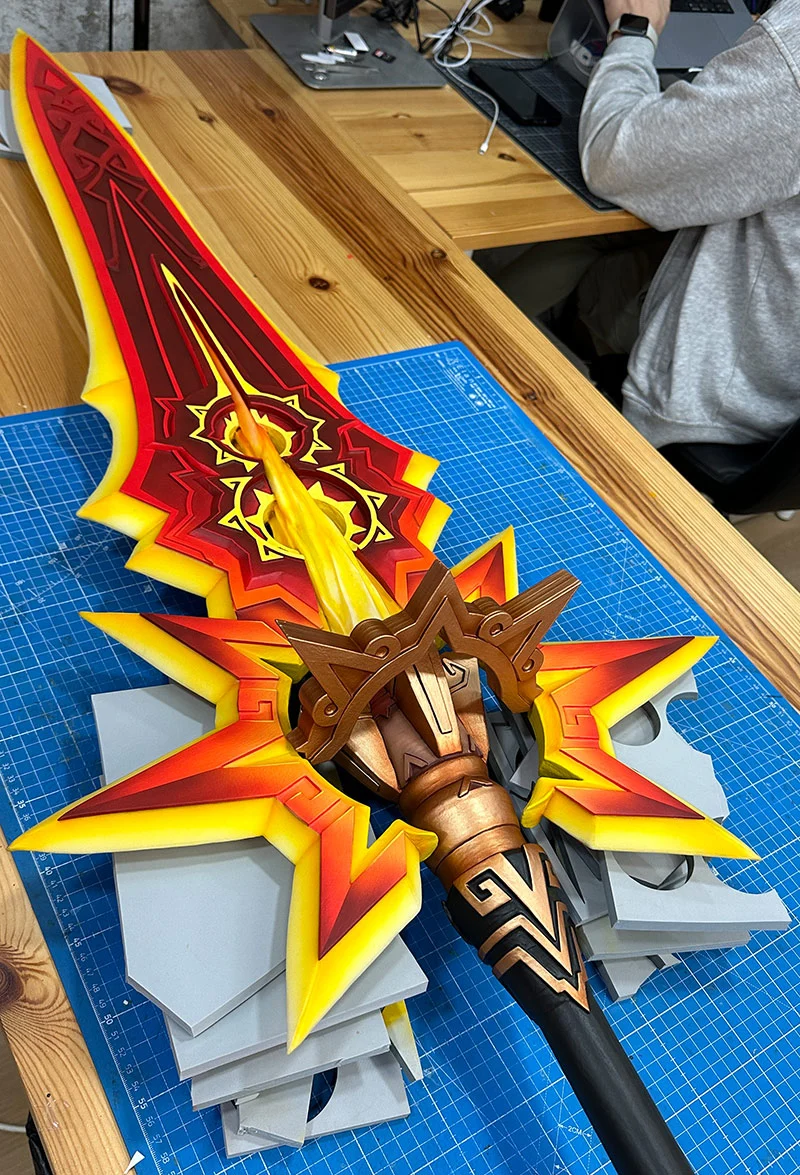
In the high-stakes world of professional cosplay, where character designs often push the boundaries of physics, translating a 3D digital asset into a tangible, light-up prop is the ultimate test of craftsmanship. Recently, renowned creator Kamui Cosplay took on the monumental challenge of recreating "A Thousand Blazing Suns," the iconic greatsword wielded by Mavuika, the Fire Archon from HoYoverse’s global phenomenon, Genshin Impact.
This project, spurred by an official collaboration with HoYoverse, represents a bridge between fan-driven passion and professional industry promotion. By blending advanced EVA foam fabrication, complex micro-controller programming, and high-stakes airbrushing, the final build serves as a masterclass in modern prop-making.

The Genesis of a Legend: Project Scope and Collaboration
The intersection of hobbyist enthusiasm and professional demand is where the most compelling cosplay work emerges. For Kamui, the allure of the Fire Archon was immediate. “Cosplay is all about combining passions,” they note. “I’m a huge fan of Genshin Impact, love working with EVA foam, and always enjoy adding as many LEDs as possible.”
The synergy between the creator and the publisher was serendipitous. HoYoverse approached Kamui to develop creative promotional content for Mavuika’s debut in the game. This provided the perfect impetus to tackle the sword, a weapon defined by its massive scale and intricate, burning aesthetic. While past projects like Yelan and Beidou showcased technical proficiency, the Mavuika build demanded a new level of ambition, particularly regarding its lighting and structural integrity.

Chronology: A Four-Phase Construction Journey
Phase I: The Blueprint and Digital Forensics
Before a single sheet of foam was cut, the foundation was laid in the digital realm. Precision is paramount in large-scale prop making, and for this project, Kamui utilized official 3D assets provided by HoYoverse via aplaybox.com.
Navigating the intricacies of 3D model acquisition—often involving Chinese-language interfaces and the utility of translation software—is a standard hurdle for modern prop-makers. These models are vital for establishing accurate proportions. However, "accuracy" does not always mean "1:1 scale." Kamui opted to scale the sword down from its gargantuan in-game appearance to a more manageable two-meter length. This decision highlights a crucial aspect of professional cosplay: functionality and visual weight. A sword that follows the character’s in-game proportions would be functionally impossible to maneuver, whereas a two-meter version maintains the "heroic" look while remaining practical for the wearer.

Phase II: Foam Architecture and Structural Core
The physical build began with structural integrity. Because the sword features a "rocket-engine" central core that glows with intense heat, the internal architecture had to be robust enough to hold the weight while concealing a PVC pipe skeleton.
Using 10mm high-density EVA foam, Kamui constructed the core, ensuring it could withstand the torque of a two-meter prop. The process involved layering the foam to create the aggressive, angular silhouette characteristic of Natlan’s design language. For the edge-lighting, Kamui utilized specialized light-diffusing foam, a critical material choice that ensures the LED glow is soft and consistent rather than harsh and pixelated.

Phase III: The Electronic Heart
Electronics are where a prop transitions from a static statue to a cinematic piece. To achieve the pulsing fire effect, Kamui employed a sophisticated setup centered on the Adafruit Feather M4 Express and a Prop-Maker FeatherWing.
With nearly 300 addressable RGB pixels embedded throughout the blade, the complexity of the wiring was significant. All power management, micro-controllers, and battery systems were hidden within the sword’s grip. The standout feature is the "impact trigger"—a custom code that shifts the sword’s animation from a standard pulsing fire effect to a brilliant white flash upon striking the ground. This level of interaction turns the prop into a performance piece, elevating it far beyond a simple costume accessory.

Phase IV: The Marathon of Color
The final phase, and perhaps the most stressful, was the paint job. Working with husband and collaborator Benni, the pair opted for airbrushing to achieve the vibrant, metallic gradients required by the weapon’s design.
This phase was a logistical challenge. Painting with an airbrush requires layering, which necessitates masking off sections with tape. Because the paint layers were sensitive, the tape could only remain on the prop for a maximum of 12 hours before risking damage to the finish. Given the sword’s surface area, this created a race against time. The duo worked for twelve hours straight, finishing at 6:00 AM, before hand-painting the final fine details with high-pigmentation acrylics.

Technical Specifications and Supporting Data
For those looking to replicate the quality of this build, the technical requirements are substantial. Kamui highlights several key pieces of equipment that define the modern "pro-cosplay" workflow:
- Fabrication: 10mm high-density EVA foam and light-diffusing LD45 LED foam.
- Precision Cutting: A C02 laser cutter (xTool S1 40W) was utilized for complex geometry, though the creator notes that the need for vector-file preparation makes this a high-effort, high-reward alternative to traditional hand-cutting.
- Electronics: Adafruit NeoPixel strips (300 pixels total) controlled by a Feather M4 Express.
- Finishing: Vallejo Model Air metallic paints applied via an Iwata Eclipse HP-CS airbrush.
The use of these tools underscores a shift in the hobby: from "crafting" to "digital manufacturing." By integrating laser-cutting and custom code, the barrier to entry is higher, but the ceiling for quality is essentially non-existent.

Official Industry Implications
The collaboration between Kamui and HoYoverse signals a growing trend in the gaming industry: the formalization of "Cosplay Marketing." Rather than treating cosplay as a grassroots community activity, publishers are increasingly viewing it as a vital pillar of their content strategy.
By commissioning high-fidelity props and videos, HoYoverse gains high-quality assets that translate the digital fantasy of Genshin Impact into the real world, generating significant social media engagement and organic reach. For the creator, these partnerships provide the financial stability and resources to attempt projects that would be cost-prohibitive for a casual hobbyist. It represents a professionalization of the craft where the output is treated with the same reverence as official marketing materials.

Conclusion: The Value of "Good Enough"
The final result, "A Thousand Blazing Suns," stands as a testament to the idea that perfection is not always about mathematical accuracy. While the sword is smaller than the in-game model, its presence and interactivity make it a superior prop for real-world display.
As Kamui aptly puts it: "It’s far more important to be happy with your piece than to create something perfectly scaled to the insane proportions of a fictional character." This philosophy serves as a guiding light for the cosplay community, encouraging creators to prioritize their own vision and the joy of the build over the rigid constraints of a digital source file. Whether through the pulse of 300 LEDs or the meticulous gradients of an airbrushed finish, the sword is more than just a prop—it is a bridge between the virtual world of Natlan and the tangible creativity of the real world.

 Siti Muinah
 Azzam Bilal Chamdy