Muslim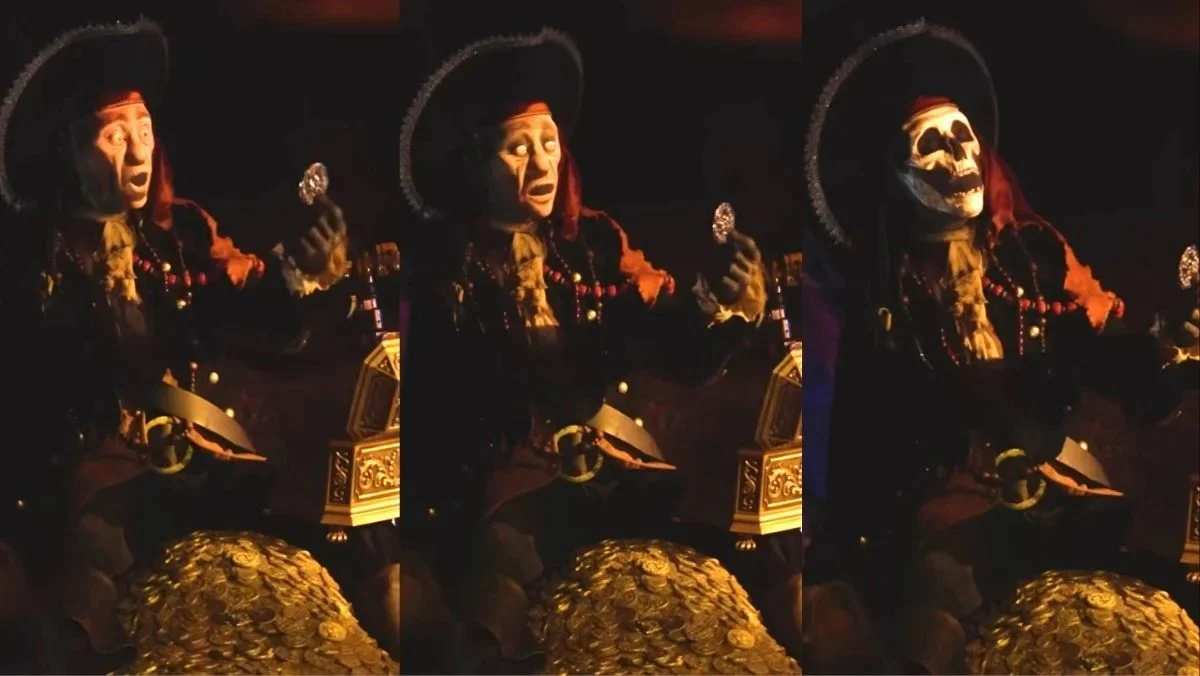
Disneyland’s Pirates of the Caribbean has long served as the gold standard for dark ride storytelling. Since its debut in 1967, the attraction has defined the theme park experience, transporting millions of guests into a swashbuckling world of debauchery, treasure, and high-seas adventure. However, even the most legendary attractions require evolution to remain relevant in an era of rapid technological advancement. Following an extensive, months-long refurbishment, the ride has reopened with a technological marvel that marks a seismic shift in how Walt Disney Imagineering approaches its craft: the integration of real-time front projection onto a traditional, articulated mechanical head.
The Main Event: A Cursed Transformation
For those who have navigated the grotto room of Pirates of the Caribbean countless times, the skeleton pirate guarding his mountain of gold has become a fixture of the ride’s atmosphere. Previously a static, albeit iconic, skeleton, this figure has been completely reimagined. Guests now encounter a dynamic, breathing, and shifting character that brings a dark, supernatural narrative arc to a previously silent scene.
The effect is hauntingly seamless. As guests drift past, they witness the pirate clutching a cursed piece of Aztec gold. As he holds the coin, his flesh begins to wither away, transforming him into a ghastly, skeletal specter before he abruptly drops the treasure and returns to human form. This cycle of greed and damnation repeats, offering a narrative "story-within-a-story" that adds a layer of depth to the ride’s existing lore. This is not merely an aesthetic update; it is a fundamental change in how the ride interacts with its audience.
Chronology of Innovation: From Mechanical Puppets to Digital Hybrids
To understand the significance of this update, one must look at the evolution of Disney’s audio-animatronics (AA).
- 1963–1967: The Birth of the Audio-Animatronic. The technology began with the Enchanted Tiki Room and culminated in the sophisticated systems seen in the original Pirates of the Caribbean. These figures relied on pneumatic and hydraulic actuators to move, with voices synced to physical mouth movements.
- 1980s–2000s: The Era of Refinement. During this period, Imagineers focused on fluid movement, implementing more complex control systems and synthetic skin materials to make the robots appear more lifelike.
- 2010s: The Projection Era. As digital technology advanced, Disney began experimenting with front-projected faces on static surfaces. While cost-effective, this approach often resulted in a "flat" look that lacked the physical presence of a true animatronic.
- 2024–2025: The Hybrid Milestone. The current refurbishment represents the convergence of these two paths. By marrying the physical weight and mechanical movement of a traditional AA with the expressive, real-time flexibility of digital projection, Disney has bypassed the "uncanny valley" that plagued earlier projection attempts.
The Mechanics Behind the Magic: Technical Specifications
The ingenuity of this new system lies in its patent-pending synchronization technology. Unlike previous projection systems that relied on a static canvas, the new pirate’s head is a complex, sculpted mechanical structure.

The Unreal Engine Integration
At the heart of the system is the integration of Epic Games’ Unreal Engine. By utilizing a game engine in real-time, Imagineers can map facial expressions, skin texture changes, and skeletal transitions with frame-perfect accuracy. The engine renders the visual effects in real-time, allowing the pirate to react to his own cycle of greed.
Synchronization and Invisible Markers
The most significant technical hurdle in projection mapping—especially on a moving object—is calibration. To solve this, Imagineers have embedded invisible markers across the mechanical head. While undetectable to the human eye, these markers provide constant spatial data to the control system, ensuring that the projection remains locked onto the physical structure regardless of the head’s position or the speed of the animation. Furthermore, a redundant backup system has been integrated into the ride’s infrastructure, ensuring that should the primary rendering node fail, the figure continues to function without breaking the immersion for guests.
Supporting Data: Why This Beats Traditional Projections
The industry has been divided on the effectiveness of facial projection. In recent years, Disney has faced mixed feedback regarding this technology:
- The "Flat" Problem: At attractions like Frozen Ever After, the reliance on projection onto flat surfaces led to complaints that the characters looked like video screens rather than living beings. This eventually prompted a pivot back to more traditional, physical animatronics.
- The Hybrid Solution: The new Pirates figure addresses the "depth" issue. Because the projection is cast onto a sculpted surface, the light interacts with the physical contours of the nose, cheekbones, and brow. This creates genuine shadows and depth, making the transformation from flesh to bone appear physically tangible.
Official Responses and Industry Implications
While Walt Disney Imagineering has been tight-lipped regarding the exact proprietary details of the patent, internal sources suggest that this technology is intended to be a "scalable platform."
"We aren’t just updating a ride; we are building a new storytelling language," said a spokesperson close to the project. "The ability to have an animatronic that can age, show pain, or shift between states of being without requiring a total mechanical overhaul opens up possibilities for every attraction in our portfolio."
The implications for the theme park industry are vast. Historically, changing a character’s expression or narrative beat in an attraction required a physical rebuild of the animatronic face. With this new technology, Disney could theoretically update the "performance" of a character via software, allowing for seasonal variations, different dialogue, or evolving story beats without shutting down an attraction for months of physical construction.
The Future of Storytelling
The success of the cursed pirate signals a shift in the philosophy of the "Disney magic." By embracing digital tools to enhance physical artistry rather than replacing it, Imagineers have bridged the gap between the tactile, nostalgic charm of the 1960s and the boundless potential of modern computing.
As guests continue to cycle through the grotto, witnessing the doomed pirate’s eternal, tragic loop, they are seeing more than just a clever visual trick. They are seeing the next fifty years of theme park design. The "cursed coin" may be the object of the pirate’s greed, but for Disney, the real treasure is the ability to keep their classic stories alive, dynamic, and perpetually surprising for generations to come.
This is, undeniably, just the first of many figures to receive this transformative upgrade. Whether it be the Haunted Mansion, Jungle Cruise, or future E-ticket attractions, the marriage of Unreal Engine and mechanical engineering has officially set sail, and the horizon looks brighter—and more haunting—than ever before.


 Siti Muinah
 Azzam Bilal Chamdy