Layla Zulfa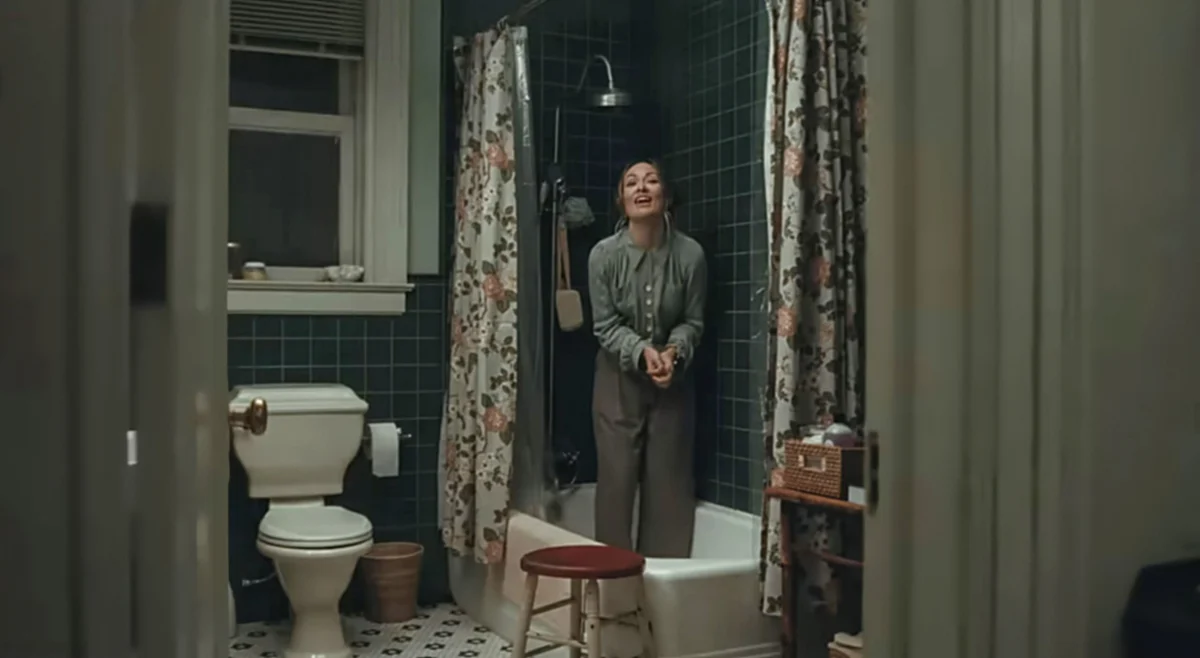
Unless you are comfortably ensconced in the gilded, detached "wealth porn" of Succession, most living spaces act as a silent protagonist, narrating the internal lives of their inhabitants. For production designer Jade Healy, creating the interiors for Olivia Wilde’s latest feature, the charming yet razor-sharp sex comedy The Invite, was less about aesthetic curation and more about deep-dive character psychology.
"I became a version of Angela [Wilde’s character], designing and decorating this apartment," Healy told IndieWire. The result is a pre-war San Francisco apartment that serves as the crucible for the film’s central conflict—a space that feels not just lived-in, but actively fraying at the seams alongside the marriage of its tenants.
The Foundation: Building a Mirror of Inner Turmoil
The apartment, built entirely as a set, was born from a combination of San Francisco location scouting and the modern, digital-age ritual of scouring Zillow listings. The narrative stakes are high: Angela, a former artist who sacrificed her career to become a stay-at-home mother, shares this space with her husband, Joe (Seth Rogen), a once-vibrant punk musician now reduced to a burnt-out music teacher.
Healy’s mission was to ensure the set didn’t merely exude "fraying millennial comfort" but functioned as a physical manifestation of the couple’s eroding bond. We are introduced to them on a high-tension Friday night, as they open their home—fresh from months of arduous, budget-strained renovations—to an enigmatic couple from upstairs: Pína (Penélope Cruz), a therapist, and Hawk (Edward Norton), a firefighter.

"It was really fun to think, ‘Who is she? What did it look like before? What is she constantly redoing in her house? Pillows, curtains?’" Healy pondered.
To achieve an authentic, lived-in feel on a single-income budget, Healy eschewed the pristine pages of high-end interior design magazines. Instead, she leaned into the messy, maximalist reality found on Instagram accounts where ordinary women document their own DIY projects. "I was really more interested in people who design with a personal touch," she explained.
Chronology of a Domestic Set
The construction of The Invite’s world was a deliberate, layered process. Healy’s methodology relied on the philosophy that a set must be a sensory environment for the actors. By sourcing vintage items—including a specific, period-appropriate toilet—from Facebook Marketplace, she grounded the space in a reality that felt attainable yet exhausted.
The Creative Process
- Conceptualization: Healy developed a lookbook and physical models to establish the "Angela" aesthetic—a woman desperately trying to control her environment as her professional and personal identity slipped away.
- The "Marketplace" Aesthetic: By utilizing platforms like Facebook Marketplace, the design team ensured that every item felt like a "find" rather than a catalogue purchase, emphasizing the financial constraints of the couple.
- The Floor Plan Pivot: In a departure from the original script, Healy and Wilde decided against an open-concept floor plan. By creating defined rooms, they physically enforced the distance between Angela and Joe, making the space feel like a collection of separate islands rather than a cohesive home.
- The Final Touches: The set was finalized just as the cameras were set to roll, with the intention that the physical environment would be the "last piece of information" the actors received before stepping into character.
Supporting Data: The Geography of Disconnect
The brilliance of the design lies in the rooms that weren’t curated with the same desperate energy as the rest of the home. Healy identified two distinct areas that remain in a state of purgatory: Joe’s study and the master bedroom.

Joe’s study is a claustrophobic repository of his musical past, a cramped space that houses his failed ambitions. Conversely, the bedroom is a study in "negative space." It is the only room in the apartment that feels unfinished, with paint samples languishing on the wall.
"I just wanted that feeling when you go into the bedroom that she’s worked on every other aspect of the apartment, but the bedroom is just kind of ‘bleh,’" Healy noted. "A wall with nothing on it says something." It is a visual shorthand for a marriage where the intimacy has reached a point of total stagnation.
The Cinematographic Collaboration
Healy’s work was inextricably linked to the vision of Director of Photography Adam Newport-Berra. The production designer specifically aimed for "frames within frames," a technique that allowed the camera to isolate the characters.
"I knew that allowed him to separate the characters and move from one room to the other, dividing Joe and Angela by doorways, dividing them by rooms, even dividing them through the reflections in mirrors," Healy explained.

The synergy between the set and the lens was further heightened by the decision to shoot on 35mm film. "I don’t think that the relationship between set design and shooting on film is discussed enough," Healy said. According to her, the grain and texture of film stock provide a lived-in, organic quality that is notoriously difficult to replicate in the digital realm. This choice forced the art department to prioritize reality over "screen-ready" polish, ensuring that every scuff on the floor and every faded curtain felt historically accurate to the characters.
Official Responses and Creative Synergy
The collaboration between Jade Healy and Olivia Wilde was, by all accounts, a masterclass in professional alignment. Having worked on numerous projects, Healy noted that working with a female director like Wilde offered a unique level of clarity.
"She was so confident," Healy said of Wilde. "She’d go from [the role of] Angela and then put on her directing hat. She knew exactly what she wanted; she knew exactly what was doing."
For Healy, the ultimate goal of any production design is to liberate the director. By providing a fully realized, immersive environment, she ensures that Wilde and her cast can dedicate their mental energy to rehearsals and shot listing, rather than troubleshooting the physical space. "That’s always what I want to deliver," she added. "A space where the actor can get lost."

Implications: The Legacy of the Set
The implications of Healy’s work on The Invite extend beyond the film’s release. As the industry moves toward more digital-heavy production methods, the tactile, intentional design found here serves as a reminder of the power of physical space in storytelling. By treating the apartment as a character—complete with its own history, failures, and moments of neglect—Healy has created a template for how production design can amplify the subtext of a script.
The film, which chronicles a single, volatile evening, benefits immensely from the fact that the house feels like a pressure cooker. When the characters move from the "curated" living room to the "empty" bedroom, the audience feels the transition viscerally. It is a testament to the fact that when set design is treated with the same weight as performance or cinematography, the result is a more cohesive, haunting cinematic experience.
The Invite opens in limited theaters on June 26, followed by a wide release on July 10. As audiences watch the drama unfold, they will be witnessing more than just a performance; they will be observing the architectural breakdown of a marriage, one carefully placed, thrifted lamp at a time.


 Sagoh
Sagoh
 Suro Senen