In a move that marks the most significant architectural shift for the company in over a decade, Intel officially unveiled its 12th Generation "Alder Lake-S" desktop processors this week. Representing the debut of the "Intel 7" manufacturing process, these chips are designed to bridge the gap between high-performance computing and energy-efficient architecture. With the introduction of a hybrid core design, support for next-generation memory, and a revamped motherboard ecosystem, Intel is positioning itself to reclaim the crown in both gaming and workstation productivity.
Main Facts: The New Lineup and the Hybrid Architecture
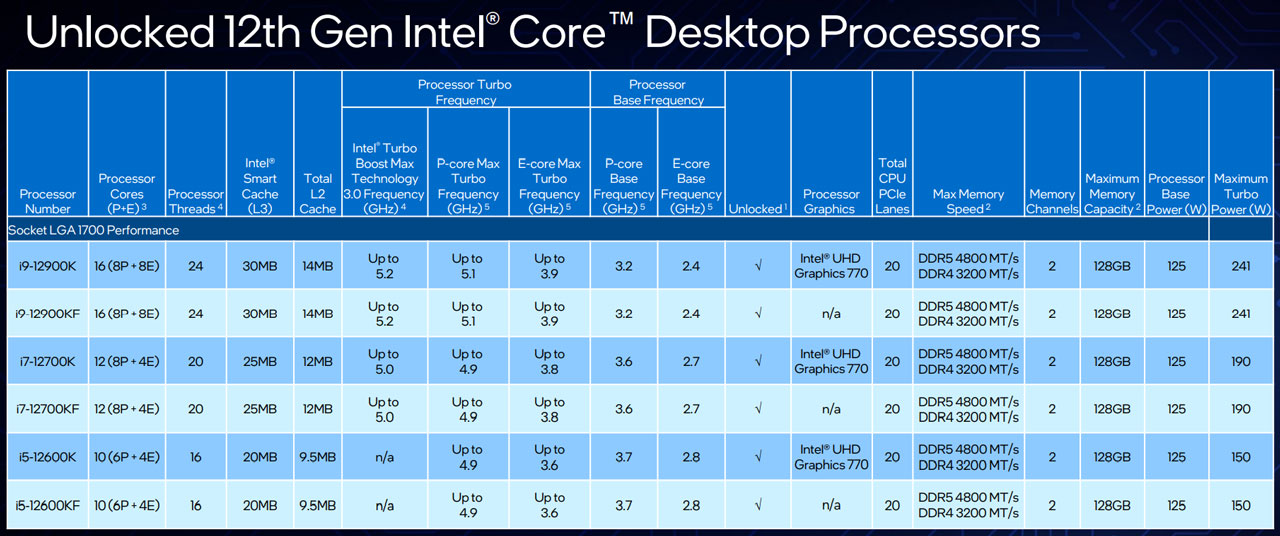
Intel has launched six initial "K-series" SKUs, all featuring unlocked multipliers for enthusiasts and overclockers. The lineup is segmented into three tiers: the Core i9-12900K/KF, the Core i7-12700K/KF, and the Core i5-12600K/KF. The "K" suffix denotes the presence of integrated graphics, while the "KF" variants signify models where the integrated GPU has been disabled.
The standout feature of this generation is the transition to a hybrid architecture, combining Performance-cores (P-cores) and Efficient-cores (E-cores). This design philosophy, long utilized in mobile ARM-based processors, is now being brought to the desktop to optimize power efficiency without sacrificing peak performance.
The Launch SKUs at a Glance
| Processor | Cores (P+E) | Threads | Max Turbo Frequency | Base/Turbo Power |
|---|---|---|---|---|
| Core i9-12900K/KF | 8+8 | 24 | 5.2 GHz | 125W / 241W |
| Core i7-12700K/KF | 8+4 | 20 | 5.0 GHz | 125W / 190W |
| Core i5-12600K/KF | 6+4 | 16 | 4.9 GHz | 125W / 150W |
A critical detail for enthusiasts is the shift in power management. While Intel lists a "Processor Base Power," the company acknowledges that enthusiast-grade motherboards will default to the "Maximum Turbo Power" limits to squeeze every ounce of performance from the silicon. Users should prepare for significant thermal output, particularly with the i9-12900K, which is known to pull over 240W under sustained, heavy-duty workloads.
Chronology of the Alder Lake Reveal
The road to the 12th Generation launch has been a carefully orchestrated campaign of information disclosure. Following the initial architectural teasers shared during Intel’s Architecture Day in August 2021, the company provided high-level insights into the "Golden Cove" P-core and "Gracemont" E-core designs.
Following the formal announcement this week, the tech industry is now in a "review embargo" phase. While the specifications, pricing, and initial marketing slides are public, independent third-party verification remains gated. Intel has set November 4th as the official date when the CPUs and accompanying Z690-based PCs will hit retail shelves, allowing for the publication of independent benchmarks.
Supporting Data: Benchmarks and Competitive Positioning
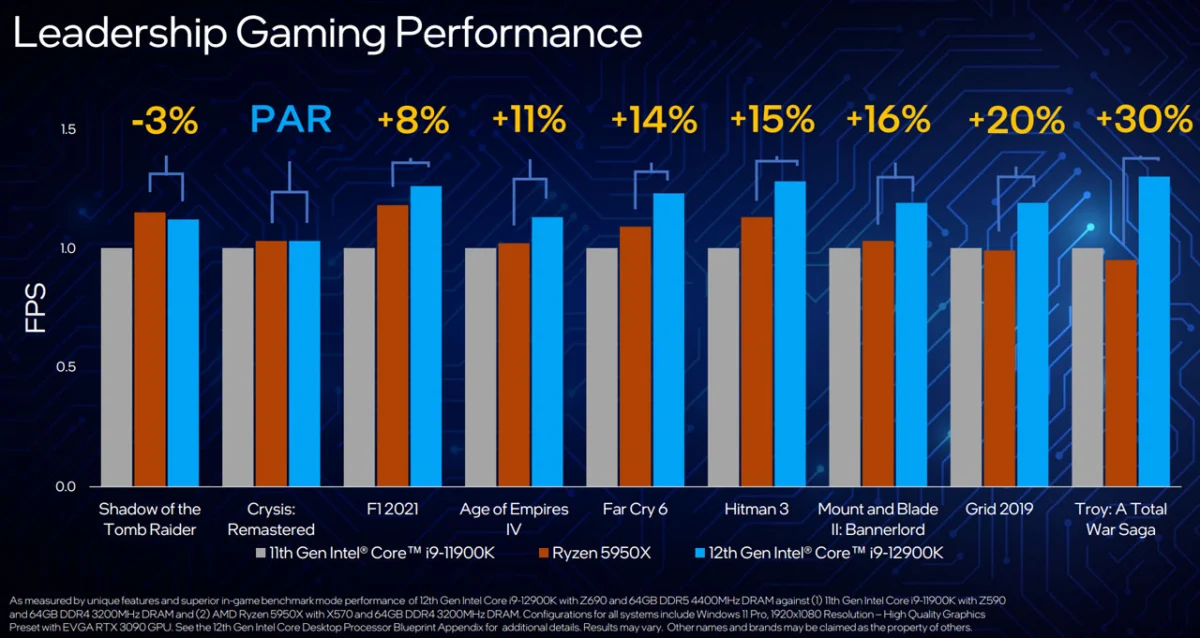
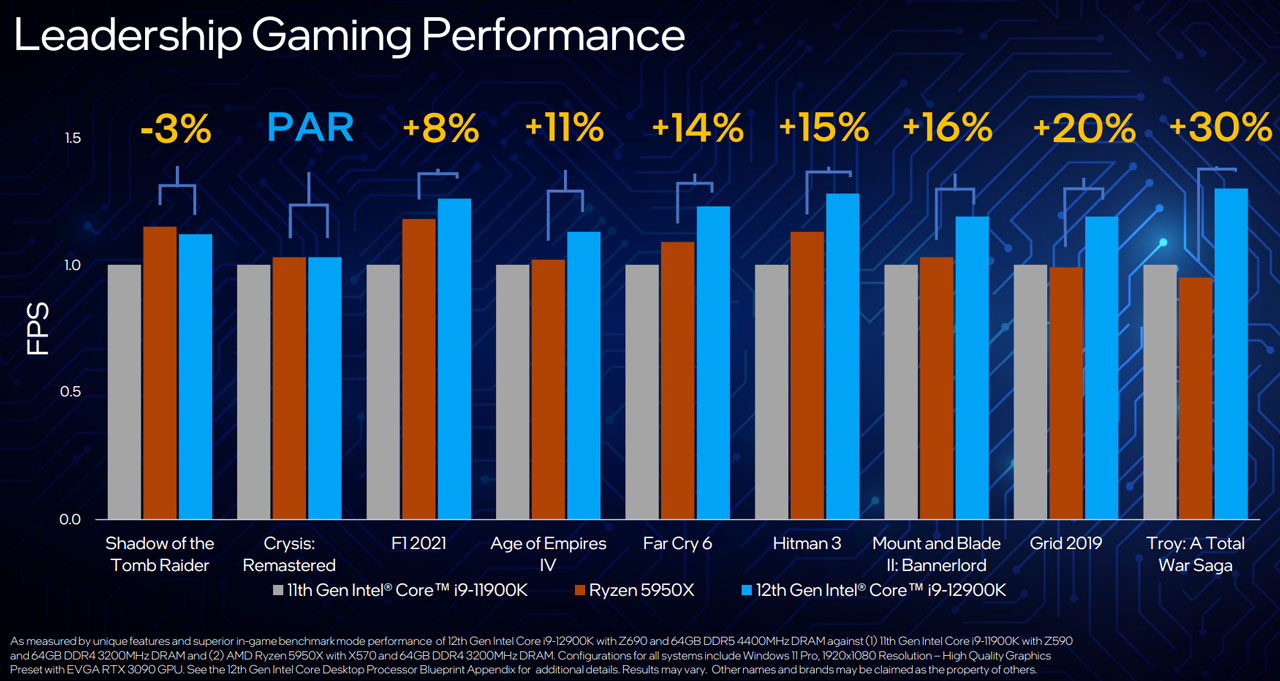
Intel has pulled no punches in its marketing, labeling the i9-12900K the "world’s best gaming processor." During the launch event, the company showcased internal test results suggesting a 12% performance lead over AMD’s Ryzen 9 5950X in modern gaming titles.
The Windows 11 and AMD Caveat
It is vital, however, to contextualize these performance figures. Intel’s internal benchmarks were conducted on Windows 11 systems, but critics have noted that these tests were performed before the deployment of critical patches intended to resolve L3 cache latency issues on AMD platforms. At the time of testing, these latency bugs were potentially degrading AMD performance by up to 15%. As such, the 12% lead claimed by Intel may narrow or fluctuate once both platforms are optimized and independently audited on identical, fully patched software stacks.
Content Creation Gains
Beyond gaming, Intel has focused heavily on content creation. In multi-threaded, processor-intensive applications—such as video rendering, 3D modeling, and code compilation—the 12th Gen architecture reportedly provides a 30% to 50% uplift over the previous 11th Gen "Rocket Lake" flagship. This performance delta is largely attributed to the increased core count and the efficiency of the background processing tasks handled by the new E-cores, which free up the P-cores for the primary application workload.
Official Responses and Ecosystem Support
Intel’s ecosystem partners have responded with a massive rollout of hardware to support the new socket (LGA 1700). The 600-series chipset, specifically the enthusiast-grade Z690, is the cornerstone of this launch.
The Motherboard Explosion
Manufacturers like ASUS, Gigabyte, and MSI have prepared an unprecedented volume of motherboards. ASUS alone has announced nineteen distinct Z690 models, ranging from compact Mini-ITX boards for small-form-factor builds to massive E-ATX boards for liquid-cooled enthusiasts. These motherboards act as the bridge to new industry standards, including:
- PCIe 5.0: Doubling the bandwidth of current GPUs and storage devices.
- DDR5 RAM: Offering higher data transfer rates and increased power efficiency, though backward compatibility with DDR4 remains an option on specific boards.
- Enhanced Connectivity: Standardized support for the latest Wi-Fi 6E protocols and high-speed wired networking (2.5GbE or higher).
Industry Collaboration
Companies like G.Skill are already pushing the boundaries of the platform, announcing DDR5 memory kits that reach speeds of 6800MHz. This symbiotic relationship between Intel and its memory/motherboard partners is aimed at ensuring that the transition to the new platform feels like a complete generation leap rather than an incremental upgrade.
Implications for the Future of Desktop Computing
The launch of the 12th Gen Core processors has profound implications for the PC industry. By adopting a hybrid architecture, Intel is effectively ending the "more cores, more power" philosophy of the past decade. Instead, the focus has shifted toward "intelligent computing," where the operating system and the processor work in tandem to delegate tasks based on their intensity.
The "Intel 7" Transition
This launch also serves as a proof-of-concept for the "Intel 7" process node. After years of struggling with 14nm refinement and the slow transition to 10nm, Intel is demonstrating that its manufacturing capabilities are back on track. If these chips can maintain high yields and acceptable thermal profiles, Intel will be in a strong position to challenge AMD’s market dominance in the DIY space.
Pricing and Market Availability
With the flagship i9-12900K priced at approximately $590, the i7-12700K at $410, and the i5-12600K at $290, Intel is maintaining a competitive pricing strategy. While the total cost of ownership—which includes the price of a new Z690 motherboard and potentially expensive DDR5 memory—remains a barrier to entry, the performance-per-dollar ratio appears, at least on paper, to be the most compelling offering Intel has provided since the heyday of the 8th and 9th generation chips.
Conclusion
As we approach the November 4th release date, the anticipation is palpable. The Alder Lake launch is not merely about clock speeds or core counts; it is about the fundamental restructuring of how a desktop CPU handles the modern digital workflow. By balancing high-octane performance cores with efficiency-focused silicon, Intel is betting that the future of the PC lies in smarter, more dynamic processing. Whether these promises hold up under the scrutiny of independent reviewers remains to be seen, but one thing is certain: the competitive landscape for desktop processors has just become significantly more exciting.