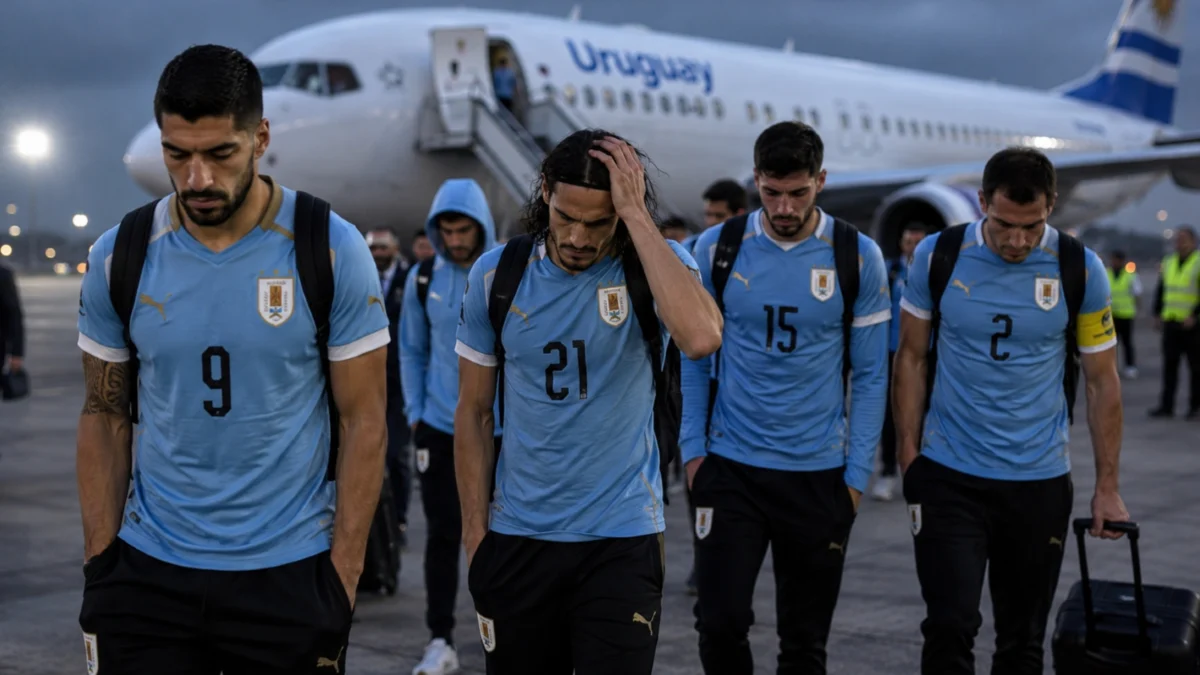
The world of international football was sent into a state of shock this week following a draconian disciplinary measure taken by the Uruguayan Football Association (AUF). Following a catastrophic performance at the ongoing FIFA World Cup, the governing body made the unprecedented decision to cancel the team’s chartered flight back to Montevideo. The move has left the national squad—a group of elite professionals—stranded, forcing them to navigate their own return journeys individually on commercial airlines.
This public rebuke signals a profound rift between the nation’s footballing hierarchy and the players, marking a dark chapter for a country that considers football a fundamental pillar of its national identity.
A Legacy of Greatness: The Weight of Expectations
To understand the severity of the AUF’s reaction, one must first appreciate the stature of the La Celeste. Uruguay is a nation of immense footballing pride, holding a historical footprint in the sport that far outweighs its modest population of roughly 3.5 million people.
Uruguay’s pedigree is cemented in the annals of history. They were the hosts and inaugural winners of the first-ever FIFA World Cup in 1930, defeating neighbors Argentina 4-2 in a final that effectively put the tournament on the map. Their second triumph, the legendary "Maracanazo" of 1950, remains one of the most significant upsets in sporting history. In that match, Uruguay stunned a capacity crowd in Rio de Janeiro, defeating Brazil 2-0 to secure their second world title.
Being the smallest nation by population to ever win the World Cup, Uruguay has always punched above its weight. This historical success has created a culture where anything less than a deep tournament run is viewed not merely as a setback, but as a national failure. It is this intense, unforgiving standard that catalyzed the AUF’s recent decision.
The Campaign: A Statistical Collapse
The narrative of this year’s tournament for Uruguay was one of stagnant progression and eventual collapse. Entering the competition with hopes of repeating past glories, the team struggled to find rhythm from the opening whistle.
Group Stage Chronology:
- Matchday 1: The team failed to convert possession into goals, resulting in a lackluster stalemate that set a tone of frustration for the weeks to follow.
- Matchday 2: Despite tactical shifts, the squad remained unable to break through defensive lines, recording another disappointing draw that left their tournament fate hanging in the balance.
- The Decider: The campaign reached its grim conclusion with a 1-0 defeat to Spain. The loss was not just a scoreline; it was a systematic dismantling of the Uruguayan sporting project, confirming their elimination before the knockout stages could even begin.
For a nation that prides itself on the "garra charrúa"—a term referring to the fierce, never-say-die spirit of Uruguayan athletes—this tournament was characterized by an uncharacteristic passivity. The inability to secure a single win across the group stage left the AUF leadership with little patience for diplomatic pleasantries.
The AUF’s Punishment: A Logistical Exile
In a move that has sent ripples of debate through the international football community, the AUF cancelled the chartered flight originally meant to transport the entire delegation back to the capital, Montevideo.
The rationale provided by the association is as blunt as it is punitive: the performance on the pitch was deemed "wholly unacceptable" for the standards of the Uruguayan jersey. By cancelling the charter, the AUF has forced the players to fend for themselves. Whether they are flying back to their respective European clubs or returning to Montevideo, the responsibility for booking tickets, navigating layovers, and covering the logistical hurdles of international travel now rests on the players’ shoulders.
This move is widely viewed by analysts as a "symbolic abandonment." It serves as a reminder to the squad that the privilege of representing the national team is contingent upon results. By denying them the collective homecoming—a tradition usually reserved for the end of a campaign—the AUF has effectively distanced itself from the squad, publicly shaming the group for their collective failure.
Evaluating the Sporting Project: The Future of Marcelo Bielsa
The fallout from this incident extends well beyond the inconvenience of travel arrangements. The AUF has confirmed that an intensive internal audit of the national team’s sporting project is now underway.
At the center of this scrutiny is head coach Marcelo Bielsa. Known for his intense tactical philosophy and "all-or-nothing" approach to management, Bielsa was brought in to modernize the Uruguayan setup. However, the failure to secure a victory in the group stage has placed his position in extreme jeopardy.
Key Areas of Assessment:
- Tactical Cohesion: Evaluators are questioning whether Bielsa’s rigid tactical structure was ill-suited for the specific skill set of the current Uruguayan roster.
- Squad Selection: Critics have pointed toward the exclusion of certain veteran players who might have provided the necessary grit in high-pressure moments.
- Communication: The breakdown between the coaching staff and the players during the final group match will be a primary focus of the AUF’s investigative report.
The coming weeks will be critical. If the AUF determines that the failure was a result of fundamental strategic misalignment, it is highly likely that they will move to terminate Bielsa’s contract, triggering a search for a new identity for the national team.
Implications for International Football
The incident serves as a stark case study in the modern politics of national team football. While players are often shielded by the fame and financial security of their club careers, the national team remains the arena where they are most accountable to their heritage.
The AUF’s decision to abandon the charter has set a precedent that will likely be discussed in football boardrooms for years to come. Does a governing body have the right to treat its employees with such public disdain following a sporting failure? Proponents argue that it is a necessary corrective measure for professional athletes who failed to meet their obligations. Detractors argue that it creates a hostile, toxic environment that will only serve to further demoralize a team that is already at its lowest ebb.
As the dust settles, the focus turns to the individual players. Forced to return home via commercial flights, the team members will face a barrage of media scrutiny, fan anger, and personal reflection. For a nation that defines itself through the success of its football, this is a time of deep introspection.
Looking Ahead
As the World Cup continues without them, the Uruguayan Football Association remains at a crossroads. The decision to cancel the flight was a signal that the status quo is dead. Whether this leads to a productive reconstruction or a period of internal instability remains to be seen.
For the players, the journey home—whether it involves long layovers in hubs like Madrid or Frankfurt, or a direct flight back to the emotional weight of Montevideo—will be a long and lonely one. It is a harsh reality for a group that only weeks ago arrived at the tournament with dreams of lifting the trophy. Now, they return as individuals, stripped of the collective honor that once defined their mission, tasked with explaining to a grieving nation exactly how the dream fell apart.
The world of football waits to see how this story concludes. Will the AUF’s "punishment" provide the shock therapy needed to rejuvenate the program, or will it be remembered as the moment the Uruguayan national team fractured beyond repair? For now, the only thing certain is that the La Celeste will have to wait for the next cycle to restore the honor of their crest.