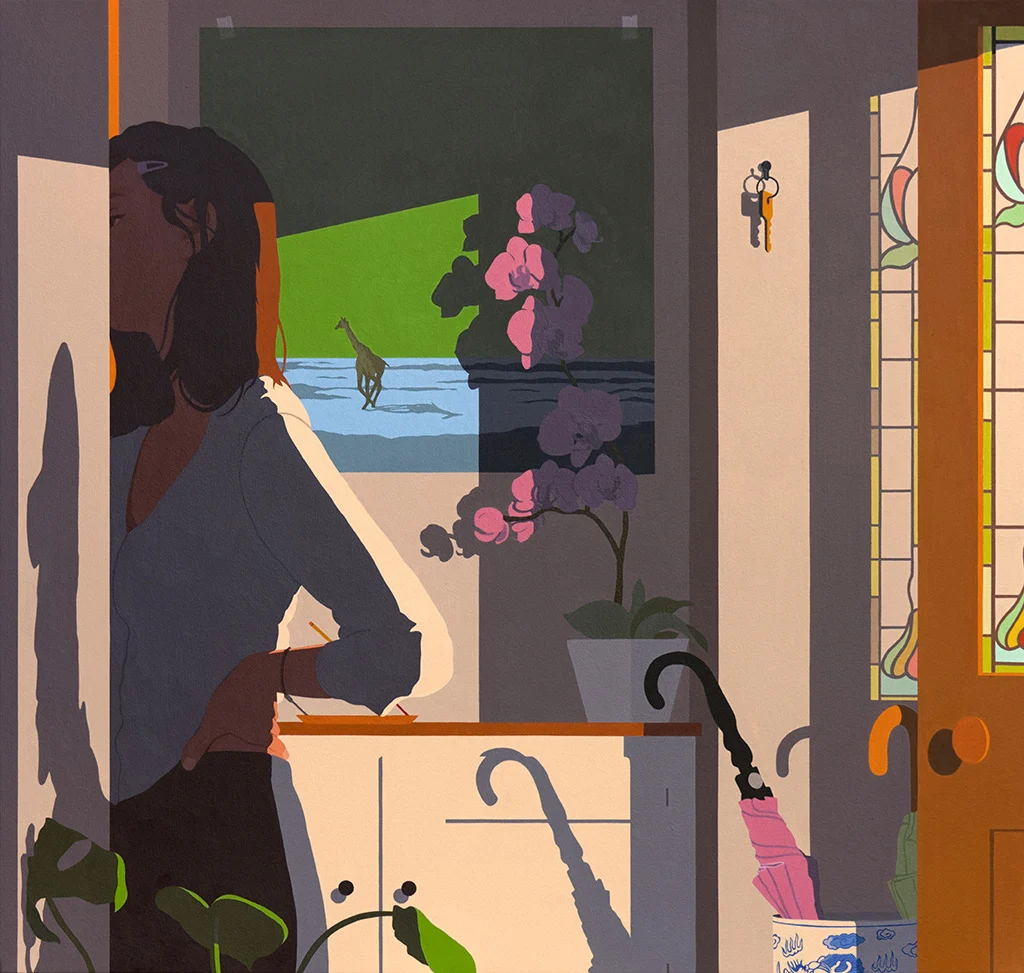
In the hushed, contemplative corners of Hashimoto Contemporary in New York City, Los Angeles-based artist Adrian Kay Wong has unveiled a collection that challenges the viewer to reconsider the architecture of their own daily lives. Titled In The Middle of Things, the exhibition is a meditative exploration of the interstitial spaces we inhabit—the moments that occupy the periphery of our consciousness but define the texture of our existence. Running through July 11th, the show serves as a poignant reminder that while we often look for meaning in grand, climactic events, the truth of the human experience is more frequently found in the stillness of the mundane.
The Genesis of a Perspective
Adrian Kay Wong’s artistic trajectory is rooted in a synthesis of place and introspection. Born and raised in the San Francisco Bay Area, Wong’s aesthetic sensibility was forged in the unique intersection of urban transition and cultural flux. He later honed his craft at The School of the Art Institute of Chicago, where he earned his BFA. It was there that he began to refine his signature style: a meticulous, almost clinical approach to painting that belies a deep, emotional core.
Wong’s work is characterized by its ability to capture subtle narratives within the seemingly incidental. His canvases often function as mirrors for the viewer’s own memories and cultural identity, blending the specificity of his personal upbringing with the broader, universal language of isolation and intimacy. By weaving together the dualities of transience and permanence, he creates a visual dialogue about what it means to belong, and conversely, what it feels like to be estranged from one’s own environment.
Chronology: From Concept to Canvas
The development of In The Middle of Things did not happen in a vacuum. It is the culmination of years of iterative practice where Wong transitioned from capturing landscapes to focusing on the human figure suspended in quietude.
- Early Influences: Drawing from his formative years in the Bay Area, Wong began exploring how architecture influences social interaction. His early sketches were marked by a focus on public transit and shared living spaces.
- Academic Rigor: During his tenure at The School of the Art Institute of Chicago, Wong began to experiment with the “in media res” narrative style, moving away from purely representational art toward conceptual storytelling.
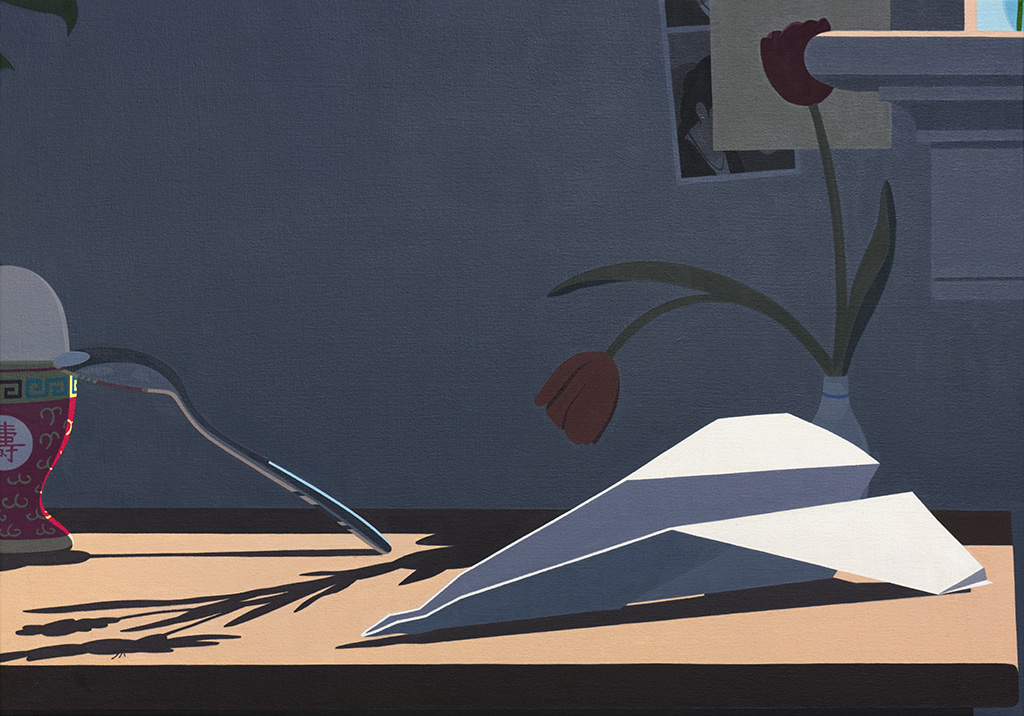
- The Pandemic Shift: Like many artists, the isolation of the early 2020s pushed Wong to examine the intimacy of home life. This period solidified his interest in the “unnoticed” moments—the empty chair, the half-finished cup of coffee, the figure staring out of a window.
- Exhibition Realization: The current exhibition at Hashimoto Contemporary represents the most refined iteration of this vision. By curating a series of works that specifically address the "middle of things," Wong has created a cohesive narrative that guides the viewer through a series of atmospheric vignettes.
Supporting Data: The Anatomy of a Scene
To understand the power of Wong’s work, one must look at the technical composition of his paintings. Wong employs a deliberate, restrained color palette that serves to flatten the image, forcing the viewer to focus on the interplay of light and shadow rather than the spectacle of the subject.
Data regarding the reception of his work suggests a growing market interest in "quiet" or "slow" art—a reaction against the hyper-stimulated digital landscape of the 21st century. According to gallery insights from Hashimoto Contemporary, Wong’s pieces resonate particularly well with collectors who prioritize emotional resonance over decorative value. The exhibition features a range of medium-to-large scale canvases, each meticulously balanced to ensure that the "negative space" is as significant as the primary subjects. This balance is not accidental; it is a calculated effort to force the viewer to participate in the "in-betweenness" of the narrative.
Official Responses and Curatorial Insight
The curatorial team at Hashimoto Contemporary has described In The Middle of Things as a "recalibration of the gaze." By stripping away the context of a "beginning" or an "end," Wong forces the viewer to confront the subject as a static reality.
In a statement provided by the gallery, they noted: "Wong’s work operates on a frequency of calm, yet there is a lingering tension present in every frame. He captures his figures at a point of hesitation—that split second before a decision is made or a thought is fully formed. This is the essence of in media res as applied to painting; he does not show us the outcome, but rather the heavy, beautiful weight of the process itself."

Wong himself has alluded to this in interviews, suggesting that his paintings are less about the figures themselves and more about the "aura" of the spaces they inhabit. "I want the viewer to feel like they’ve walked into a room just as someone has left, or just as they are about to speak," Wong noted. "That specific friction—the feeling of being ‘in the middle’—is where I find the most truth."
The Implications of the "In-Between"
The implications of Wong’s work extend beyond the art world and into the broader socio-cultural conversation regarding attention and presence. In an era defined by rapid-fire content consumption and the constant pursuit of the "next big thing," Wong’s work demands a radical slowing down.
The Psychology of Stasis
Psychologically, the paintings invite a state of "flow" or meditative engagement. When a viewer stands before a Wong painting, the absence of a clear narrative arc forces the brain to fill in the gaps. This act of cognitive participation is what makes the work so enduring. It turns the viewer into a collaborator, forcing them to project their own memories onto the canvas.
Cultural Identity and Modernity
Furthermore, Wong’s work serves as a subtle commentary on the Asian-American experience in contemporary society. Without resorting to overt political iconography, his paintings capture the quiet navigation of dualities—the struggle to bridge the gap between tradition and modernity, and the personal search for a sense of place in a country that is constantly shifting.
Conclusion: Why Now?
As the world continues to move at an accelerating pace, exhibitions like In The Middle of Things act as a necessary counter-weight. Adrian Kay Wong has successfully managed to bottle the essence of the ephemeral, presenting it in a way that feels both deeply personal and universally accessible.
For those in the New York area, a visit to Hashimoto Contemporary before July 11th is more than just an art outing; it is an opportunity to practice the art of stillness. In the middle of the city’s chaotic, relentless energy, Wong offers a quiet room, a suspended moment, and a chance to reflect on the things that are usually left behind in our rush to move forward.
As we look toward the future of contemporary art, it is clear that artists like Wong, who prioritize the depth of the interior life over the breadth of external spectacle, will continue to play a vital role in our collective cultural dialogue. He reminds us that the most significant events of our lives often happen when nothing much is happening at all—in the quiet, in the hesitation, and in the middle of things.
For more information on the artist, visit adriankaywong.com. To view the full exhibition catalog or inquire about available works, visit Hashimoto Contemporary.