The annual Cannes Lions International Festival of Creativity is widely regarded as the global epicenter for the advertising and marketing industries. This year, the event served as a high-stakes laboratory where the world’s most influential brand leaders converged to navigate the seismic shift brought on by Artificial Intelligence and changing consumer behaviors.
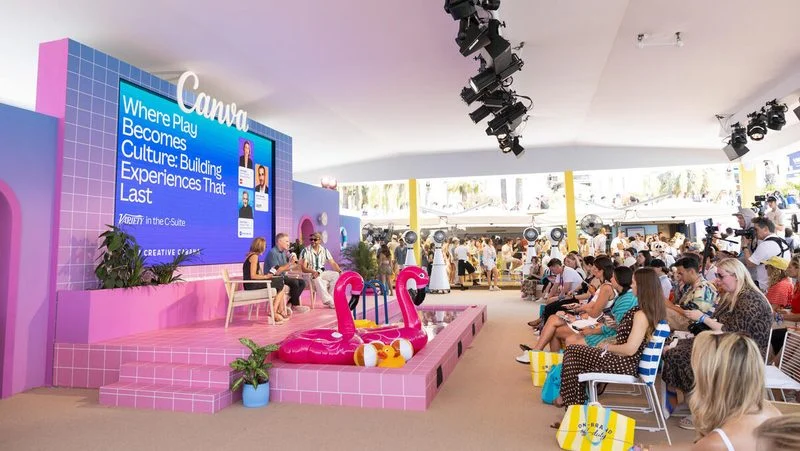
In a series of exclusive conversations recorded at the Canva Creative Cabana during the June 22–25 festival, Variety business editor Todd Spangler sat down with top executives from NBCUniversal, IBM, State Farm, Autodesk, and Coinbase. The result was a comprehensive blueprint for how legacy corporations and digital-native giants are rewriting their playbooks to stay relevant in an era of rapid technological disruption.
Main Facts: The Intersection of Tech and Human Creativity
The prevailing theme across all discussions was clear: AI is no longer a futuristic concept but a functional imperative. However, the execution of this technology varies significantly depending on the industry. While Autodesk and Coinbase are leveraging AI to refine their technical workflows and creative output, IBM is positioning itself as the infrastructure backbone for enterprises struggling to integrate these tools.
Meanwhile, traditional media titans like NBCUniversal and community-focused brands like State Farm are leaning into the "human-first" experience. Even as digital tools evolve, these companies are doubling down on high-touch, immersive physical events to secure the loyalty of the next generation of consumers.
Chronology of Innovation: From Efficiency to Experience
The AI Adoption Curve
The dialogue regarding AI revealed a profound "skills-gap" crisis. Dara Treseder, CMO of Autodesk, highlighted startling data: while 82% of the general population feels comfortable using AI in their personal lives, only one-third of the workforce feels confident deploying these tools in their professional fields. This represents a dangerous friction point for the global economy.
To bridge this, Autodesk has committed $350 million to workforce development. This initiative is designed to upskill individuals in design and "make" industries—spanning architecture, engineering, construction, and media—ensuring that the next generation of creators is not replaced by AI, but empowered by it.
Coinbase’s Agentic Future
Cat Ferdon, CMO of Coinbase, provided a glimpse into the internal culture of a firm that has embedded AI into its DNA since inception. Coinbase’s approach is "agentic-forward," meaning they view AI as an autonomous partner in the creative workflow. Ferdon noted that while AI dramatically accelerates creative outcomes, it is strictly viewed as an augmentative tool rather than a replacement for the human spark.
IBM’s Efficiency Revolution
Jonathan Adashek, Senior VP of marketing and communications for IBM, offered a pragmatic look at the ROI of AI. For "Big Blue," the primary goal was liberating human talent from "grunt work." By automating derivative creative assets, IBM reduced the time spent on repetitive tasks by half. Adashek cited a recent project involving the Las Vegas Sphere, where AI-assisted design reduced a 16-day project to just two days. Most importantly, the creative team reported feeling more inspired, not less, as the tool prompted them to explore new conceptual avenues.
Supporting Data: The Cost of Stagnation
The economic impact of AI integration is perhaps best illustrated by IBM’s internal metrics. Through a combination of AI implementation, automation, and process improvement, IBM has successfully stripped $4.5 billion out of its annual operating spend over the last three years. The company plans to cut an additional $1 billion this year, proving that AI is not just a marketing buzzword, but a core component of fiscal discipline in the modern corporate era.
However, this transition is not without its risks. As Treseder pointed out, the job market is currently characterized by a mismatch. While the number of job postings listing AI as a prerequisite has more than doubled, the current labor pool remains inadequately trained. This suggests that the real challenge for the next five years will not be the development of the technology itself, but the massive scale of human retraining required to operate it.
Official Responses: Cultivating Cultural Capital
While the tech-heavy companies focused on efficiency, the media and insurance sectors focused on the "why." Kristyn Cooke, chief agency sales marketing officer for State Farm, emphasized that in a fragmented digital landscape, shared interests are the only currency that matters.
The BravoCon Case Study
State Farm’s partnership with NBCUniversal’s BravoCon exemplifies a pivot from static advertising to experiential marketing. Cooke explained that early efforts relied on simple branded spaces, but the brand has since evolved toward "memorable experiences." By fostering an environment where fans can interact, feel, and belong, State Farm has successfully tapped into the cultural passion points of younger demographics.
"The audience is the story," Cooke noted. This sentiment underscores a broader shift: brands are no longer just sponsors of events; they are active participants in community-building.
Implications: The Future of Media and the 2028 Olympic Games
As the industry looks toward the 2028 Summer Games in Los Angeles, the strategy for media giants is shifting toward hyper-personalization. Mark Marshall, chairman of advertising partnerships for NBCUniversal, outlined the sheer scale of the challenge and opportunity.
Comparing the 1996 Atlanta Games—which featured 186 hours of programming—to the anticipated 8,000 hours for the 2028 Los Angeles Games, Marshall highlighted the democratizing power of streaming. Fans can now curate their own experience, choosing between live coverage on Peacock or the high-production, narrative-driven storytelling delivered by personalities like Mike Tirico.
The implication for advertisers is significant: the "one-size-fits-all" broadcast model is dead. In its place is a multi-layered ecosystem where storytelling, live action, and data-driven engagement intersect. Whether it is through the NFL, MLB, or the Olympics, NBCUniversal is betting that deep-dive storytelling—the "how we got here" narratives—is what will sustain fan engagement in a crowded digital marketplace.
Strategic Synthesis: Navigating the "AI Era"
The collective wisdom shared at the Strictly Business podcast recordings suggests that the industry is entering a new phase of maturity.
- AI is a Force Multiplier, Not a Replacement: Executives from IBM to Coinbase agree that the most successful companies are those that offload "derivative" work to machines while reserving human bandwidth for high-level creative concepting and empathy-driven strategy.
- The "Experience Economy" is Expanding: Despite the ubiquity of AI, consumers are craving physical, communal experiences more than ever. Brands that ignore the importance of "passion points"—like those seen at BravoCon—risk becoming invisible to the next generation.
- The Skills Gap is the Primary Barrier: The $350 million commitment from Autodesk is a bellwether. The industry acknowledges that the pace of technological adoption is currently outpacing the pace of workforce development.
- Customization is the New Standard: The evolution of Olympic coverage demonstrates that audiences demand agency. They want to choose how, when, and where they consume content, and they want the ability to toggle between raw data and narrative storytelling.
As the industry leaves Cannes and heads into the latter half of the decade, the divide between those who successfully integrate these lessons and those who resist them will only widen. For the companies represented in these conversations, the goal is clear: utilize AI to optimize the "grunt work," and use the newly reclaimed time to forge deeper, more authentic connections with the human beings at the other end of the screen.
The takeaway from Variety’s deep dive is ultimately one of optimism. Technology is not shrinking the role of the creative professional; it is refining it, stripping away the monotony to reveal the core of what makes marketing work: the ability to tell a story that resonates, connects, and lasts. As we approach the 2028 Los Angeles Olympics, the stage is set for a new era of engagement—one where the machine provides the efficiency, and the human provides the soul.