

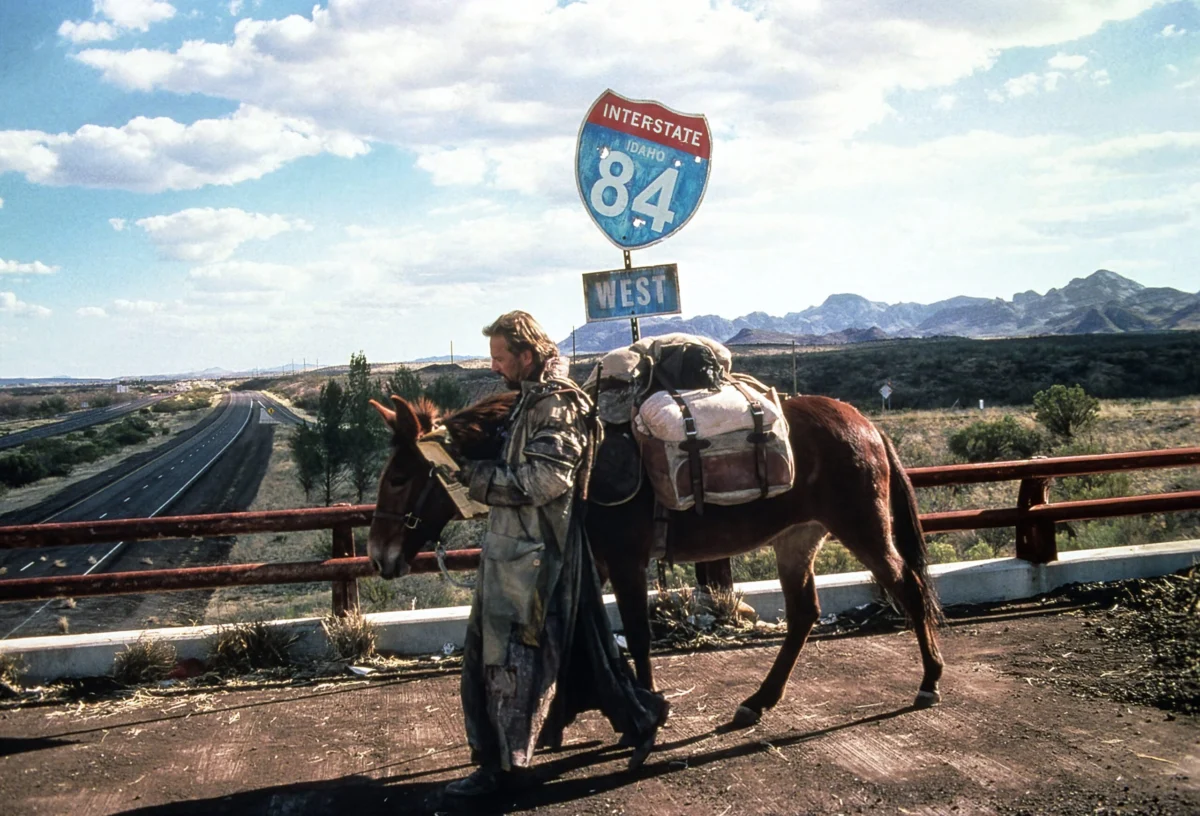
Every Friday, IndieWire After Dark delves into the fringes of cinema history, excavating midnight movies that defy easy categorization. This week, we examine a film that occupies a singular, paradoxical space in the American cultural canon: Kevin Costner’s 1997 epic, The Postman. Often dismissed at the time of its release as a bloated, self-indulgent misfire, the film has undergone a quiet, poignant reappraisal. As we approach the 250th anniversary of the United States, The Postman has transformed from a punchline into a surprising, essential testament to the power of human connection.
The Bait: A Legacy Found in the Mail
The inspiration for this exploration began in the quiet of a family home in Alabama. Following the passing of my grandmother, I found myself sorting through the artifacts of a life well-lived. Tucked away in a drawer was a framed certificate honoring my late grandfather, Dale James Foreman, for his 17 years of service with the United States Postal Service.

Accompanying the award was a weathered retirement mug bearing the slogan, "Goodbye tension, hello pension." Reading the official letter, which lauded an organization "built on the service of people like you" and thanked him for fostering "a happier life for our customers," I was struck by the profound simplicity of the sentiment. In a polarized era, the idea that a functioning society relies on ordinary people showing up for one another felt radical. It was the perfect lens through which to view Kevin Costner’s three-hour post-apocalyptic odyssey.
A Chronology of a Cult Object
To understand The Postman, one must understand its trajectory. Released in 1997 following the massive success of Dances with Wolves and the infamous, tabloid-heavy production of Waterworld, the film arrived with immense baggage. Adapted from David Brin’s novel, it presents a wasteland where a wandering drifter inadvertently sparks a revolution by pretending to be a representative of a restored United States government—a government that, in reality, does not exist.

The Pandemic Resurgence
For decades, the film was relegated to the "disaster" pile of 1990s Hollywood history. However, 2020 served as a turning point. During the height of the global pandemic, as isolation became the norm, audiences began to revisit Costner’s sincere, if flawed, vision of rebuilding a country through the simple act of delivering letters.
The film’s central premise—that communication is the glue of civilization—suddenly resonated with a populace starved for connection. By 2026, the film has solidified its status as a "midnight movie." It is now recommended not for its technical perfection, but for its core conviction: that society survives through collective reliance rather than conquest.

The Costner Paradox: A Cinematic Study
Kevin Costner is a polarizing figure in film history. For some, he embodies a sturdy, American-bred machismo akin to John Wayne. For others, his performances have historically lacked the range to elevate high-concept material.
The Auteur vs. The Actor
While my own assessment of Costner as an actor remains unchanged—I often find his emotional range limited—my appreciation for Costner the auteur has grown. His recent work, including the ambitious Horizon: An American Saga, displays a filmmaker grappling with the contradictions of American history.

Costner’s political identity does not map neatly onto modern partisan divides. Instead, his work exhibits a reverence for American ideals coupled with a burgeoning awareness of the darker realities of colonialism. This creates a "textual friction" that makes his films, including The Postman, essential viewing. They are not always "good" in the traditional sense, but they are undeniably fascinating windows into a specific, earnest, and deeply patriotic worldview.
Implications: The Power of the Ideal
The film’s central conceit—that the U.S. Postal Service could act as the catalyst for societal rebirth—is, on its face, absurd. Yet, as Wilson Chapman notes in our secondary analysis, it is a stroke of genius. The settlers and survivors who join the "new" postal service are not driven by jingoism or the thirst for combat. They are driven by the promise of communion.

Rebuilding Through Storytelling
In a time when the world feels increasingly fragmented, The Postman reminds us that institutions are only as strong as the faith we place in them. The fact that this dream was founded on a lie—the protagonist’s initial deception—is rendered irrelevant by the end of the film. The act of delivering mail, of proving that someone, somewhere, cares enough to send a letter, becomes a revolutionary act of justice.
The repertory cinema scene in 2026 is currently experiencing a boom, driven by platforms like Letterboxd and a renewed interest in revival screenings. This is not merely a nostalgic retreat; it is an attempt to build community. Discussing old films allows us to pass meaningful messages from one person to another, making the act of consumption a communal experience that mitigates the isolation of modern life.

Why We Still Need the Postman
We live in a world where the creeping sense that every major institution is failing—or has already failed—is pervasive. Yet, the 2026 summer season has seen a shift toward more communal experiences, from the global interest in sports to a collective fixation on cultural milestones.
The Postman serves as a reminder that powerful, if unconventional, figures once championed the idea that society could be rebuilt through kindness and communication. While the film’s dialogue can be stilted and its direction occasionally stodgy, its sincerity is its greatest asset. In our current climate, that kind of earnestness feels increasingly rare.

The Final Verdict
Is The Postman worth recommending? If you are looking for a perfectly paced, gritty masterpiece, the answer is no. If you are looking for a film that captures the weird, ungainly, and deeply heartfelt struggle to maintain faith in one’s fellow citizens, then it is essential.
Getting a major studio to fund a multi-million-dollar blockbuster about the inherent goodness of the U.S. Postal Service is, in many ways, the ultimate manifestation of the American Dream. It is a film that refuses to let cynicism win. As we continue to navigate the uncertainties of the 21st century, perhaps we could all learn a thing or two from the nomad who realized that, in the ruins of a broken world, the most heroic thing you can do is deliver a letter.

For more installments of After Dark, IndieWire’s midnight movie club, check our archives for deep dives into cult classics, forgotten gems, and the films that continue to define our cinematic consciousness.










