

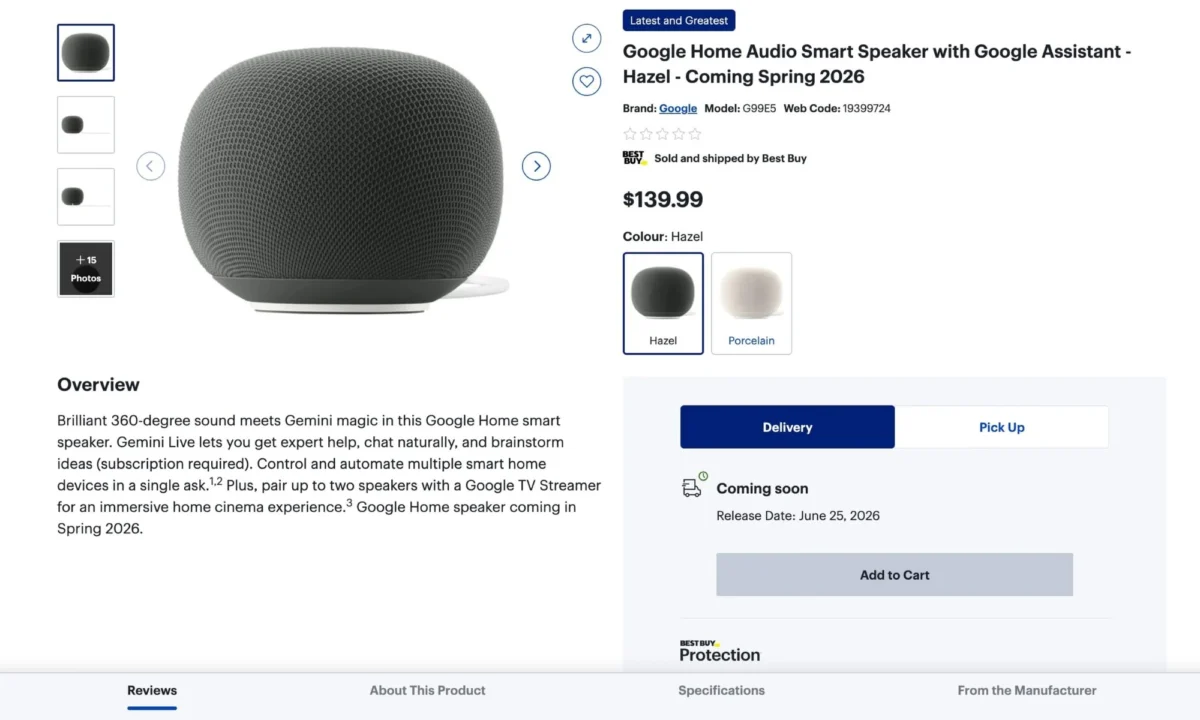
After a deafening six-year silence in the smart speaker hardware category, Google’s strategy is finally coming into focus. Since the initial announcement of a new Gemini-powered home speaker in October 2025, speculation has reached a fever pitch. The absence of the device at Google I/O 2026 had many analysts questioning if the project had been relegated to the company’s infamous "graveyard" of discontinued hardware. However, a fleeting but telling slip-up on Best Buy Canada’s website has provided the most concrete evidence yet: the Google Home Speaker is not only alive, but it is likely mere weeks away from hitting shelves.
The Best Buy Leak: A Window into the Release Schedule
The tech industry is no stranger to accidental leaks, but the nature of the recent Best Buy Canada listing suggests this was far from a mere placeholder. For a brief window, the retailer’s product page displayed a release date of June 25, 2026. While the page was scrubbed of this date shortly after being discovered by eagle-eyed observers and reported by outlets like 9To5Google, the brevity of the leak suggests a final, high-intent data push by retailers preparing for inventory arrival.

In the world of supply chain management, dates like "December 31" or "Q4 2026" are classic placeholders. A specific mid-week date, such as June 25, typically signals that a product has been scanned into warehouse systems and is moving through the logistics pipeline. Furthermore, this date falls just four days after the official end of spring, aligning with Google’s earlier, albeit vague, commitment to a spring launch window. While the company missed its self-imposed deadline, the June 25 date suggests that Google prioritized a polished, AI-ready experience over rushing a product to market.
A Chronology of the Silence
To understand the gravity of this release, one must look at the timeline of Google’s "Home" evolution.

- October 2025: Google officially announces the development of a new, AI-first home speaker. The announcement is heavy on the integration of Gemini, Google’s multimodal large language model, but light on physical hardware specs.
- Late 2025 – Early 2026: Google begins the aggressive rollout of "Gemini for Home." Rather than launching a new device immediately, the company focuses on updating its existing, aging hardware fleet to handle the complex requests inherent in an AI-powered ecosystem.
- March 2026: The frequency of software updates for Gemini-integrated devices increases to three or four times per month, signaling that the underlying software architecture is nearing a state of maturity.
- May 2026: Google I/O passes without a hardware announcement. The industry interprets this as a sign that the speaker is being treated as a "software-first" product, potentially decoupled from the traditional developer conference hype cycle.
- June 2026: Best Buy Canada leaks the June 25 release date, finally breaking the silence.
The delay, while frustrating for enthusiasts, appears to be a calculated strategic move. Google was tasked with the monumental challenge of migrating a legacy smart home ecosystem into a generative AI-powered one. By using the last eight months to refine Gemini’s performance on older speakers, Google has essentially beta-tested its new interface on millions of existing devices, ensuring that the new hardware doesn’t launch as a "broken" or "beta" product.
Design and Technical Specifications: The Gemini Integration
The new Google Home Speaker is designed to be a fundamental departure from the minimalist "pebble" aesthetic of the Nest Audio. It features a 360-degree fabric-wrapped chassis, broken only by a base that functions as both a structural anchor and a hub for physical controls.

Advanced Hardware Features
- Microphone Mute and Status Feedback: The base houses a physical mute switch—a nod to user privacy—and a dynamic ring of status lights. These lights are not static; they shift in color and pulse pattern based on whether the device is listening, processing, or responding, providing a visual language for the AI’s internal state.
- Audio Ecosystem: Google is clearly positioning this as a cornerstone for home entertainment. The device supports seamless pairing with the Google TV Streamer, allowing users to create a robust home cinema setup. Furthermore, it supports stereo pairing with legacy Nest Audio speakers, a move that encourages users to upgrade their existing home audio without discarding their previous investments.
- AI-Driven Functionality: At its core, the device is an interface for Gemini. Unlike the rigid, command-based Google Assistant of the past, this speaker is built for natural, multi-turn conversations. While basic functions are included, Google has gated certain "advanced" brainstorming and creative features behind a premium Gemini subscription, signaling a move toward a service-as-hardware revenue model.
Market Implications and Competitive Landscape
Priced at $99.99, the speaker enters a crowded market dominated by Amazon’s Echo series and Apple’s HomePod Mini. However, Google’s strategy is distinct. By launching in 19 countries simultaneously—including the US, UK, Canada, France, Germany, and Japan—Google is signaling an aggressive push for global market share.
The competitive landscape is particularly fraught. With Nvidia, Dell, and Samsung all pivoting toward high-performance AI hardware at events like Computex 2026, the smart home has become the "third front" in the AI wars. While Dell and Nvidia fight for the workstation and creator markets, Google is fighting for the living room, aiming to ensure that when a user thinks of "AI at home," the first thing they think of is the Google Home ecosystem.

Why This Matters: The Shift to Generative Smart Homes
The implications of this device go beyond a simple piece of plastic and a microphone. For years, the "Smart Home" was limited to binary triggers: "Turn on the lights," "Set a timer," or "Play jazz." These interactions were inherently transactional.
With the new Home Speaker, the shift is toward contextual intelligence. A user will be able to say, "I’m having a small dinner party, what should I play, and can you adjust the lighting to be warm but dim?" The ability for the device to synthesize these disparate requests—music selection, mood setting, and environmental control—represents the promise of what many call "Ambient Computing."

Google’s decision to wait until the software was fully ready suggests they recognize the danger of a bad first impression. In the age of generative AI, users have little patience for "hallucinations" or slow, laggy responses. By holding the product until the software stack was mature, Google is betting that the quality of the interaction will outweigh the six-year delay in hardware iteration.
The Road Ahead
As we approach the expected June 25 launch date, the industry will be watching two things closely: the initial consumer reception and the stability of the Gemini-for-Home backend. If the speaker delivers on its promise of a fluid, natural interface, it could reinvigorate a stagnant smart home market. If it falters, it may force Google to reconsider its hardware-first strategy in the home entirely.

For now, the leaked date serves as a countdown. After years of being left behind by competitors, Google appears ready to reclaim its place at the center of the home. Whether the product lives up to the weight of six years of anticipation remains to be seen, but one thing is certain: the era of the "smart" speaker is ending, and the era of the "intelligent" speaker is about to begin.
Consumers in the confirmed 19 launch countries should prepare for a rollout that will likely be accompanied by a massive marketing campaign, as Google attempts to re-establish the relevance of the living room as a critical pillar of its AI-first future.












No comments yet. Be the first to join the conversation!