Ali Ikhwan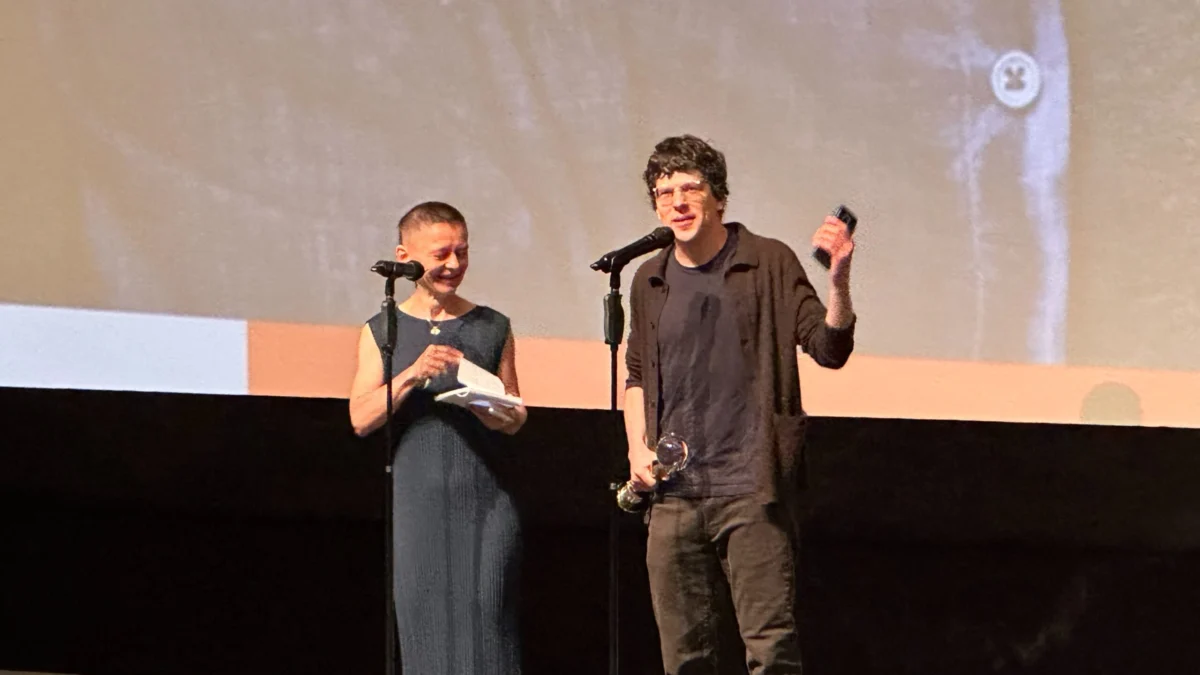
The Announcement: A New Chapter in Central Europe
In a poignant moment during the 60th anniversary edition of the Karlovy Vary International Film Festival (KVIFF), actor, writer, and director Jesse Eisenberg delivered a revelation that signaled a significant shift in his professional and personal trajectory. Standing in the Grand Hall of the iconic Hotel Thermal—the heartbeat of the Czech Republic’s premier cinematic gathering—Eisenberg announced that he is set to receive Polish citizenship within the coming week.
The declaration was met with a standing ovation from the audience, an emotional reception that Eisenberg playfully described as a “massive collective hug.” For the Social Network star, this transition is not merely a matter of bureaucratic paperwork; it is a deliberate alignment of his creative identity with the artistic sensibilities of Central Europe.
“Being here has particular meaning for me right now, because in exactly one week I am receiving my Polish citizenship,” Eisenberg told the audience while clutching the festival’s prestigious President’s Award. “I pursued Polish citizenship because of my family’s heritage, but also because I want to spend more time in my life and my career working in Europe, specifically Central Europe.”
The Hollywood Critique: Seeking “Human-Scale” Cinema
Eisenberg’s move toward Europe is underscored by a growing disillusionment with the current landscape of the American film industry. During his time at KVIFF, the filmmaker provided a candid critique of the challenges facing mid-budget, character-driven storytelling in the United States.
“In America, many of the kind of films that I love so much—human-scale, strange mid-budget films—have become increasingly difficult to make,” Eisenberg explained. “But in Europe, those movies are thriving and celebrated.”
This sentiment resonates with a broader trend among auteur-driven filmmakers who feel alienated by the Hollywood obsession with blockbuster franchises and high-stakes intellectual property. By pivoting toward a European base, Eisenberg is positioning himself within a tradition that prioritizes nuance, psychological depth, and the “strange” sensibilities that characterize the films he has long admired. He noted that even his 2013 film The Double, directed by Richard Ayoade, was a project that “owes so much to Central European cinema,” making his presence at the festival feel like a homecoming of sorts.
Chronology of a Multifaceted Career
To understand the gravity of Eisenberg’s shift, one must look at the trajectory that brought him to this moment. KVIFF, in honoring him, highlighted his evolution from a promising young actor to a singular voice in contemporary cinema.
Early Beginnings and the Breakout (2002–2009)
Eisenberg’s career began in earnest with the 2002 film Roger Dodger, a performance that secured him the “Most Promising Young Actor” award at the San Diego Film Festival. This set the tone for a career defined by intellectual rigor and neurotic charm. His 2005 role in Noah Baumbach’s The Squid and the Whale garnered significant critical acclaim, including nominations for both the Independent Spirit Award and the Critics’ Choice Award. By 2009, he had demonstrated his commercial viability with the box-office success of the apocalyptic horror-comedy Zombieland.
The Zuckerberg Era and Global Stardom (2010–2020)
The definitive moment in Eisenberg’s acting career arrived in 2010 when he portrayed Mark Zuckerberg in David Fincher’s The Social Network. The role, which required a rapid-fire delivery and a cold, calculating intensity, earned him his first Oscar, Golden Globe, and BAFTA nominations. This era cemented his status as a marquee talent, capable of carrying both complex dramas and large-scale studio productions.
The Transition to Auteur (2020–Present)
In recent years, Eisenberg has pivoted behind the camera, establishing himself as a formidable writer and director. His directorial debut, When You Finish Saving the World, explored the fractured relationship between a mother (Julianne Moore) and her son (Finn Wolfhard). The film’s premiere at Sundance and Cannes marked his arrival as a director with a distinct, often uncomfortable, emotional perspective.

His sophomore feature, A Real Pain (2024), served as a precursor to his current desire to connect with his heritage. Starring alongside Kieran Culkin as cousins traversing Poland to reconcile with their family history, the film was a critical darling. It secured a BAFTA Award for Best Screenplay, alongside nominations for an Oscar and a Golden Globe. Culkin’s performance in the film also yielded an Academy Award for Best Supporting Actor, further validating Eisenberg’s creative vision.
The Karlovy Vary Context: A Festival in Transition
Eisenberg’s announcement came during a landmark year for the Karlovy Vary International Film Festival. The 60th edition, held in the festival’s 80th year, has been characterized by an influx of global talent and a commitment to honoring the history of cinema while embracing the future.
The festival’s “expanded red carpet” played host to a variety of industry icons this year, underscoring its relevance as a bridge between the American and European film markets. Dustin Hoffman, a veteran of cinema, was honored with the festival’s Crystal Globe for Outstanding Artistic Contributions to World Cinema. Similarly, Maggie Gyllenhaal received the President’s Award, joining Eisenberg in the festival’s roster of esteemed honorees. Other notable figures, including Harvey Keitel, were seen navigating the festivities in the historic spa town, confirming KVIFF’s status as a vital hub for international dialogue.
Implications for Future Filmmaking
The decision by a major American talent to secure European citizenship in order to facilitate more frequent work abroad carries significant implications for the industry.
1. The Migration of Creative Talent
Eisenberg is not the first artist to look toward Europe for creative freedom, but his public endorsement of the European production model suggests a growing trend. As Hollywood continues to consolidate around risk-averse, high-budget tentpoles, the “human-scale” filmmaker is finding a more hospitable environment in the state-subsidized and independent-heavy circuits of Europe.
2. A Shift in Funding and Production
With his upcoming film, The Debut—which stars Julianne Moore and Paul Giamatti and features original music and lyrics written by Eisenberg—the actor-director is already looking toward new horizons. By establishing a legal base in Poland, he is likely streamlining the process of securing European grants and co-production deals, which are essential for the types of films he intends to make.
3. Cultural Heritage as Narrative
Eisenberg’s work has increasingly focused on the intersection of personal identity and historical memory. A Real Pain was a deeply personal exploration of the Jewish-Polish experience. By formalizing his citizenship, Eisenberg is not just making a political or practical choice; he is grounding his future narratives in a lived reality that connects him more deeply to the stories he is interested in telling.
Conclusion: A New Aesthetic Horizon
As the 2026 KVIFF draws to a close, the narrative surrounding Jesse Eisenberg is no longer solely about his past roles in Hollywood hits. It is about his intentional departure from the status quo.
In a world where the film industry is increasingly homogenized by global distribution strategies, Eisenberg’s commitment to Central Europe represents a defiant choice. By seeking out a environment that celebrates the “strange” and the “human-scale,” he is ensuring that his voice remains distinct. As he prepares to release The Debut this fall via A24, the film world will be watching to see how this newfound European connection influences his aesthetic, his storytelling, and his overall legacy as one of the most multifaceted figures in modern cinema.
For Eisenberg, the path forward is clear: it involves less time in the boardroom of a Hollywood studio and more time in the creative laboratories of Central Europe, where the art of film still finds its strength in the intimacy of the human condition.

 Nana
Nana
 Layla Zulfa