
Earth, as we know it today, is a paradox of geology. It is the only known planet in our solar system characterized by buoyant, silica-rich continental crust—the very foundation upon which life eventually bloomed. Yet, for decades, the scientific community has been locked in a stalemate regarding its origins. The oldest continental rocks ever discovered date back approximately 4.03 billion years, leaving the first half-billion years of our planet’s existence—the Hadean Eon—shrouded in mystery.
Now, a groundbreaking study published in Science (2026) by Dr. Tim Johnson and his colleagues at Curtin University suggests that the answer to this enigma does not lie deep within the Earth’s mantle, but rather in the violent reaches of space. Their research posits that the continents were not an inevitable result of slow cooling, but a direct consequence of a sustained, catastrophic barrage of asteroid impacts that kept the early crust in a state of flux, ultimately paving the way for the continents we recognize today.
The Hadean Mystery: Why the Silence?
The fundamental challenge in reconstructing the Hadean Eon is a lack of physical evidence. Plate tectonics acts as a global recycling machine; it subducts old crust back into the mantle, melting and erasing the historical record of the planet’s infancy. Consequently, geologists are left with mere fragments: basaltic rocks dating back 4.2 billion years and a handful of resilient zircon crystals that push the timeline to 4.4 billion years.
Beyond these rare, weathered remnants, the Hadean is a "black box." For years, two primary schools of thought have dominated the discourse. The first suggests that a form of plate tectonics, similar to modern processes, was already active, with continents forming at the boundaries where tectonic plates collided. The second theory argues that the early Earth was far too hot for rigid plates, proposing instead that crust formed above mantle plumes—rising blobs of heat analogous to the wax in a lava lamp.
However, both theories faltered on a single, stubborn metric: the Earth’s heat budget. Previous models suggested the planet should have been too cold for either mechanism to function efficiently. "People have tried to understand Earth’s heat budget through time, and nobody could make it fit," explains Dr. Johnson. "That is because we did not consider the energy coming from outside of Earth."
Chronology of a Violent Birth
To understand the Hadean, the researchers turned their gaze toward the Moon. Unlike Earth, the Moon lacks the recycling mechanism of plate tectonics. Its surface is a preserved, scarred map of the solar system’s early history. By calibrating crater counts on the lunar surface against samples brought back by the Apollo missions, Johnson’s team was able to estimate the frequency and scale of impacts that occurred during the Hadean.
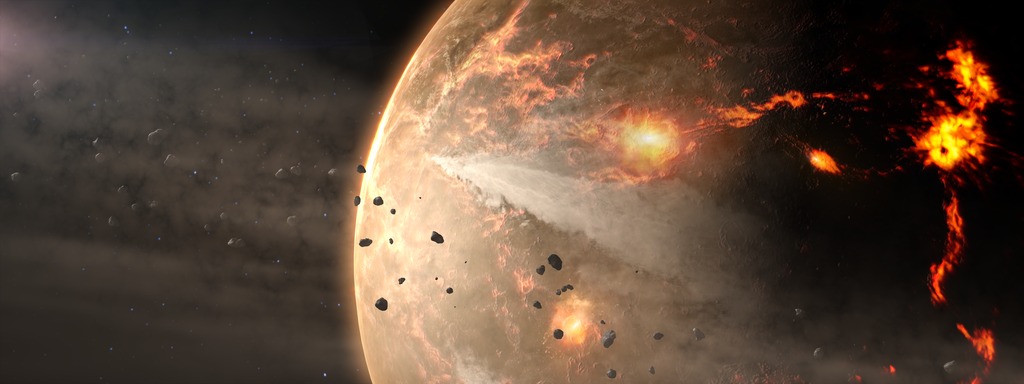
The timeline established by the team reveals a period of intense instability:
- 4.5 Billion Years Ago: The Earth forms, characterized by an initial, rapid accretion of matter and the formation of its core.
- 4.5–4.0 Billion Years Ago (The Hadean): The planet endures a persistent, heavy bombardment by asteroids and meteorites. The new model estimates thousands of impactors larger than 10 kilometers in diameter striking the Earth.
- 3.9–3.5 Billion Years Ago: The frequency of impacts declines exponentially, allowing the internal heat budget to finally stabilize and the mantle to cool.
- 3.5 Billion Years Ago–Present: As the crust thickens and cools, the conditions for modern plate tectonics are finally met, leading to the rapid proliferation of continental landmasses.
The Physics of Cosmic Heating
The study introduces a novel approach to the Earth’s "heat budget," moving beyond internal radioactive decay and residual heat from accretion. When a massive asteroid strikes, the kinetic energy is enormous. A portion of this energy vaporizes rock at the impact site, but the vast majority propagates deep into the mantle.
"It really is as simple as converting the size and the velocity of the impactor into energy," Dr. Johnson notes. The simulation reveals that this energy input was significant enough to exceed radiogenic and core heat for the majority of the Hadean by approximately an order of magnitude.
The geological implications of this are profound. The intense bombardment created a crust that was, for the first few hundred million years, incredibly thin—likely less than 5 kilometers thick. More importantly, the model suggests that at depths of only 2 to 3 kilometers, partial melting was widespread. By 5 kilometers, melt fractions reached 30 percent, creating a "mushy" environment where rigid tectonic plates could not possibly exist. This "heat-soak" effectively prevented the formation of the lithosphere required for subduction, explaining why the early Earth looked nothing like the world we know today.
Implications for Earth’s Crustal Evolution
The findings offer a compelling explanation for two major mysteries: the lack of surviving Hadean crust and the absence of shock-deformed zircons. The team’s simulations show that the intense heat from impacts caused wholesale recycling of the crust. Material was constantly being dragged down to depths of 600 kilometers or more. Furthermore, the presence of widespread, shallow melt acted as a natural dampener, absorbing and scattering the shockwaves from major impacts before they could leave permanent markers in the surviving mineral record.
As the bombardment subsided, the Earth entered a transitional phase. With the external heat source fading, the upper mantle cooled, allowing the basaltic crust to thicken. Once the crust reached a critical threshold—approximately 30 kilometers—it became rigid enough to support the stresses of plate tectonics. It is no coincidence, the researchers argue, that the oldest continental rocks appear exactly when the impact flux drops below a critical level.

"As soon as you can create thick crust and you can create a mantle lithosphere underneath, you can start building continents," Johnson explains.
Scientific Perspectives and Future Research
The reliance on complex, physics-based modeling rather than direct physical samples has drawn some scrutiny, but the consensus within the community is shifting. Given the impossibility of finding a "complete" geological record of the Hadean, the scientific community is increasingly accepting that numerical simulations are the most robust tool available for understanding the planet’s earliest chapters.
The argument is bolstered by the ongoing hunt for ancient terrestrial samples. The discovery of a 4.2-billion-year-old mafic rock in the Nuvvuagittuq Greenstone Belt in Canada has provided a vital anchor point for these models. Dr. Johnson hints that the scientific community should expect further revelations: "I know another group has found a rock which is possibly even older. Hopefully, you will be able to read about it in the next couple of months."
Ultimately, this study reframes the history of our planet. Rather than viewing the Hadean as a period of quiet, internal maturation, we must now see it as a period of external violence. The continents, and by extension the environment that allowed for the evolution of life, are the survivors of a cosmic bombardment that defined the early solar system.
The "missing" 500 million years are no longer missing; they were simply written in a language of fire and impact, a history that we are only now beginning to translate through the synergy of lunar data and computational geodynamics. As we continue to refine these models, we move closer to understanding the true cost—and the violent necessity—of the ground beneath our feet.