In January 2025, the Eaton Fire tore through Altadena, California, with a ferocity that defied containment. For residents like Sylvie Andrews, the blaze was not merely a natural disaster; it was the violent erasure of a decade of life. The fire consumed the house she and her partner had painstakingly built, a structure that represented years of sacrifice, savings, and the promise of a stable future in their hometown.
"We put a lot of blood, sweat, and tears into it," Andrews says, reflecting on the devastation. "That’s what we lost in the fire."
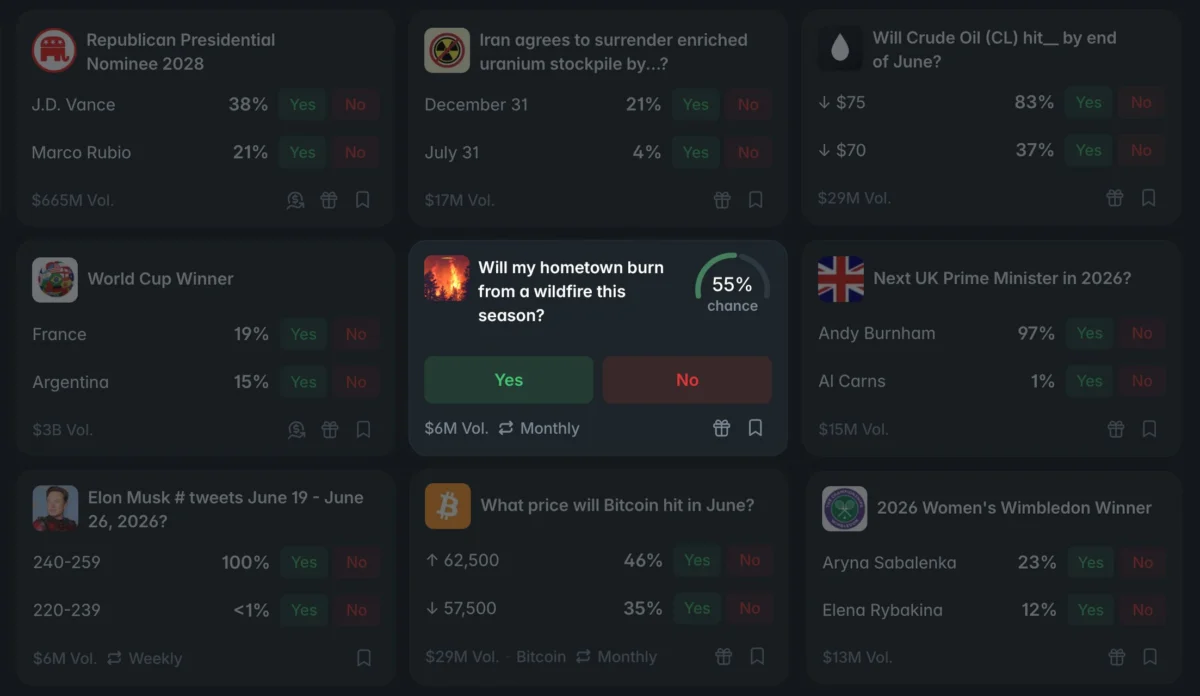
Yet, as thousands of Angelenos were scrambling to evacuate, navigating the trauma of fleeing their homes, a disparate group of individuals was viewing the catastrophe through a very different lens: as a financial instrument. On Polymarket, the world’s largest prediction market, users were placing bets on the fire’s trajectory—its speed, its duration, and the extent of the destruction it would leave in its wake. This phenomenon, where human suffering is reduced to a "yes" or "no" contract, has sparked a fierce debate over the ethics of modern gambling and the dangerous incentives created by turning environmental crises into commodities.
The Mechanics of "Catastrophe Capitalism"
Prediction markets operate as speculative exchanges where participants buy and sell contracts on the outcomes of future events. While these platforms often focus on elections or sports, their reach has expanded to include virtually anything with a measurable outcome. Contracts fluctuate in price between $0 and $1; if a "yes" contract sits at 50 cents, it indicates a collective belief that the event has a 50 percent probability of occurring. The platform host profits by taking a transaction fee on every wager.
During the January 2025 wildfire crisis, Polymarket listed nearly 20 questions related to the Palisades and Eaton fires. These were not abstract queries; they were granular, high-stakes prompts: How many acres will the Palisades Fire burn by Friday? Will the fire reach Santa Monica by Sunday? When will the blaze reach 50 percent containment?
According to data cited by Aeon Magazine, users wagered a staggering $1.2 million on these specific queries. When informed of the scale of the betting, Andrews was left speechless. "My first take is that it’s morally reprehensible," she said. "The fact that someone would feel OK doing that flabbergasts me."
A Chronology of Crisis and Speculation
The wildfire season in Southern California is an annual ritual of anxiety, but 2025 marked a dark evolution.
- January 2025: The Eaton and Palisades Fires ignite, leading to mass evacuations.
- January 10, 2025: Polymarket begins hosting active betting markets on the fires’ progression, drawing national attention and criticism.
- Early 2025: Total wagers on wildfire outcomes reach $1.2 million, highlighting the intersection of digital gambling and climate-driven destruction.
- March 2025: Bipartisan federal legislation is introduced by representatives from Utah and California, aiming to curb markets related to violence and disaster.
- Mid-2025: A specialized platform, "Wyldfyre," launches with the provocative tagline: "You can’t predict wildfire. But you can trade on it."
The emergence of niche platforms like Wyldfyre suggests that the practice is not merely an anomaly but a growing business model. While Wyldfyre currently operates as a simulator, it has signaled that real-money trading is "coming soon." By utilizing NASA hotspot data and National Interagency Fire Center perimeters, these platforms claim to offer a public service—a "crowdsourced intelligence" model that purports to turn collective intuition into accurate forecasting.
The Perilous Intersection of Arson and Incentive
The primary concern among fire survivors and public safety officials is the potential for these markets to incentivize criminal behavior. Unlike a hurricane or a heatwave—natural phenomena that are largely impervious to human intervention—a wildfire can be ignited by a single person with a match.
"The prediction markets are just the wild, wild West," says Susan Sherman, a Pacific Palisades resident who lost her childhood home in the 2025 fires. "I look at [betting on the fires] as just being very crass and heartless."
Sherman’s fear is shared by experts who warn that the financial gain offered by these platforms could provide a perverse motivation for arson. If an individual stands to make a significant profit by betting that a fire will expand or cross a specific boundary, the barrier to committing a crime is lowered.

Ann Skeet, senior director of leadership ethics at the Markkula Center for Applied Ethics at Santa Clara University, emphasizes the danger of this dynamic. "Imagine what a bad actor might do," Skeet says. "A market that might support that kind of activity is a dangerous market." Beyond arson, Skeet warns of the potential for insider trading, where individuals with privileged access to emergency management data—such as firefighters or municipal officials—could leverage their knowledge for personal gain.
Official Responses: Science vs. Speculation
Despite the claims of prediction market proponents that their platforms provide useful data, the institutions tasked with managing these fires have issued a categorical rejection of such services.
"The Forest Service does not use information from prediction markets for wildfire forecasting," a spokesperson for the agency stated. "We do not rely on any system that treats wildfire as an event for speculation. Our priority is protecting firefighters, communities, and public lands."
The California Department of Forestry and Fire Protection (Cal Fire) echoes this stance. Phillip SeLegue, staff chief of Cal Fire’s intelligence program, clarifies that their operational decision-making is rooted in "deterministic and physics-based" modeling. This system integrates real-time weather observations, fuel and vegetation moisture levels, and topography. "Our modeling is not informed by markets, wagering systems, crowd predictions, or any other form of prediction-market mechanism," SeLegue noted.
For these agencies, the distinction is vital: while prediction markets rely on the "wisdom of the crowd"—which is often influenced by hype and cognitive biases—firefighting requires rigorous, science-based data to save lives.
The Ethical and Legislative Fallout
The rise of these markets has triggered a legislative scramble. In March, federal lawmakers introduced bipartisan bills to prohibit betting on events related to terrorism, war, and "illegal activity." California senators have similarly pushed for legislation that would explicitly ban contracts regarding an individual’s death or catastrophic injury.
The legal landscape remains complicated. When Minnesota attempted to become the first state to outlaw the hosting of such markets, the federal government challenged the move, arguing it was an overreach of state authority. This legal tug-of-war highlights the difficulty of regulating digital platforms that operate across state and national borders.
However, the most pressing issue remains the moral erosion caused by these platforms. "When you start gambling on somebody’s potential death or harm, you’re really diminishing the value that you’re placing on human life," Skeet observes.
A Path Toward Restorative Justice?
As the wildfire season looms, the debate over whether to ban these markets or merely regulate them continues. For survivors like Sylvie Andrews, the presence of these markets feels like a final indignity. She offers a simple, albeit radical, proposal: if these platforms insist on profiting from the misery of others, that money should be redirected.
"If someone won money in gambling with our fate, I would hope that they might be ashamed of themselves," Andrews says. "And take that money and donate it directly to fire survivors."
Whether the gambling industry will ever embrace such a measure remains unlikely. For now, the "Wild West" of prediction markets continues to operate, turning the charred remains of homes and the fear of displaced communities into the latest high-frequency trade. As the world watches the climate grow more volatile, the question of whether we will allow our tragedies to become our currency is one that society must answer—before the next spark is struck.