

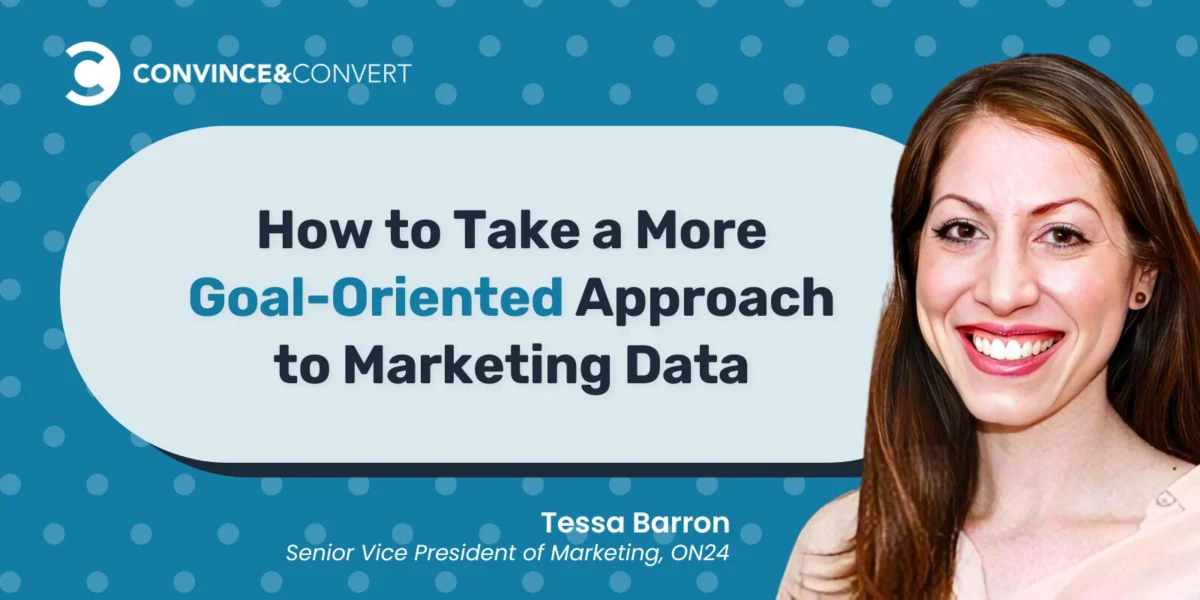
In the current economic climate, the mantra "do more with less" has become a pervasive, if exhausting, directive for marketing departments across the globe. As organizations face the dual pressures of tightening budgets and ballooning pipeline targets, many marketers find themselves trapped in a cycle of diminishing returns. The traditional response—cranking up the volume on content creation, increasing ad spend, and accelerating the cadence of webinars—often fails to bridge the gap between effort and actual revenue generation.
However, according to Tessa Barron, former Senior Vice President of Marketing at ON24 and a recent guest on the Data-Driven Decisions podcast, the solution to this impasse is not to increase output, but to fundamentally alter the philosophy of marketing itself. By shifting from a "tactic-first" mentality to a "goal-oriented" data strategy, marketers can transform their departments from cost centers into precision-engineered revenue engines.
The Myth of the Tactic-First Approach
For years, the marketing playbook has remained largely stagnant: execute a high volume of webinars, whitepapers, blog posts, and videos, and hope the pipeline follows. This reliance on "tried-and-tested" methods is a comfort zone for many, but it is also a trap.
The fundamental issue, Barron argues, is the disconnect between activity and objective. When marketers start by planning "four webinars for Q1," they are focusing on the how rather than the why. If the goal is a 10% increase in pipeline or a specific number of new account acquisitions, the tactic should be a deliberate response to that goal, not the starting point of the conversation.
The Post-Pandemic Reality Check
The professional landscape has shifted dramatically since 2020. Buyer behaviors have evolved, and the "same old" tactics that yielded high engagement three years ago may now be failing to resonate with an audience that is increasingly fatigued by digital noise. Barron challenges marketers to perform a self-audit: if you are executing your marketing strategy exactly as you did four years ago, you are likely chasing ghosts. "If the answer is yes, that is the first sign that we need to stop expecting that if we execute the same way… we’re going to get more in return," she notes.
Uncovering Key Signals: Beyond Vanity Metrics
In an era of "big data," marketers are drowning in information. The challenge is not gathering data, but identifying the "signal" within the noise. A signal, in this context, is any behavioral indicator that suggests a prospect is moving closer to a conversion point.
Designing "Traps" for Insight
Barron advocates for the use of interactive content as a data-collection mechanism. Instead of treating a webinar as a passive broadcast, marketers should treat it as an opportunity to "set traps"—strategic touchpoints designed to capture actionable intent.
By utilizing features like polls, live surveys, and targeted Q&A, marketers can move beyond vanity metrics (like attendee count) and focus on intelligence gathering. For instance, if a company identifies that prospects using a specific cloud provider are ten times more likely to convert, they can embed a direct question about cloud infrastructure within a webinar registration form or live poll. This transforms the webinar from a simple content delivery vehicle into a high-fidelity qualification tool.
Case Studies in Strategic Capture
- The Technology Sector: A firm struggling to regain market share utilized webinar polls to qualify attendees based on their existing tech stack. By isolating the segment using a specific cloud provider, they could feed these "high-signal" leads directly to sales, dramatically increasing the efficiency of the follow-up process.
- The Pharmaceutical Industry: A healthcare company aimed to identify doctors with high-risk patient bases. By creating educational content that addressed specific treatment breakthroughs and asking attendees to self-identify their patient risk profile, the company was able to prioritize their outreach to the doctors who had an immediate, high-priority need for their therapies.
Aligning the Marketing-Sales Interface
Perhaps the most critical, yet often overlooked, component of pipeline growth is the alignment between marketing and sales. Too often, marketing departments operate in a vacuum, creating content based on internal assumptions rather than the realities of the sales floor.
Bridging the Knowledge Gap
Barron posits that the best source of marketing intelligence is not a dashboard, but a conversation with a salesperson. Sales teams sit on the front lines, engaging in direct dialogue with prospects who are currently experiencing pain points, doubts, and hesitations. By failing to integrate this front-line feedback, marketers risk creating content that is technically impressive but strategically irrelevant.
Marketers should be asking:
- What are the top three objections the sales team encounters during a discovery call?
- What specific information does a prospect need to feel confident enough to move from a demo to a contract?
- How can we build "signals" into our content that specifically address those doubts?
Defining Roles in the Pipeline
There is a common misconception that marketing is responsible for the pipeline. Barron clarifies this: "Marketers are creating signals and developing a net to catch people who might turn into pipeline. But it’s the salespeople, those on the front lines, who create pipeline."
When marketing views its role as providing the "clearest picture" of the prospect to the sales team before the first phone call, the dynamic changes. Marketing ceases to be a separate silo and becomes an extension of the sales force, tasked with the mission of shortening the sales cycle and increasing the velocity of lead-to-opportunity conversion.
The Framework for Persistent Messaging
To effectively move prospects through the pipeline, marketers must move beyond generic messaging. The goal is to create a seamless, relevant narrative that evolves as the prospect engages. This requires a rigorous audit of every touchpoint:
- Eliminating Friction: Often, the barrier to conversion is not the content, but the administrative hurdle—such as overly long, outdated lead forms.
- Tailored Content Paths: Using data signals to trigger specific, relevant follow-up content based on the prospect’s previous interactions.
- Cross-Departmental Synergy: Ensuring that the messaging used in marketing collateral is echoed in the sales deck, creating a consistent brand experience that builds trust.
By focusing on the "little steps" between a cold lead and a qualified opportunity, marketers can exert control over the conversion rate. It is in these granular adjustments—shortening a form, refining a CTA, or targeting an email based on a specific webinar poll response—that significant, compounding growth is found.
Communicating Value to Stakeholders
The final hurdle for the data-driven marketer is the presentation of results to executive stakeholders. In many organizations, there is a disconnect between the "noise" of marketing data and the "bottom line" concerns of the C-suite.
Barron emphasizes that simplicity is a virtue. Stakeholders are generally less interested in the complexity of the strategy and more concerned with the directionality of the metrics: Is the pipeline growing? Is the cost-per-acquisition trending down? Does this specific tactic impact the bottom line?
By stripping away the vanity metrics and presenting only the data that tracks against the stated organizational goals, marketers build credibility. When the entire company speaks the same language of "signals" and "conversion," the strategy becomes a shared mission rather than a department-specific task.
Implications for the Future
The shift toward a more intentional, data-informed marketing strategy is not merely a reaction to current budget constraints—it is a necessary evolution. As the digital landscape becomes more crowded and buyer attention more fragmented, the ability to discern intent and act upon it with surgical precision will define the winners in the marketplace.
Marketers who successfully pivot away from the "do more" mindset and embrace the "do better" philosophy will find themselves better positioned to weather economic volatility. By aligning data capture with sales goals, refining the handoff between marketing and sales, and focusing exclusively on metrics that signify intent, organizations can build a sustainable pipeline that is resilient, scalable, and—most importantly—profitable.
The era of mass-market, high-volume tactics is waning. The era of the strategic, signal-based marketer is here. To listen to the full discussion on these methodologies, industry professionals are encouraged to explore the Data-Driven Decisions podcast series, where these concepts are explored in greater depth, offering a blueprint for the next generation of marketing leadership.










