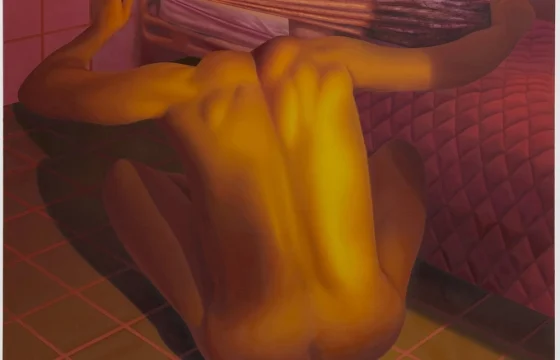
In the white-walled sanctuary of Lyles & King’s project space, a series of new paintings by Los Angeles-based artist Kate Meissner is currently commanding the attention of the New York art world. The exhibition, which remains on view through April 4, marks a pivotal moment in Meissner’s rapidly ascending career, offering a visceral, unfiltered investigation into the physical and psychological landscapes of pregnancy and early motherhood. By centering her practice on the inherent "animalistic and mammalian nature" of the human body, Meissner has crafted a collection of works that challenge traditional aesthetic representations of gestation, opting instead for a raw, honest look at human metamorphosis.
Main Facts: A Visceral Exploration of Transformation
Kate Meissner’s latest exhibition is not merely a collection of paintings; it is a meditation on the biological imperative of change. The works on display, curated specifically for the gallery’s intimate project space, utilize the canvas as a site of physical inquiry. For Meissner, the body is a site of constant negotiation—an entity capable of extreme elasticity, shifting, expanding, and reforming to accommodate new life.
The central thesis of the exhibition is deeply rooted in the artist’s personal history. Having given birth to her first child just last year, Meissner’s brushwork reflects a profound shift in perspective. Her compositions suggest that the body is not a static vessel, but a permeable, changing landscape. Critics and gallery visitors alike have noted the "animalistic" quality of her subjects, which move away from the idealized, serene depictions of pregnancy often found in art history. Instead, Meissner leans into the physiological grit of the experience: the stretching of skin, the shifting of organs, and the primal instinctual nature that governs the mammalian body during the reproductive cycle.
Chronology: The Evolution of an Artist
To understand the weight of this current exhibition, one must look at the trajectory of Meissner’s career, which has been characterized by a steady rise toward institutional recognition.
- 1995: Born in Sacramento, California.
- Formative Years: Meissner developed an interest in the intersection of biological science and visual art, a theme that would eventually define her signature style.
- Yale University: Meissner earned her MFA from the prestigious Yale School of Art, where her technical proficiency in painting matured, and her conceptual focus on the human form began to take its current shape.
- Career Foundation: Following graduation, Meissner established a base in Los Angeles, where the landscape of the American West began to influence the color palettes and atmospheric depth of her work.
- Institutional Recognition: Her work was acquired by several major institutions, including the Denver Art Museum, the Xiao Museum of Contemporary Art in Rizhao, China, The Mer Collection in Madrid, and the Abroms-Engel Institute for the Visual Arts.
- 2023-2024: The birth of her child catalyzed a radical shift in her creative process, leading directly to the body of work currently on display at Lyles & King.
- Present Day: The exhibition at Lyles & King, New York, serves as a major platform for her most personal and poignant work to date.
Supporting Data: The Institutional Footprint
Meissner’s presence in the global art market is underscored by the diversity of her permanent collections. Her work occupies a unique space between figurative abstraction and surrealist biology, a duality that has attracted significant institutional support.
| Institution | Location | Collection Focus |
|---|---|---|
| Denver Art Museum | Denver, CO | Contemporary Figurative Art |
| Xiao Museum of Contemporary Art | Rizhao, CN | International Contemporary |
| The Mer Collection | Madrid, ES | Modern & Contemporary |
| Abroms-Engel Institute | Birmingham, US | Academic & Contemporary |
These acquisitions are significant because they suggest that Meissner’s exploration of the body is viewed as a vital contribution to contemporary discourse. By placing her work alongside historical and contemporary masters in these collections, galleries and museums are validating her exploration of pregnancy as a subject worthy of serious, intellectualized artistic pursuit.
Official Responses and Artistic Intent
In her official statement regarding the show, Meissner provides a roadmap for the viewer, clarifying the impetus behind the series:
"These works are an exploration of the human body’s elasticity and capacity to metamorphose. Informed by my own experience of pregnancy and the birth of my first child last year, these paintings are a meditation on physiological transformation and the body’s underlying animalistic and mammalian nature."
The gallery, Lyles & King, has positioned this project as a flagship event for the season. By dedicating their project space to these works, they are acknowledging that Meissner is one of the most compelling young voices examining the physical reality of being human. The gallery’s support of her work reflects a broader trend in the New York art scene, which is increasingly prioritizing artists who merge personal autobiography with universal biological themes.
Implications: The Future of "Body Politics" in Art
The implications of Meissner’s exhibition are manifold. By stripping away the "glow" often associated with pregnancy in pop culture and replacing it with an exploration of "elasticity" and "mammalian nature," Meissner is reclaiming the narrative of childbirth as a transformative, often uncomfortable, and undeniably powerful physical event.
The Re-centering of the Maternal Body
For centuries, the maternal body in art has been filtered through the male gaze—rendered either as a symbol of divine holiness or as a source of domestic comfort. Meissner’s work disrupts this binary. Her paintings treat the body as a site of labor and survival. This shift has implications for how we define "figurative painting" in the 21st century. It suggests that the most compelling subjects for contemporary art are not necessarily external landscapes, but the internal landscapes of our own physical systems.
The Intersection of Science and Aesthetics
Meissner’s work also bridges the gap between scientific observation and artistic expression. By emphasizing the "mammalian nature" of the subject, she invites viewers to think about humanity not as something distinct from the natural world, but as a direct participant in it. This has profound implications in an era defined by climate crisis and a growing awareness of our environmental dependencies. If we view the body as a site of animalistic metamorphosis, we are forced to view the "self" as something fluid rather than fixed.
Institutional Shifts
The fact that major institutions like the Denver Art Museum and the Xiao Museum of Contemporary Art have already invested in Meissner’s work suggests that the art market is hungry for this kind of rigorous, identity-based, yet deeply universal inquiry. We can expect to see more galleries focusing on artists who leverage personal life events—such as motherhood, aging, and recovery—to interrogate the broader human condition.
Conclusion: A Must-See Exhibition
Kate Meissner’s exhibition at Lyles & King is a testament to the power of the artist’s gaze to transform the intimate into the monumental. By inviting the public to engage with the realities of pregnancy—not as a social milestone, but as a profound biological event—she has created a series of works that are as intellectually demanding as they are visually arresting.
For those looking to engage with the cutting edge of contemporary painting, the exhibition provides a rare opportunity to witness an artist operating at the height of her powers. As the exhibition concludes on April 4, the lasting impact of Meissner’s work will likely be felt in the ongoing discourse regarding the body in art, serving as a reminder that our most fundamental human experiences are often the most misunderstood and the most worthy of artistic exploration.
Visitors interested in viewing the exhibition are encouraged to visit Lyles & King in New York City. The gallery continues to maintain strict standards regarding visitor experience, ensuring that the dialogue between the viewer and the art remains the primary focus of the space.