Asro
Asro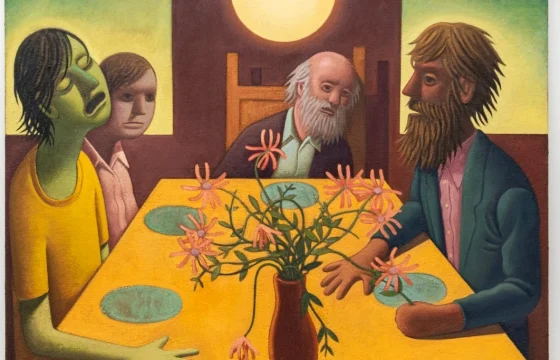
HESSE FLATOW, the acclaimed New York-based contemporary art gallery, has officially unveiled its latest exhibition, Franklin, a poignant and expansive collection of new paintings and works on paper by Nat Meade. Marking his third solo presentation with the gallery, the exhibition serves as a profound meditation on the complexities of the masculine experience, familial legacy, and the cyclical nature of life. The show, which opened recently, will remain on view through April 18, 2026, offering visitors an immersive look into the evolving visual lexicon of an artist who continues to interrogate the boundaries between the personal and the archetypal.
The Intersection of the Personal and the Archetypal
At the heart of Franklin lies an emotional topography that maps the struggles and triumphs of the human condition. Meade’s work does not aim for the literal; he is not interested in the documentary portraiture of his own life. Instead, he utilizes his personal experiences—navigating the multi-faceted roles of father, son, partner, and academic—as a springboard for creating timeless archetypes.
In this exhibition, the figures that inhabit Meade’s canvases act as proxies for universal existential quandaries. We encounter the lone traveler, a figure burdened by the search for validation; we see the friction of intergenerational dynamics; and we witness the quiet, often absurd, moments of domestic life. By distancing himself from direct autobiography, Meade achieves a rare clarity, allowing the viewer to project their own experiences onto his subjects. This allegorical approach transforms individual vulnerability into a broader, more resonant narrative about the inherent absurdity and solemnity of human nature.
A Chronology of Artistic Evolution: From Turbulence to Calm
To understand the significance of Franklin, one must look at the trajectory of Meade’s career and the recent, seismic shifts in his personal life. The themes present in this body of work were catalyzed by the recent passing of his father—an event that forced the artist into a rigorous re-evaluation of his own role as a parent and his position within the lineage of his family.
Early Career: The Struggle with Nature
In previous bodies of work, Meade’s protagonists were frequently depicted as victims of, or participants in, violent confrontations with the natural world. Figures were often shown wrestling with turbulent winds, engulfed by crashing waves, or dwarfed by geological forces. These paintings served as metaphors for the uncontrollable pressures of societal and familial expectations. The environment was an adversary, and the figures were defined by their struggle for survival.
The Turning Point: The ‘Franklin’ Era
In Franklin, the environment has shifted. The seas have calmed, the storms have abated, and the focus has moved from external struggle to internal reconciliation. This evolution marks a significant departure in Meade’s artistic output. The inclusion of younger, more harmonious figures—children and adolescents—contrasts sharply with the weight of the adult characters. This is not merely a stylistic choice but a philosophical one: Meade is charting a path toward healing, suggesting that by acknowledging one’s "rocky histories," it is possible to release future generations from the burdens of the past.
Supporting Data and Thematic Analysis: The Symbolism of the Archetype
Meade’s work is layered with dense, often literary, and historical references that reward close inspection. The exhibition title itself, Franklin, acts as a subtle, unsettling homage to the 1974 horror classic The Texas Chainsaw Massacre. The reference to the character Franklin—a member of a doomed group navigating a landscape dominated by a deranged patriarchal family—sets the tone for the exhibition’s exploration of the "inner turmoil" of inherited violence and masculine dysfunction.
The Specter of the Past
Throughout the exhibition, ghostly specters hover over many of the figures. These ethereal, translucent forms serve as visual metaphors for inherited trauma and the process of release. In a nod to the slapstick morbidity of classic cartoons—where a soul might peel away from a body at the moment of expiration—Meade’s ghosts look back at their hosts with expressions that hover between happiness and regret. It is a chilling yet tender depiction of the duality of memory.
Mythological and Literary Echoes
Meade draws heavily from the Western canon to ground his figures in historical significance:
- Promethean Suffering: A striking work depicting a vulture picking at a corpse invokes the eternal punishment of Prometheus, highlighting themes of endurance and suffering.
- The Blakean Influence: A bearded figure, rendered on his hands and knees, mirrors William Blake’s iconic depiction of Nebuchadnezzar, a king driven mad by his own lust for power and pride.
- Ascension and Descent: In the piece titled Poise, a pair of legs dangles from a cloud. The ambiguity—are they descending or ascending?—questions the interchangeability of life and death, physical existence and spiritual transcendence.
Official Perspectives: The Artist’s Intent
While the gallery maintains a curatorial distance, the thematic core of the show has been shaped by Meade’s transparent grappling with his own history. The artist does not shy away from the darker aspects of the human psyche—pain, mortality, and the antagonistic impulses that define our worst moments—but he balances these with a newfound sense of hope.
"The introduction of younger males in this body of work," notes the gallery’s exhibition summary, "casts a sense of hope, acceptance, reconciliation, and renewal." This is most evident in the paintings of a young boy steering a boat with a radiant torch, or an adolescent reaching into a cove filled with marine life. These figures are not yet weighed down by the "societal and familial pressures" that define the adult figures in the gallery. By placing these innocent, explorative figures alongside the older, more troubled ones, Meade provides a visual roadmap for progress.
Implications for Contemporary Figurative Painting
The exhibition Franklin serves as an important case study in how contemporary painters are reclaiming the figure to address systemic issues of masculinity and mental health.
The Sublimation of Trauma
Meade’s work suggests that art serves as a site of sublimation—a way to put one’s impulses "in their place." By painting his demons, he renders them manageable. The implication for the viewer is one of empowerment; if the artist can acknowledge his own rocky history and steer the boat toward calmer, clearer waters, then the cycle of trauma is not inevitable.
Resilience as a Human Constant
Ultimately, the exhibition stands as a testament to the "stubborn resilience of human nature." Despite the "insurmountable heaviness" that the adult figures often carry, the presence of the child represents a possibility for a future free from the patterns of the past. The tender depiction of a father guiding his son in a shallow pool—a mirror image of the father/son dynamic that haunts the rest of the show—serves as the emotional anchor of the exhibition. It is a quiet, powerful assertion that while the past cannot be erased, it can be steered, guided, and eventually, healed.
Conclusion: A Must-See Exhibition
Nat Meade’s Franklin is more than an exhibition; it is an exorcism of sorts—a way of mapping the ghosts of the past to clear a path for the future. By combining the humor of the absurd with the gravity of historical and literary tragedy, Meade has created a space where the viewer is invited to confront their own familial narratives.
For those visiting Hesse Flatow between now and April 2026, the exhibition offers a rare opportunity to witness an artist at the height of his powers, successfully navigating the bridge between the personal and the universal. Whether through the lens of art history, psychoanalysis, or simply the appreciation of masterful figurative painting, Franklin provides a resonant, challenging, and deeply moving experience that lingers long after one has left the gallery walls.

 Reynand Wu
 Nana Wu