

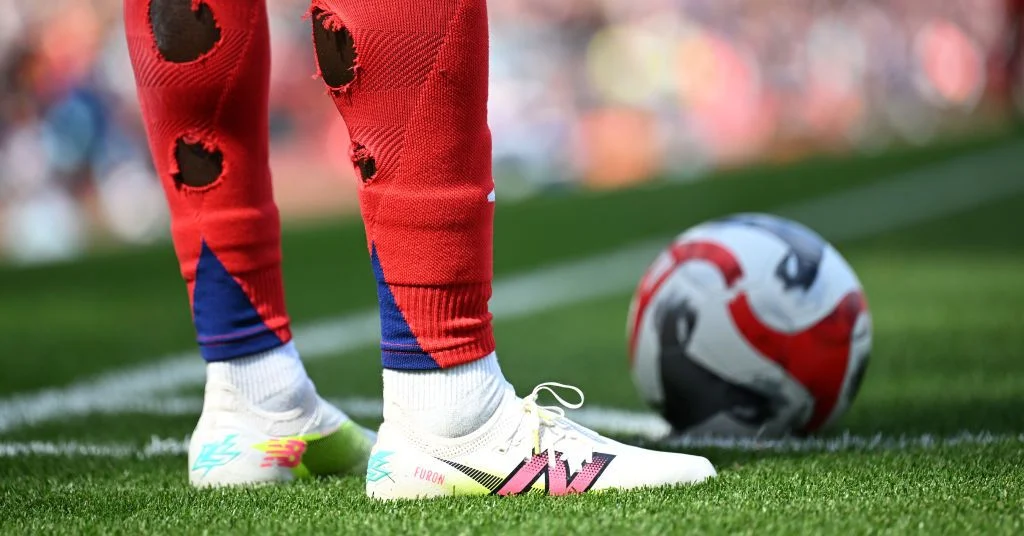
In the high-stakes theater of modern professional soccer, every margin matters. From the caloric intake of a striker to the specific stud configuration on a midfielder’s boots, the pursuit of marginal gains has transformed the sport into a data-driven enterprise. Yet, amidst this scientific revolution, one peculiar trend has taken hold on the world’s biggest stages, including the World Cup, the European Championships, and the Olympics: the deliberate mutilation of professional-grade equipment.
Game after game, millions of viewers watch as elite athletes take the pitch wearing socks riddled with holes in the calf area. While social media pundits have long theorized that these incisions provide a clandestine competitive edge—perhaps by improving aerodynamics or altering blood flow—the reality is far more grounded in human comfort and the complex interplay between anatomy and elite performance.
The Evolution of the Soccer Sock
To understand why players are cutting their socks, one must first understand what a modern soccer sock is designed to achieve. These garments are not merely textiles; they are precision-engineered tools. Utilizing advanced synthetic fibers like polyester, nylon, and spandex, manufacturers create form-fitting, high-compression tubes meant to serve three primary functions: holding shin guards firmly in place, managing moisture through wicking technology, and providing structural support to the ankle and arch.
For decades, this design principle has remained largely static. The goal has always been stability. By minimizing the micro-movements of the foot inside the cleat, players can optimize their traction and balance. However, as the pace of the game has accelerated—with modern players covering more ground and executing more high-intensity sprints than their predecessors—the demands placed on these garments have changed. The materials have become thinner and more durable, but the fundamental issue of compression remains.
A Chronology of a Growing Trend
The practice of cutting holes in socks did not emerge overnight. It has been a creeping phenomenon, observed intermittently over the last decade across various international competitions.
- 2014–2018: Early sightings of "vented" socks began to appear in European leagues. Initially, observers attributed these holes to wear and tear from aggressive play or poor equipment quality.
- 2020–2022: As the trend became more uniform across top-tier clubs, the realization dawned that these cuts were intentional. Players began appearing at major tournaments, including the UEFA European Championship, with symmetrically placed holes.
- 2024–2026: By the time of the most recent World Cup cycles, the practice had become widespread, effectively shifting from a niche preference to a semi-standardized ritual among elite professionals.
This chronology reveals a transition from a hidden, perhaps embarrassed, fix for discomfort to a visible, accepted practice that is now a hallmark of the modern professional’s kit.
The Biomechanics of Compression: Why the Calf Matters
The primary driver behind this practice is the physiological reaction of the calf muscle during elite exertion. The gastrocnemius, the largest muscle in the calf, is a powerhouse of human movement. During a sprint or a rapid change of direction, this muscle contracts violently, increasing in thickness and volume to generate the force required to propel the athlete forward.
During a 90-minute match, this cycle of contraction and expansion happens thousands of times. When a player wears a high-compression sock, that fabric exerts constant, unyielding pressure on the calf. For many athletes, this is a non-issue. However, for others, the synergy between the swelling muscle and the restrictive fabric creates a sensation of "tingling," numbness, or intense tightness.
This is not necessarily a sign of a medical emergency, but rather a manifestation of nerve compression or restricted blood flow within the superficial layers of the skin and fascia. Players have reported that this constant constriction feels like a "cramp waiting to happen," leading them to use scissors to manually "release the tension" in the fabric. By creating an opening, they allow the muscle to expand without being constrained by the synthetic weave of the sock.
What the Science Says: Fact vs. Feeling
Despite the ubiquity of the practice, there is a stark divide between player sentiment and sports medicine research.
The Medical Perspective
Sports scientists and physiologists have been clear: there is no empirical evidence to suggest that cutting holes in socks enhances physical performance. In fact, most research regarding compression garments suggests the opposite. When properly fitted, compression wear is designed to reduce muscle oscillation, support venous return, and limit inflammation during and after intense exertion. By tearing the fabric, players may be inadvertently undermining the very support the gear was designed to provide.
The Psychological Component
If the physiology doesn’t support the practice, why does it persist? The answer lies in the "psychology of the kit." In high-performance sports, the perception of comfort is intrinsically linked to confidence. If an athlete believes their movement is being restricted—even if that restriction is largely psychological—it can become a significant mental hurdle.
Eliminating that perceived barrier allows the player to enter a "flow state" more easily. If cutting a hole in a sock makes a player feel lighter, faster, or simply less bothered, that placebo effect can translate into tangible confidence on the pitch. In the world of elite sports, where the difference between winning and losing is often measured in milliseconds, the power of a player’s comfort cannot be discounted.
Official Responses and Regulatory Silence
The regulatory bodies governing international soccer, such as FIFA and various continental confederations, have maintained a surprisingly hands-off approach to the trend. The rules of the game dictate that equipment must be safe and that shin guards must be covered.
As long as the player’s modification does not compromise safety or obscure the protective gear, it is generally ignored. Unlike a torn jersey—which could provide an unfair advantage by giving an opponent something to grab or by violating strict kit-branding regulations—the sock modification is viewed as a personal preference. This lack of intervention has essentially given players a "green light" to continue the ritual, reinforcing its place in the modern game.
Broader Implications: The Future of Sports Equipment
The persistence of this trend highlights a potential gap in the sports manufacturing market. If elite players are consistently forced to modify their equipment to reach a state of comfort, it suggests that the current "one-size-fits-all" approach to compression technology may be outdated.
We are likely to see, in the coming years, a shift toward "modular" or "vented" professional socks. Manufacturers are already exploring weaves that provide high compression in the ankle and arch while utilizing lower-density, breathable mesh in the calf area. By integrating the functionality of the "cut-sock" into the manufacturing process, companies can solve the comfort issue without requiring players to compromise the structural integrity of their gear.
Conclusion
The practice of shredding socks at the World Cup is a fascinating intersection of modern sports science and the enduring, irrational rituals of the athlete. While it lacks the backing of peer-reviewed data, its existence is a testament to the fact that sports are played by humans, not machines.
Whether it is a genuine physiological relief or a powerful psychological placebo, the trend serves as a reminder that the "perfect" piece of equipment is not defined solely by lab results, but by the athlete who wears it. As we look to the future of the sport, the "holey" sock may eventually disappear, replaced by innovative designs that respect the unique biomechanical needs of the modern player. Until then, it remains a visible, shredded symbol of the athlete’s relentless quest for the perfect fit.











