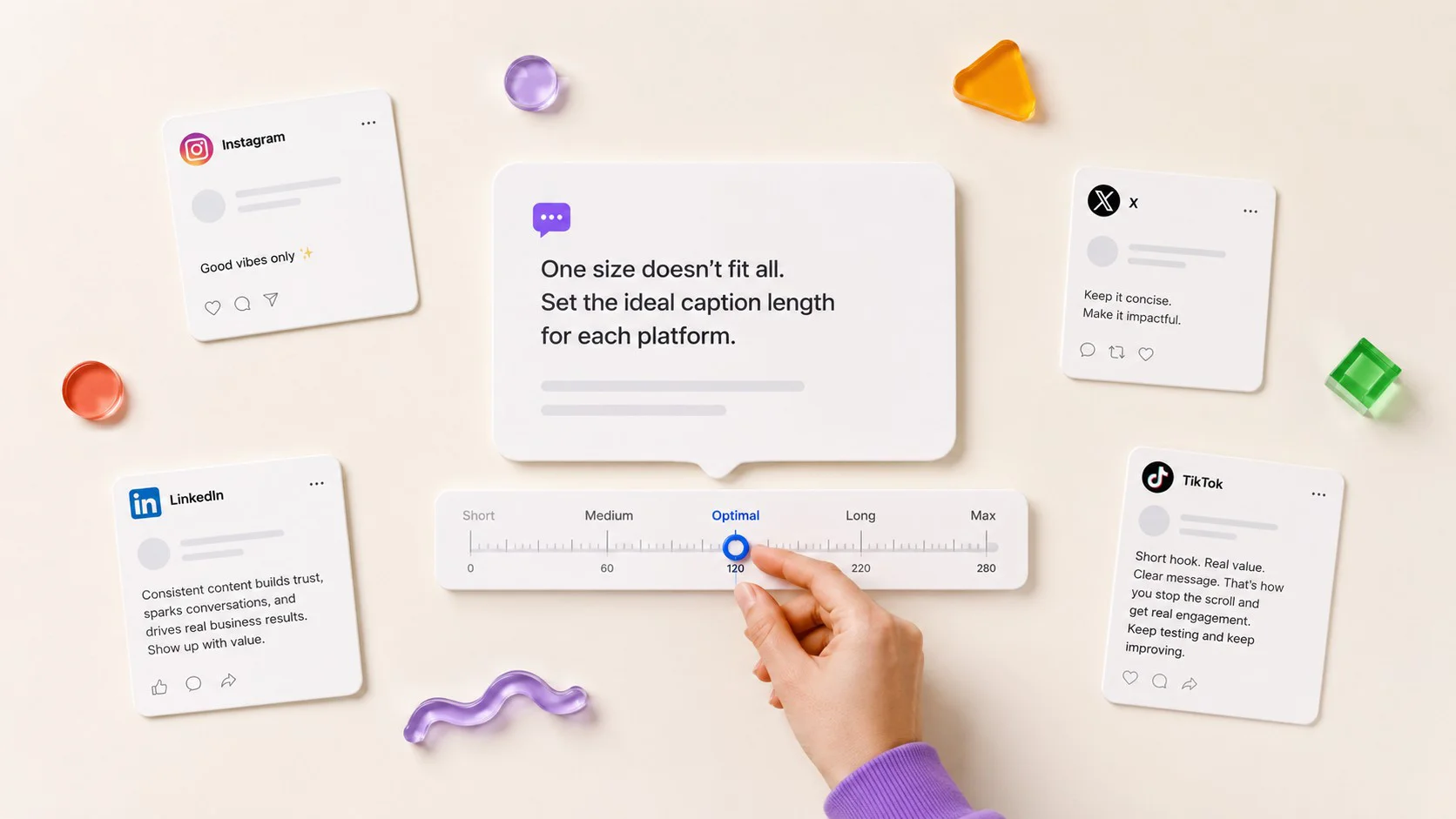
In the fast-paced world of social media, marketers often find themselves paralyzed by a simple, recurring question: "How long should my caption be?" It is a question that frequently leads to conflicting advice. One expert might insist that brevity is the soul of engagement, while another points to high-performing long-form posts as the key to algorithm success.
The reality is that both perspectives are correct, but they are rarely talking about the same platform. The confusion stems from a lack of official, universal guidance from the platforms themselves. As one marketer recently noted in a popular industry forum, the "visible hook" on LinkedIn is often limited to the first 200 characters—a technical reality that forces a specific creative strategy. When you paste the same caption into five different apps, you are likely to watch it get clipped in five different ways, rendering your carefully crafted message disjointed or hidden.
To master social media distribution, you must move beyond the "ideal length" myth. Success isn’t about finding a magic number; it is about understanding the intersection of platform architecture, user behavior, and algorithmic priority.
The Triad of Caption Strategy: Limits, Engagement, and Cut-offs
There is no single "ideal" caption length because every platform is engineered for a different user experience. To build a successful content strategy, you must understand the three distinct layers that dictate how your words appear and perform.
1. The Hard Limit (Technical Restriction)
The maximum character limit is the "floor and ceiling" set by the platform. It defines the technical boundaries of what you can publish. However, just because a platform allows 63,206 characters (as Facebook does) does not mean your audience has the patience to read them.
2. The Engagement Sweet Spot (Audience Behavior)
The best-performing length is determined by data, not by engineering. It represents the length at which users are most likely to pause, read, comment, or share. These benchmarks vary wildly based on the platform’s intent—whether it is a search engine, a conversation hub, or a visual discovery feed.
3. The Cut-off Point (The "See More" Threshold)
This is perhaps the most critical layer for performance. It is the character count at which the feed hides the remainder of your text behind a "More" or "See more" link. If your hook—your primary value proposition—is buried after this threshold, your engagement will plummet because users won’t take the extra step to expand the post.
| Layer | Definition | Impact of Ignoring It |
|---|---|---|
| Character Limit | The hard technical cap | Post rejected or truncated mid-sentence |
| Engagement Length | Optimal length for audience action | Users scroll past; content fails to gain traction |
| Cut-off Point | The "More" link threshold | Your primary hook remains hidden from view |
The Chronology of Platform Evolution
The evolution of caption limits reflects the changing nature of the platforms themselves. Initially, social media was about status updates (short). Today, platforms have shifted into search engines and long-form content hubs.
For instance, TikTok’s journey from a 300-character limit to a 4,000-character allowance signals a shift from purely visual entertainment to a robust search-indexed environment. Similarly, LinkedIn’s shift toward favoring "dwell time" has transformed its feed into a home for long-form, value-driven newsletters and posts. Understanding this history is essential: you aren’t just writing for people; you are writing for the algorithms that categorize your content based on these changing technical parameters.
Platform-by-Platform Benchmarks
Instagram: The Visual-First Approach
On Instagram, the visual takes center stage. Data from industry analysts suggests that captions under 30 words (approximately 125–150 characters) generate the highest engagement. Since Instagram cuts off captions at roughly 125 characters, your most compelling hook must appear before that point.
- Best Practice: Use the first 125 characters to provide a bold statement or a question. Reserve the remaining 2,000+ characters for stories or context, but ensure the "meat" of the post is front-loaded.
LinkedIn: The Authority Play
LinkedIn is the anomaly where "longer is better." With a 3,000-character limit, posts between 200 and 400 words often perform best. The platform’s algorithm heavily favors "dwell time," meaning it rewards content that keeps users on the platform for longer.
- Best Practice: Structure your post with a powerful hook in the first 200 characters. Use line breaks to make long-form content scannable, and treat the "See more" button as a gateway to your deeper insights.
TikTok: The Dual Strategy
TikTok requires a bifurcated strategy. If your video is trending or humorous, keep the caption under 150 characters to avoid distracting from the video. If your video is an educational "how-to," use 150–300 characters to include SEO-friendly keywords.
- Best Practice: TikTok now functions as a search engine. Use your caption to define what the video is about to help the algorithm index your content for relevant searches.
YouTube: The Search Engine Standard
YouTube titles should be kept under 70 characters to avoid truncation in search results. Descriptions, however, allow 5,000 characters.
- Best Practice: Front-load the first 150 characters of your description with primary keywords, as this is all that appears in search snippets.
Supporting Data: Why "Dwell Time" Matters
The shift toward longer, more descriptive content on platforms like LinkedIn and TikTok is not accidental. Recent analysis shows that posts exceeding 400 words on LinkedIn earn significantly higher median impressions than their shorter counterparts. This is driven by "dwell time"—the amount of time a user spends interacting with a post.
Conversely, Facebook remains a platform of brevity. Data suggests that for organic posts, 40 to 80 characters remain the standard for effective communication. The lesson is clear: do not force long-form content onto a platform designed for quick, bite-sized interactions.
Official Guidance and Platform Implications
While platforms rarely provide a "cheat sheet" for caption length, their UI design acts as an implicit guide. The presence of a "See more" link is a direct instruction from the platform: capture the user’s attention within these parameters, or lose them.
The implication for brands is significant: you must invest in "hook writing." If you cannot distill your value proposition into the first 100–200 characters, the depth of your content becomes irrelevant. Furthermore, as AI integration becomes standard, platforms are increasingly prioritizing the intent of the text. Captions that sound like natural language rather than keyword-stuffed SEO traps are beginning to perform better across the board.
Workflow: How to Adapt Without Rewriting
The fear of having to write eight different versions of the same caption is a common barrier to consistency. To streamline this, adopt a "Master-to-Fragment" workflow:
- Draft a Master Caption: Write your most comprehensive version first, including all relevant context, storytelling, and call-to-actions.
- Extract the Hook: Condense your master version into a single, punchy opening sentence. This is your "universal hook."
- Platform-Specific Trimming:
- For LinkedIn: Use the full master version.
- For Instagram: Use the hook plus a brief supporting sentence.
- For X/Threads: Use the hook plus a call to action.
- Keyword Injection: Adjust the vocabulary based on the platform’s search intent (e.g., use SEO keywords for TikTok and YouTube, but keep the tone conversational for Threads).
Conclusion: The Data-Driven Future
There is no universal "ideal" caption length, and any source claiming one is ignoring the nuance of modern social media. The right length is the one that respects the platform’s design, satisfies the algorithm’s ranking signals, and answers the user’s intent.
The next time you draft a post, look beyond the character count. Ask yourself: "Does this hook demand attention within the first 150 characters?" If the answer is yes, you have already won half the battle. Use these benchmarks as a starting point, but let your own analytics dashboard be the final judge of what works for your specific audience. By moving from a "guesswork" strategy to a "data-optimized" workflow, you can ensure that your message is not just published, but actually read.