

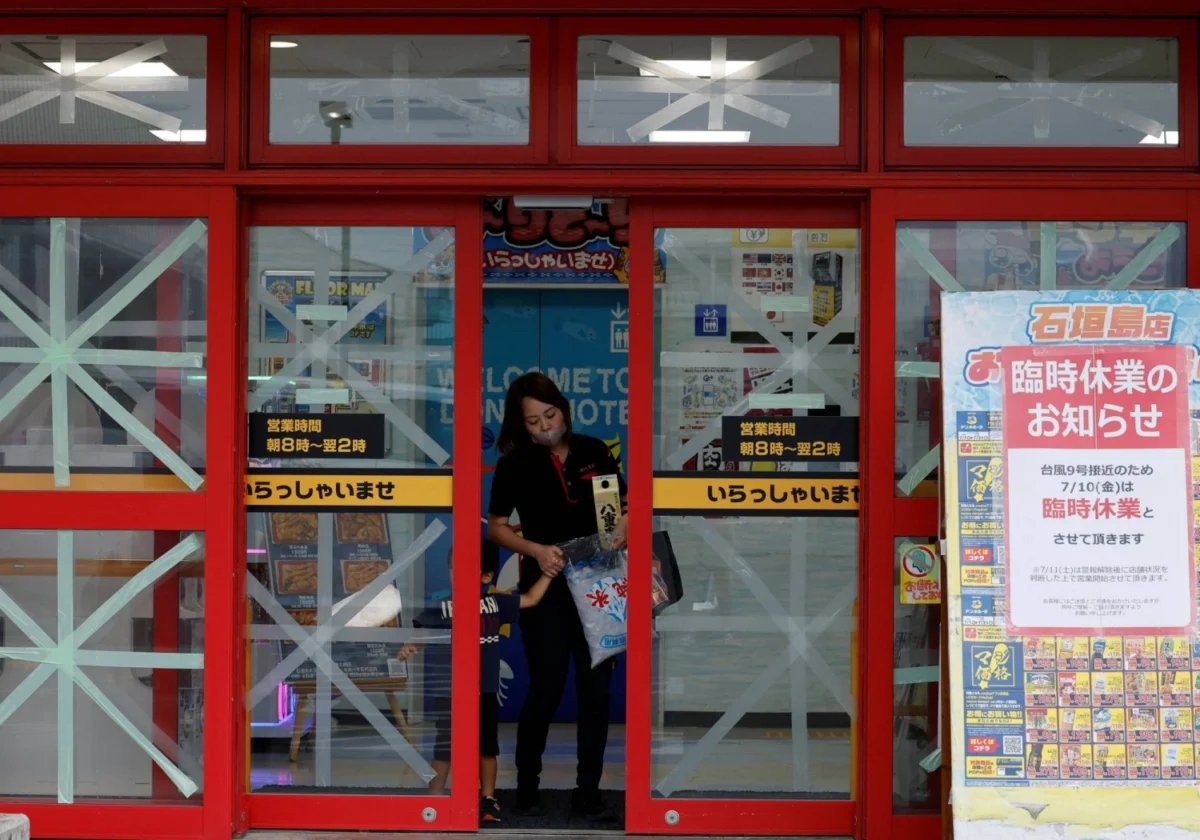
ISHIGAKI, OKINAWA PREF. — Residents of Japan’s remote southwestern island chain are bracing for impact as Typhoon Bavi, a powerful and rapidly intensifying cyclone, tracks toward the Sakishima Islands. With maximum sustained winds already clocking in at 162 kilometers per hour (100 mph), local authorities have issued urgent warnings, urging citizens to prepare for what meteorologists fear could be the most destructive weather event to hit the region in recent memory.
As the storm system closes in, the mood in Ishigaki—a popular tourist destination known for its pristine beaches—has shifted from routine preparation to urgent survival mode. Windows across the island have been crisscrossed with heavy-duty duct tape, and protective windproof netting has been draped over storefronts and residential homes. The quiet efficiency of the preparations belies the gravity of the threat posed by a storm that has already left a trail of devastation in its wake elsewhere in the Pacific.
The Path of Destruction: A Chronology of the Storm
Typhoon Bavi’s current trajectory toward the Japanese archipelago follows a tragic path through the southern Philippines, where the storm demonstrated its lethal potential.
The Mindanao Tragedy
Early in the week, as the system was still gaining strength over the warm waters of the Pacific, it dumped torrential rainfall across the southern island of Mindanao. The saturated landscape could not withstand the deluge; the resulting landslides buried local communities with terrifying speed. According to disaster management officials in the Philippines, at least 15 people have been confirmed dead, while six others remain missing. The rescue efforts in the aftermath have been hampered by continued inclement weather, complicating the recovery process and underscoring the lethal nature of the storm’s outer rain bands.
Approaching the Sakishima Chain
Following its exit from the Philippine region, Bavi tracked northwest, gathering energy from the warm sea surface temperatures of the East China Sea. By Thursday, meteorological models indicated that the storm would pass in close proximity to the Sakishima Islands—a remote chain situated geographically closer to Taiwan than to the Japanese mainland.
As of Friday, the Japan Meteorological Agency (JMA) had positioned the storm on a collision course for an early Saturday morning pass. The proximity of the storm’s eye to the islands means that residents will face the brunt of the typhoon’s strongest winds and most intense precipitation.
Meteorological Analysis: Why Bavi is a "High-End" Threat
Meteorologists characterize Typhoon Bavi not just by its wind speed, but by the sheer scale of the atmospheric disturbance it represents.
Sustained Winds and Gusts
With sustained winds reaching 162 kilometers per hour, the storm is classified as a powerful typhoon. However, gust speeds—which often reach 20 to 30 percent higher than sustained winds—pose the greatest danger to infrastructure. These intermittent bursts of force can peel roofs from buildings, uproot trees, and turn unsecured outdoor objects into lethal projectiles.
Rainfall and Storm Surge
The JMA has cautioned that Bavi’s slow forward movement may exacerbate the flooding risk. Unlike fast-moving storms that dump rain and dissipate, Bavi is expected to linger near the Sakishima Islands. This "stalling" effect increases the volume of rainfall per square kilometer, heightening the risk of landslides in mountainous terrain and flash flooding in low-lying coastal urban areas. Furthermore, the storm’s barometric pressure is expected to drop as it nears the islands, potentially driving a significant storm surge—a rise in sea level that could inundate coastal roads and damage harbor infrastructure.
Official Responses and Public Preparedness
In the face of the encroaching storm, the Japanese government and local municipal authorities have activated emergency protocols designed to minimize loss of life.
The Role of Local Government
The mayor of Ishigaki, alongside regional disaster response coordinators, has urged the elderly and those living in high-risk areas to relocate to designated evacuation shelters before the onset of violent conditions. "The time to prepare is now, while the winds are still manageable," a local disaster official stated during a press briefing on Friday.

Shelters have been stocked with emergency supplies, though space is being strictly managed to adhere to health and safety protocols. Authorities are distributing sandbags to residents in flood-prone areas and have dispatched police and fire department units to patrol neighborhoods, ensuring that the most vulnerable citizens have access to assistance.
Public Awareness and Information
The Japanese public, well-versed in disaster preparedness, has responded with characteristic vigilance. Throughout Ishigaki, convenience stores have seen a surge in demand for batteries, flashlights, and non-perishable food. The "duct-tape-on-windows" technique remains a standard, albeit primitive, defense against flying debris, aimed at preventing glass from shattering inward if the pane is compromised by wind pressure.
Regional Implications: A Fragile Island Economy
The Sakishima Islands are uniquely vulnerable to the economic and logistical shocks of such a powerful typhoon. Because the islands are remote, they rely heavily on shipping lanes and air travel for the delivery of medical supplies, fuel, and fresh produce.
Supply Chain Disruptions
As the storm approaches, all flights in and out of Ishigaki and the surrounding islands have been grounded. Ferries, which are the lifeblood of inter-island commerce, have ceased operations. The immediate implication is an isolation that could last for days, depending on the severity of the damage to ports and airport runways.
Infrastructure Vulnerability
The economic impact of a major storm on a remote island chain is profound. Tourism, the primary industry for many of these islands, often suffers a prolonged downturn following major weather events due to the physical damage to resorts, beaches, and historical sites. Beyond the tourism sector, the agricultural industry—specifically the production of local sugarcane and tropical fruits—is at extreme risk. High winds can strip crops, while salt-laden spray from the ocean can cause "salt burn," killing vegetation long after the storm has passed.
Climate Change and the Future of Typhoons
While it is impossible to attribute any single weather event solely to climate change, scientists have long warned that the warming of the world’s oceans is providing more "fuel" for tropical cyclones.
Strengthening Storms
Recent studies indicate that typhoons in the Pacific are trending toward more rapid intensification—the process by which a storm jumps several categories in wind speed over a very short period. This makes forecasting more difficult and leaves residents with less time to prepare. Bavi’s rapid growth from a tropical depression to a powerful typhoon is consistent with the patterns that concern atmospheric scientists worldwide.
The New Normal
For the people of Okinawa and the Sakishima Islands, the "new normal" involves an increasing frequency of high-intensity storms. This reality is forcing a redesign of infrastructure, with more emphasis on underground power lines, reinforced concrete construction, and better-integrated drainage systems. However, as Typhoon Bavi bears down on the region, the immediate concern is not long-term climate adaptation, but the immediate safety of the people in its path.
Conclusion: A Vigilant Wait
As darkness falls over the Sakishima Islands, the sound of the wind is expected to rise. The residents of Ishigaki have done what they can: they have taped their windows, secured their belongings, and checked on their neighbors.
The coming hours will be a test of the region’s resilience. While the meteorological data provides a map of the danger, it cannot predict the individual acts of courage and community support that typically define the aftermath of such disasters in Japan. As the storm makes its expected pass early Saturday, the focus remains singular: to endure the violence of Bavi, protect the vulnerable, and begin the process of assessment and recovery the moment the winds subside.
The global community watches with concern, mindful of the tragic loss of life already recorded in the Philippines and hoping that the residents of Japan’s southwestern islands emerge from this trial with minimal harm.











