Nila Kartika Wati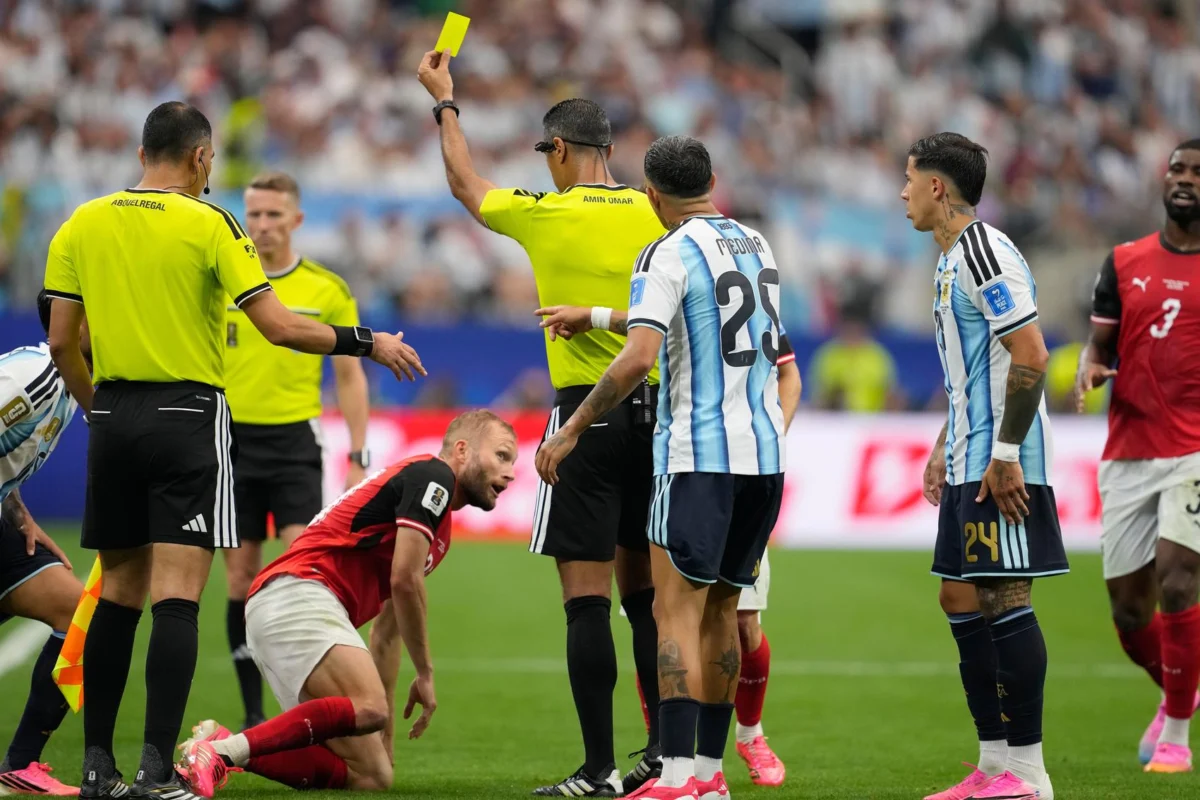
As the 2026 FIFA World Cup reaches its dramatic climax in the group stage, the world’s attention is fixed not just on the scoreboard, but on the referee’s breast pocket. With the tournament expanded to 48 teams, the margin for error has narrowed, and the tactical landscape is being dictated by an unlikely factor: the accumulation of yellow cards.
For coaches, the final round of group matches has transformed into a high-stakes chess match. The challenge is no longer just about securing points or goal difference; it is about managing the “ticking time bombs” on the pitch—key players who, if cautioned once more, face the devastating prospect of sitting out the opening match of the knockout rounds.
The Disciplinary Dilemma: A Tactical Tightrope
The fundamental tension in modern international football lies in the trade-off between fielding one’s strongest eleven and protecting assets for the tournament’s business end. A single yellow card received in the first two group matches serves as a persistent shadow over a player’s performance. In the high-pressure environment of the World Cup, where tackles are fierce and emotions run high, a referee’s whistle can be the difference between a championship run and a player’s premature exit from the pitch.
For teams already qualified for the Round of 32, the decision-making process is relatively straightforward: rest the cautioned players and allow their records to be wiped clean for the start of the elimination phase. However, for nations fighting for survival, the dilemma is acute. Coaches must decide if they are willing to risk their star striker or defensive anchor in a do-or-die match, knowing that a reckless challenge or a moment of dissent could result in an automatic suspension for the next crucial encounter.
Chronology: The Evolution of the 2026 Disciplinary Landscape
The expansion of the 2026 World Cup from 32 to 48 teams has fundamentally altered the physical and disciplinary demands of the tournament. More games mean more opportunities for players to commit fouls—both tactical and accidental.
The Group Stage Grind
In the opening matches, the pace of play was frantic, leading to a flurry of cautions. FIFA’s officiating directive has remained strict: reckless challenges, persistent fouling, and time-wasting are being punished with consistency. As the tournament progressed into the second round, the cumulative effect began to show.
Notably, the U.S. Men’s National Team (USMNT) found themselves in a precarious position heading into their final group match against Turkey. Having already secured their spot in the next round, head coach Mauricio Pochettino was forced to weigh the benefits of rhythm and momentum against the danger of losing key personnel to suspension. With four players carrying yellow cards—including standout striker Folarin Balogun and defensive linchpin Chris Richards—the U.S. camp became a masterclass in risk management.
The "Amnesty" Lifeline
Recognizing the increased risk of suspensions due to the expanded format, FIFA introduced a sophisticated system of “amnesty” periods. This rule dictates that any player carrying a single yellow card has their slate wiped clean upon the conclusion of the group stage, provided they do not receive a second caution in their final group match. A second amnesty period follows the quarter-finals, ensuring that the semi-finals and final are not marred by players missing out due to minor accumulated infractions.
Supporting Data: By the Numbers
The data from the first two weeks of the 2026 World Cup underscores the severity of the disciplinary climate.
- The USMNT Situation: The Americans entered their final group stage match with four starters walking the suspension tightrope. This included Folarin Balogun and Chris Richards, both of whom earned their cautions during a grueling 2-0 victory over Australia.
- European Giants: Other contenders are similarly affected. Portugal entered their final group match with four players sitting on a yellow card, while the Netherlands juggled three.
- The "Conduct Score" Tiebreaker: Perhaps the most overlooked aspect of the 2026 regulations is the "conduct score." In the event that two teams are tied on points, goal difference, and head-to-head results, the tiebreaker moves to the disciplinary record. This creates a scenario where a team could be eliminated from the World Cup not because of their lack of skill, but because of excessive fouls and cards accumulated throughout the group stage.
Official Responses and Tactical Philosophies
The management of disciplinary records has sparked a wide range of responses from the world’s leading tacticians.
The Pochettino Approach
Mauricio Pochettino has been vocal about the necessity of protecting his squad. Ahead of the match against Turkey, the Argentine tactician noted, “It’s unnecessary to take a risk to pick up another yellow card and not be available for the next round. We have a deep squad, and the focus must be on the tournament as a whole, not just the next 90 minutes.” This philosophy reflects a growing trend among elite managers who view the World Cup as a marathon of fatigue and discipline rather than a series of individual sprints.
The Refereeing Directive
FIFA’s officiating team has also been under the microscope. The introduction of the “mouth-covering” rule—which warrants an immediate yellow card if a player covers their mouth during an argument with an official or opponent—has already made an impact. Paraguay’s Miguel Almiron became a notable victim of this regulation, a moment that served as a stark reminder to players that modern technology and stricter enforcement are leaving less room for the “dark arts” of the game.
The Implications: A New Era of Tournament Football
The intersection of player discipline and squad rotation is changing the DNA of the World Cup.
The End of the "Dark Arts"
The stricter enforcement of rules—specifically regarding dissent and covering the mouth—is intended to preserve the integrity of the game. However, it also limits the gamesmanship that often defines high-stakes matches. Players are now forced to play with a higher degree of self-regulation, as they know the officials are monitoring not just their feet, but their behavior and communication.
The Strategic Value of the Bench
In previous iterations of the World Cup, the starting eleven was often treated as an immutable force. In 2026, the bench has become a tactical weapon. Coaches who have built squads with significant depth are finding that they can rotate players without a drop in quality, effectively mitigating the risk of suspensions. Teams that lack this depth are finding themselves forced into a dangerous gamble: play the star and risk the suspension, or bench the star and risk elimination.
The Conduct Score Conundrum
Perhaps the most significant implication of the new regulations is the pressure it puts on fair play. With the conduct score acting as a final tiebreaker, players are now incentivized to avoid petty fouls even in the dying minutes of a game they are losing. The “tactical foul” to stop a counter-attack is now a much costlier move, as it could literally be the difference between advancing to the Round of 32 or going home on a disciplinary technicality.
Conclusion: The Final Stretch
As the group stages conclude and the tournament enters the knockout phase, the yellow card counts will reset, offering a brief moment of relief for the remaining contenders. Yet, the lessons learned in the group stages will resonate throughout the rest of the 2026 World Cup.
The tournament has proven that success is no longer solely defined by tactical genius or physical prowess. It is defined by composure. In an era where every movement is scrutinized by high-definition cameras and every word is monitored by strict mandates, the teams that can maintain their discipline will be the ones standing at the end. The race for the trophy is as much about what happens on the ball as it is about the self-control shown when the referee reaches into his pocket.
For the players, the message is clear: play hard, play fair, but above all, play smart. In the 2026 World Cup, the biggest threat to a team’s championship dream might just be the yellow card they received three games ago.
© Copyright 2026 The Associated Press. All rights reserved. This material may not be published, broadcast, rewritten or redistributed without permission.


 Neng Nana
 Asro
Asro