

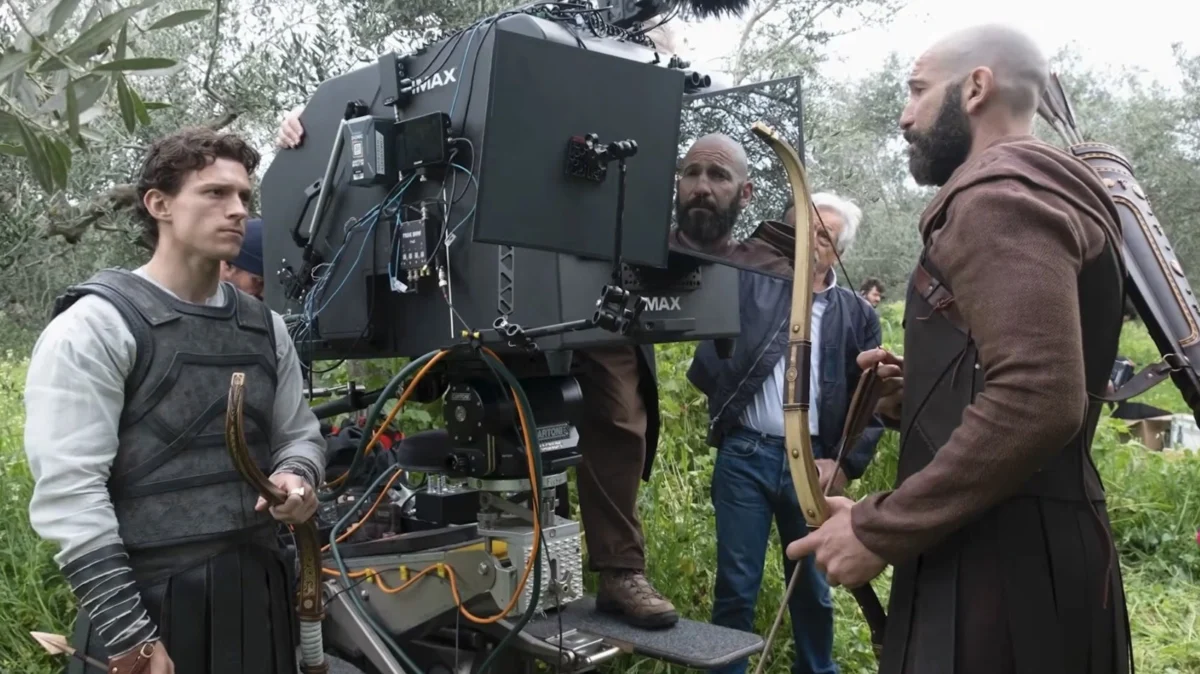
The cinematic landscape is bracing for a seismic event. On July 17, 2026, Universal Pictures will release Christopher Nolan’s The Odyssey, an ambitious, sweeping adaptation of Homer’s ancient epic that promises to be as technically groundbreaking as it is narratively profound. While much of the pre-release discourse has focused on the film’s massive scale—filmed on location across the sun-drenched landscapes of Italy and Greece—the true heart of the production lies in the intimate, rigorous collaboration between Nolan and his cast.
For actors like Jon Bernthal and Lupita Nyong’o, stepping onto a Nolan set is not merely a job; it is an initiation into a specific brand of creative intensity. As the industry looks toward what is shaping up to be the definitive film of 2026, the testimonies from the cast reveal a filmmaker who, despite his reputation for massive spectacle, operates with a startling level of human-centric precision.
The Architecture of a Master: Establishing the Vision
Christopher Nolan has long been regarded as one of the most meticulous architects of modern cinema. From the fractured time loops of Memento to the practical-effects-heavy spectacle of Oppenheimer, his filmography is defined by a singular vision. However, joining the ranks of a Nolan ensemble requires a specific temperament.
The cast of The Odyssey is a calculated blend of veteran collaborators—including Matt Damon, Anne Hathaway, Robert Pattinson, Elliot Page, and Benny Safdie—and fresh, powerful additions to the Nolan-verse, most notably Jon Bernthal and Lupita Nyong’o. Bernthal, who portrays the formidable King Menelaus of Sparta, describes the experience of working under Nolan as a rare privilege.
"There’s such comfort in going to work with someone like him," Bernthal remarked during the New York press junket. "You are seeing somebody doing the very thing that they were put on this earth to do. It’s such a comforting feeling to be in the hands of a master."
A Shared DNA: What Connects the Greats
Bernthal is no stranger to prestige filmmaking. With a resume that includes collaborations with auteurs such as Martin Scorsese, Denis Villeneuve, Steve McQueen, and Edgar Wright, he is uniquely positioned to evaluate what separates a "good" director from a "great" one. According to Bernthal, there is a uniform trait among the world’s most elite filmmakers: a profound, almost exhaustive intimacy with their narrative.
![The Odyssey's Jon Bernthal Reveals What Christopher Nolan Has In Common With Other Great Directors [Exclusive]](https://www.slashfilm.com/img/gallery/the-odysseys-jon-bernthal-reveals-what-christopher-nolan-has-in-common-with-other-great-directors-exclusive/l-intro-1783084425.jpg)
"In my experience, the true best of the best with filmmakers, they approach things so differently," Bernthal noted. "But the one thing that’s uniform is this unbelievably—I mean, beyond thorough—just this intimacy with the story, this knowledge of it, knowing exactly what they want and being able to explain it and convey it in this unbelievably cogent and clear way."
This clarity is vital, especially when tackling a story as dense and culturally saturated as The Odyssey. By the time the cameras roll, Nolan has already internalized every nuance of the script, allowing him to guide actors with surgical precision while leaving just enough room for the performance to breathe.
The Unspoken Mandate: The Nolan "Demand"
While Nolan is famous for his technical wizardry—the massive IMAX cameras, the practical set-pieces, and the complex time-bending narratives—the actors involved emphasize a much more personal requirement. There is a palpable pressure on a Nolan set, but it is not the pressure of perfectionism for perfectionism’s sake; it is a pressure of presence.
Bernthal shed light on what he calls the "demand" that Nolan places on his actors. It is not enough to simply memorize lines and hit marks; the director expects a synthesis of character and self.
"There’s this thing where it’s not [simply] acceptable for you to fill the role yourself and for you to bring yourself to it, but [the best directors] demand you to do it," Bernthal explained. "They know it so well, they’ll tell you exactly what it is they want, but you have got to bring yourself. It is our job with this very little bit of screen time to fill it, to make it matter so much because we see how much it matters to him."
This "actor-speak," as the industry often refers to it, translates to a high-stakes, high-collaboration environment. For the ensemble, the realization that the director is deeply invested in the emotional weight of every frame creates an atmosphere of immense creative freedom within the confines of his precise structure.
![The Odyssey's Jon Bernthal Reveals What Christopher Nolan Has In Common With Other Great Directors [Exclusive]](https://www.slashfilm.com/img/gallery/the-odysseys-jon-bernthal-reveals-what-christopher-nolan-has-in-common-with-other-great-directors-exclusive/intro-1783084425.jpg)
Ownership and Identity: Lupita Nyong’o’s Dual Roles
If the weight of the production is heavy, the complexity of the roles is equally demanding. Lupita Nyong’o, who takes on the challenging dual roles of Helen of Troy and her sister, Clytemnestra, has had to navigate the thin line between historical archetypes and human reality.
In a film with a nearly three-hour runtime, screen time is a precious commodity. However, Nyong’o notes that Nolan’s writing is designed to maximize impact through efficiency.
"Chris is interested in the lived experience of the characters that he’s written," Nyong’o observed. "The script gives lots of very, very spare, but very, very important clues about the character that you are building."
This approach to character building was essential in dealing with a figure as historically burdened as Helen of Troy. Rather than leaning on the mythological weight of the "face that launched a thousand ships," Nyong’o leaned into the emotional stakes provided by Nolan’s script. She emphasizes that the process was defined by a constant, productive friction between her own instincts and the director’s vision.
"With this story, there are so many iterations of The Odyssey," she said. "But then what Chris wrote was a very specific version, a choice version of the story he wanted to tell. And then it’s our job to take those clues and, like Jon said, fill it with what feels like palpable life. We get to take ownership of what we put on screen."
The Implications: Why ‘The Odyssey’ Matters
As the 2026 release date approaches, the industry is watching closely. Universal Pictures’ decision to essentially grant Nolan an open checkbook for a production of this scale is a testament to his commercial and critical standing. Filming in Greece and Italy is not merely an aesthetic choice; it represents a commitment to grounding ancient myth in physical reality.
![The Odyssey's Jon Bernthal Reveals What Christopher Nolan Has In Common With Other Great Directors [Exclusive]](https://www.slashfilm.com/img/gallery/the-odysseys-jon-bernthal-reveals-what-christopher-nolan-has-in-common-with-other-great-directors-exclusive/christopher-nolan-had-one-important-demand-of-his-actors-in-the-odyssey-1783084426.jpg)
The implications for the industry are significant. In an era dominated by CGI-heavy franchise filmmaking, The Odyssey stands as a rebuttal—an assertion that even the largest-scale stories must be rooted in the human element. By demanding that his actors take "ownership" of their roles, Nolan ensures that the film will feel lived-in and visceral, rather than sterile or overly manufactured.
Chronology of Production
The journey of The Odyssey has been a multi-year effort of planning, location scouting, and intense rehearsal.
- Initial Development: Following the massive success of Oppenheimer, rumors of a "Homeric" project began circulating in late 2024.
- Production Kick-off: Principal photography began in early 2025, with crews moving between remote Greek coastal locations and historic Italian studio sets.
- The Casting Phase: The announcement of Jon Bernthal and Lupita Nyong’o added a layer of critical intrigue, as fans speculated on how Nolan would interpret the legendary figures of Menelaus and Helen.
- Final Touches: Throughout the winter of 2025 and into 2026, the film entered an intensive post-production phase, with Nolan famously maintaining a strict, analog-forward approach to editing and sound design.
Looking Forward
As we approach the July 17, 2026, premiere, the anticipation surrounding The Odyssey is at a fever pitch. It is a film that asks much of its audience and even more of its participants. But if the testimonials from Bernthal and Nyong’o are any indication, the result will be more than just a blockbuster—it will be a deeply human exploration of what it means to come home, to fight for one’s life, and to find meaning in the midst of a masterpiece.
Christopher Nolan has always been interested in the mechanics of time, memory, and obsession. With The Odyssey, he seems poised to apply those same preoccupations to the bedrock of Western storytelling. If the director’s "demand" for his actors is any measure of the film’s quality, audiences are in for an experience that is as emotionally resonant as it is technically magnificent. The wait for the return of the king—and the director who brought him back—is almost over.










