

For the modern social media manager, the “copy-paste” era is dead. There is perhaps no greater frustration than crafting the perfect message, only to watch it get unceremoniously clipped by the unforgiving character limits of different platforms. One minute your poignant narrative is a hit on LinkedIn; the next, it is a truncated, confusing mess on Instagram.
As one marketer recently lamented in a viral thread, "The visible hook on LinkedIn is typically limited to the first 200-210 characters." The problem? Official guidance is non-existent. Platforms rarely provide a manual for success, leaving creators to navigate a sea of conflicting advice. Is shorter always better? Do algorithms favor long-form storytelling?
The answer is nuanced: both are right, just not on the same platform. To master social media in 2025 and beyond, you must move beyond "ideal length" myths and understand the three pillars of caption architecture: the technical limit, the engagement sweet spot, and the dreaded "See More" cut-off point.
Why There Is No Universal "Ideal" Length
The search for the perfect caption length often leads to chaos because platforms are not monoliths. Each network is built on unique, proprietary ranking signals designed to keep users on their specific site.
A caption that thrives on LinkedIn—a platform favoring "dwell time"—will almost certainly die on TikTok, where high-velocity consumption is the currency of the realm. Understanding why these discrepancies exist requires looking at the technical constraints versus user psychology.
The Three Layers of Caption Constraints
To optimize your content, you must categorize your text through three distinct lenses:
- The Character Limit: The "hard wall." This is the technical ceiling set by the platform. Ignoring it results in rejected posts or hard-clipped content.
- The Engagement Sweet Spot: This is not a rule, but a data-backed trend. It represents the length that has historically yielded the highest interactions (likes, shares, and saves) in large-scale studies.
- The Cut-off Point: The "above-the-fold" reality. This is the precise character count where the feed hides your text behind a "More" or "See More" button. If your hook fails here, the rest of your content—no matter how brilliant—becomes invisible.
Platform-by-Platform Analysis: A Strategic Breakdown
Instagram: The Visual-First Environment
On Instagram, your caption is a secondary citizen to your visual content.
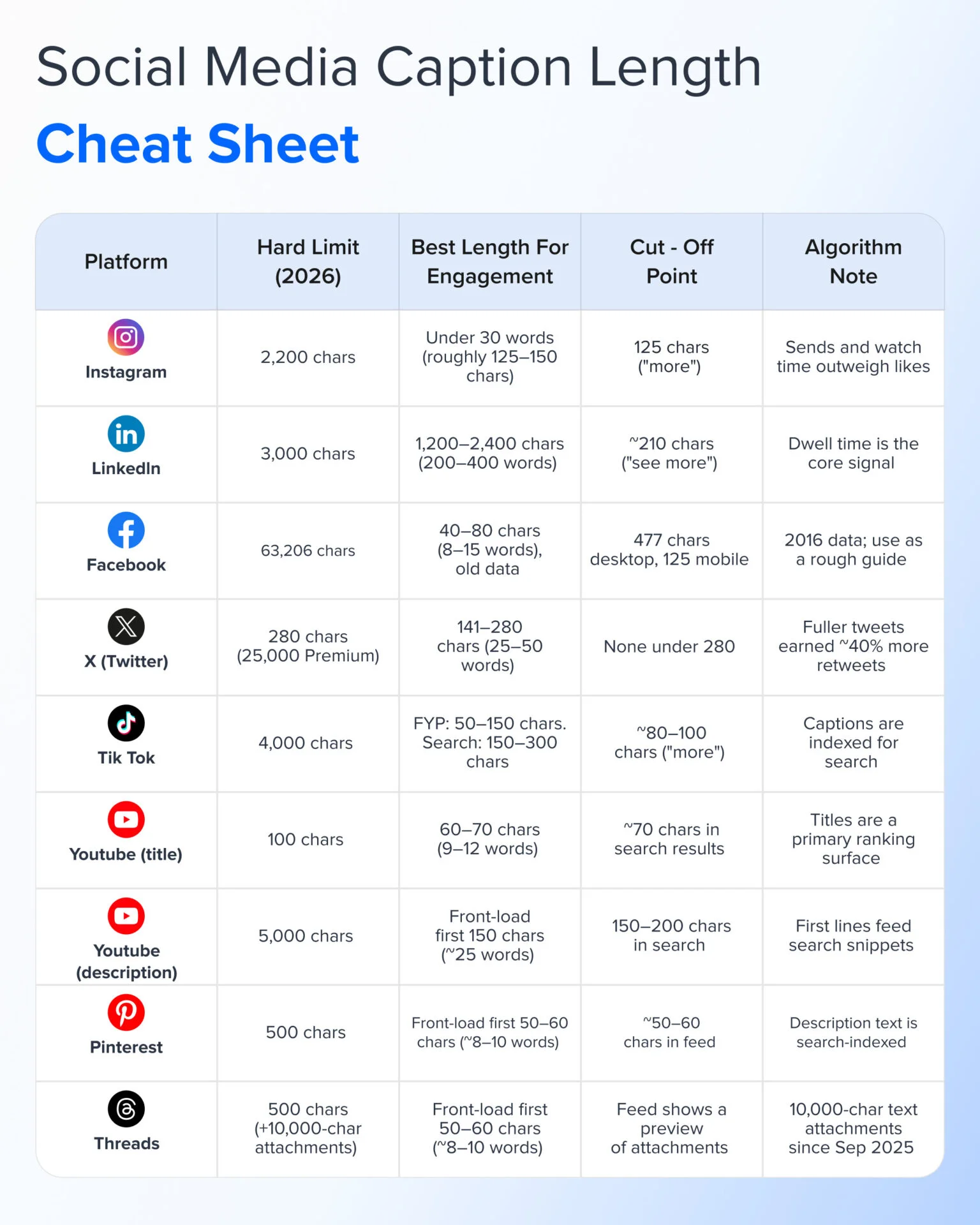
- The Data: While Instagram allows 2,200 characters, study after study shows that shorter captions (under 150 characters) generate higher engagement.
- The Strategy: Keep your message under 30 words. Your primary goal is to place the "hook" within the first 125 characters. If your opening statement doesn’t entice a click, the rest of your story remains buried.
- Best Practice: Treat the first 125 characters as a headline. Save the context and hashtags for the "below-the-fold" section.
LinkedIn: The Haven for Dwell Time
Unlike the snap-judgment nature of Instagram, LinkedIn rewards professional depth.
- The Data: Research indicates that posts between 200 and 400 words perform significantly better than short, punchy updates. LinkedIn’s AI-driven algorithm, often referred to as "360 Brew," prioritizes content that keeps users on the platform.
- The Strategy: Focus on value-driven storytelling. Your first 200 characters must promise a clear takeaway, result, or provocative question to trigger the "See More" expansion.
Facebook: The Balancing Act
Facebook is a platform of context. While it allows massive character counts (over 63,000), long-form content is rarely rewarded unless it is highly educational.
- The Strategy: For most organic posts, 40 to 80 characters suffice. Use longer formats only when you are providing deep educational value.
- The Cut-off: On mobile, the "See More" trigger happens around 125 characters, while desktop users might see up to 477. Always optimize for the mobile user.
X (formerly Twitter): The Concise Vanguard
X is the only platform where brevity is a core feature, not a constraint.
- The Strategy: While Premium users can post massive blocks of text, the best engagement on X comes from the 140–280 character range. A clear, punchy opinion is far more effective than a long, threaded explanation that feels like a blog post. If your idea requires 1,000 words, use a thread—don’t force a single, unwieldy post.
TikTok: The Dual-Identity Platform
TikTok has evolved from a short-form video app into a powerful search engine.
- The Strategy: You now have two distinct paths.
- For the FYP: Use 50–150 characters to grab attention quickly.
- For Search: Use 150–300 characters, front-loaded with natural keywords.
- The Shift: Nearly 50% of U.S. consumers now use TikTok as a search engine. Your caption is no longer just a "vibe"; it is your SEO metadata.
YouTube: The Search Engine Giant
YouTube titles and descriptions are critical for discoverability.
- The Strategy: Keep titles between 60 and 70 characters to avoid truncation in search results. For descriptions, the first 150 characters are the most important—they appear in search snippets and dictate whether a user clicks your video.
Pinterest & Threads: The Emerging Frontiers
- Pinterest: Treat it like a visual search engine. Use the 500-character limit to describe exactly what the user will find. If you aren’t using keywords in your description, you aren’t being found.
- Threads: It is built for conversation. Keep posts short and conversational, but use the "long-form attachment" feature for substantive topics to ensure the feed remains clean and readable.
Implications for Workflow: The "Master Caption" Strategy
The most common mistake creators make is trying to write unique content for every platform from scratch. This leads to burnout and inconsistent brand voice. Instead, adopt a Master Caption Workflow:
- Draft the Master: Write your most comprehensive version first, including all context, data, and the primary call-to-action (CTA).
- The Hook Optimization: Refine your first sentence so it can stand alone. This sentence will become the opening for every single platform.
- The Platform Trim: Use your master version as a source file. For LinkedIn, keep 80% of the text. For Instagram, trim it down to the hook and a punchy follow-up. For X, extract the single most compelling point.
- The Finishing Touches: Add platform-specific elements like hashtags for Instagram/TikTok, or tagging relevant users on LinkedIn/Threads.
- Preview and Schedule: Use a scheduling tool that allows you to preview the "See More" break for each platform. If your hook gets cut off in the preview, your post is already failing.
Conclusion: Data Over Dogma
The debate over "short vs. long" captions is a false dichotomy. The real key to performance is understanding the platform’s intent. LinkedIn wants to host your professional development; TikTok wants to index your keywords; Instagram wants to keep users engaged with your visuals.
By moving away from universal rules and embracing a strategy that respects both the platform’s technical constraints and the user’s behavior, you can ensure your voice is heard across the digital landscape. Remember, the ultimate benchmark is not a general industry study, but your own account’s performance data. Test these length strategies, track the results, and let your audience tell you exactly what they want to read.











