


For years, the internet’s most prominent digital town square, X (formerly Twitter), functioned through a series of "walled gardens." Language served as the primary barrier, keeping Japanese, English, Spanish, and Arabic discourse largely siloed within their respective cultural spheres. While a "Translate Post" button existed, it served as a conscious, opt-in bridge. Users knew they were stepping outside their native linguistic environment, and they viewed the resulting machine-generated output with the necessary, healthy skepticism.
Those days have effectively ended. In a sweeping move in late March 2026, X integrated Grok-powered, forced automatic translation into its platform architecture. Now, content is rendered into the user’s native language by default, often without any visual indication that the text has been processed by an algorithm. While proponents hail this as the dawn of a new, borderless digital era, critics—including prominent Japanese creators—are sounding the alarm. They argue that by making translation invisible, X has replaced the "language barrier" with a far more insidious problem: the "illusion of understanding."
The Chronology of an Unseen Shift
The rollout of X’s invisible translation feature was not a gradual experiment but a sudden paradigm shift.
- Late March 2026: X deployed its Grok-based translation engine globally. The shift was immediate: users logging into their feeds found that foreign-language posts were no longer marked with a "Translate" tag. Instead, the interface seamlessly displayed content in the user’s local language.
- Early April 2026: The immediate aftermath saw a surge in cross-cultural engagement. Anecdotal reports of Japanese manga artists interacting with American service members or global tech communities sharing research in real-time dominated the discourse.
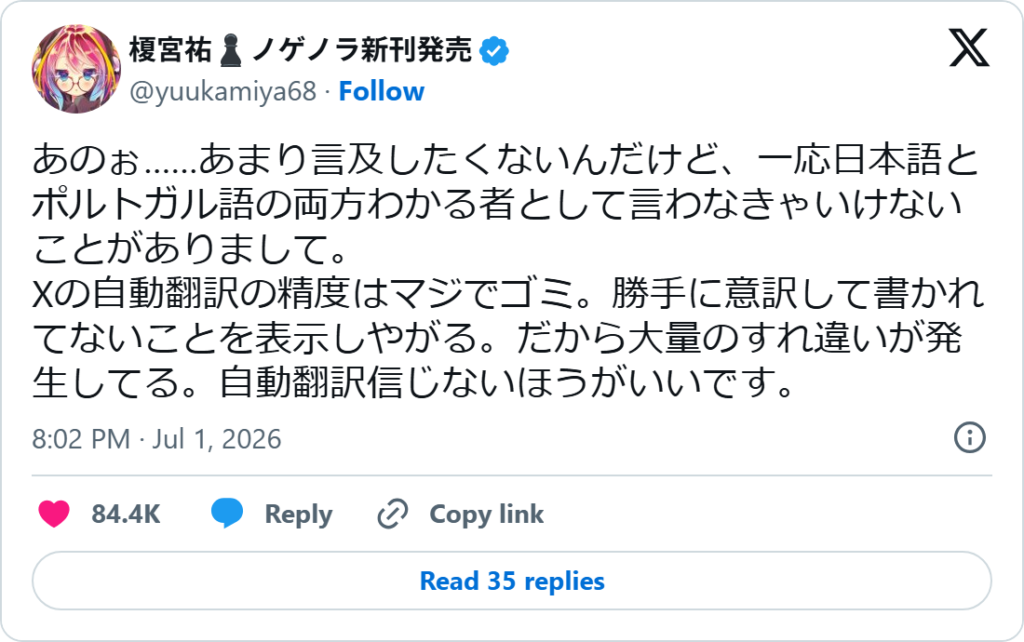
- July 2026: The honeymoon period soured. As users realized the extent of the algorithmic interference, vocal critics began to document egregious errors. The most notable flashpoint occurred when No Game No Life creator Yuu Kamiya publicly decried the feature, citing its tendency to hallucinate meanings that were never present in the original text.
- Present Day: The debate has matured into a broader societal inquiry regarding the responsibility of social media platforms in preserving the integrity of human communication.
The Mechanics of Misinterpretation: Why Japanese is a Special Case
While linguistic drift is a known risk in machine translation, the Japanese language poses unique structural challenges that render current AI models particularly prone to error. Unlike English, which relies on explicit subjects and objects, Japanese is a "high-context" language. It frequently drops subjects, pronouns, and objects when they can be inferred from the social situation or the preceding conversation.
When an AI encounters a vague, context-dependent Japanese phrase like "Yatto dekita" (Finally did it), it is forced to hallucinate. Did the speaker finish a meal? A project? Did they finally exact revenge? A human speaker uses non-verbal cues and shared cultural history to fill these gaps. A machine, however, relies on statistical probability. It guesses, and more often than not, it guesses wrong.
Furthermore, the issue of Kanji (logographic characters) exacerbates these failures. Japanese names often have multiple, context-dependent readings. Software often struggles to distinguish between a name like "Takaichi" and "Takai," leading to confusion in professional and personal contexts.
The most dangerous aspect, however, is what critics call "confident hallucination." In a high-profile example, the North American Fate/Grand Order account saw the visual novel Mahoutsukai no Yoru (Witch on the Holy Night) mistranslated as Mahou Shoujo Madoka Magica. These are two entirely distinct intellectual properties. Because the AI substituted a "statistically plausible" name rather than admitting its own ignorance, the resulting text appeared authoritative, leading readers to believe the misinformation was factual.
Supporting Data: The Double-Edged Sword
The impact of this feature is bifurcated between genuine social enrichment and the potential for diplomatic or social friction.
The Positive: Globalizing Local Experiences
Media sociologist Masahiko Shoji has noted that the removal of these barriers has allowed for profound moments of human connection. The viral story of a Japanese manga artist sharing an anecdote about meeting American service members in a Sasebo yakiniku restaurant is a primary case study. Under the old system, the story would have likely stayed within the Japanese-speaking community. Instead, it reached millions, prompting former service members to chime in with their own memories, fostering a genuine, cross-cultural emotional exchange.
The Negative: Amplifying the Fringe
Conversely, the automatic translation of hostile or xenophobic content has created a "globalization of outrage." Former television personality Kanon Aoki has argued that the visibility of toxic discourse—usually generated by a small, vocal minority—is now amplified globally. Without the cultural nuance that a human translator provides, a localized, inflammatory post can be stripped of its context and interpreted by an international audience as a reflection of an entire nation’s sentiment. This can, and does, lead to international misunderstandings, false stereotypes, and unnecessary geopolitical friction.
Official Responses and Industry Stance
While X has framed the update as the "largest cultural exchange event in history," the company has remained largely silent regarding the technical shortcomings of the Grok engine. The product lead, Nikita Bier, championed the feature’s ability to allow millions of people to participate in a single, unified conversation.
However, the tech industry at large is divided. While tools like DeepL remain the gold standard for formal and technical translation, they still struggle with the fluid, slang-heavy nature of the internet. AI models, while improving, lack the "cultural intelligence" that human translators provide.
Human translators, particularly in fandom spaces—such as those who subtitle VTuber streams—have long operated as the backbone of global Japanese media consumption. These individuals do more than translate words; they explain jokes, localize puns, and provide the necessary cultural scaffolding to make content intelligible. This human-centric approach is precisely what is missing from X’s automated, "set-it-and-forget-it" model.
The Implications for Global Discourse
The shift towards invisible, automated translation has significant implications for how we perceive "truth" on the internet. By removing the explicit notification that a post is machine-translated, X has effectively stripped away the "grain of salt" that users once applied to foreign-language content.
1. The Erosion of Critical Thinking
When we see a post in our native language, our brains are hardwired to process it as "authoritative." We assume that if the text is coherent, the speaker’s intent is captured accurately. By masking the translation process, X is training users to bypass their critical faculties, potentially turning minor machine errors into major social conflicts.
2. The Loss of Cultural Nuance
Language is the vessel for culture. When we force-feed that culture through a utilitarian AI filter, we risk a homogenization of discourse. Sarcasm, irony, and regional memes—the very elements that make internet culture vibrant—are often the first casualties of machine translation. If the world starts to communicate through a flattened, AI-filtered version of reality, we may lose the very diversity that makes global connection valuable.
3. The Liability of Misinformation
As seen with the Fate/Grand Order incident, the tendency for AI to substitute "plausible" information when it encounters ambiguity is a ticking time bomb for misinformation. In a political context, the consequences could be far more severe than a misidentified anime title. A misinterpreted news report or a mistranslated official statement from a foreign government could trigger real-world volatility before anyone realizes a machine made a mistake.
Conclusion: The Path Forward
The dream of a tower-of-Babel-free internet is an alluring one. Breaking down language barriers has the potential to democratize information, foster empathy, and accelerate scientific and artistic collaboration. However, the current implementation on X prioritizes speed and scale over accuracy and context.
For this technology to be a net positive, platforms must reintroduce transparency. A simple indicator—perhaps a small, unobtrusive icon or a hover-over tooltip—that informs the user, "This post has been machine-translated," would go a long way in restoring the necessary skepticism required for healthy communication.
Until then, the users of X are navigating a landscape where they are constantly being lied to by their own screens—not always with malicious intent, but with a confidence that is profoundly dangerous. We are currently living in an era where millions of people are engaging in heated debates, reacting to sentences that, in many cases, nobody actually wrote. The "Hitchhiker’s Guide" may have had its Babel Fish, but the reality of the 2026 digital landscape suggests that true understanding remains a human endeavor, one that cannot yet be outsourced to an algorithm.











