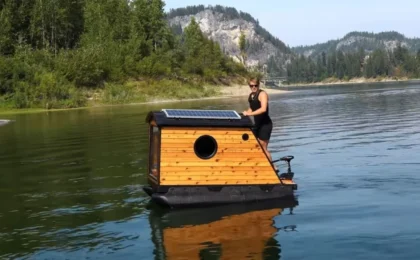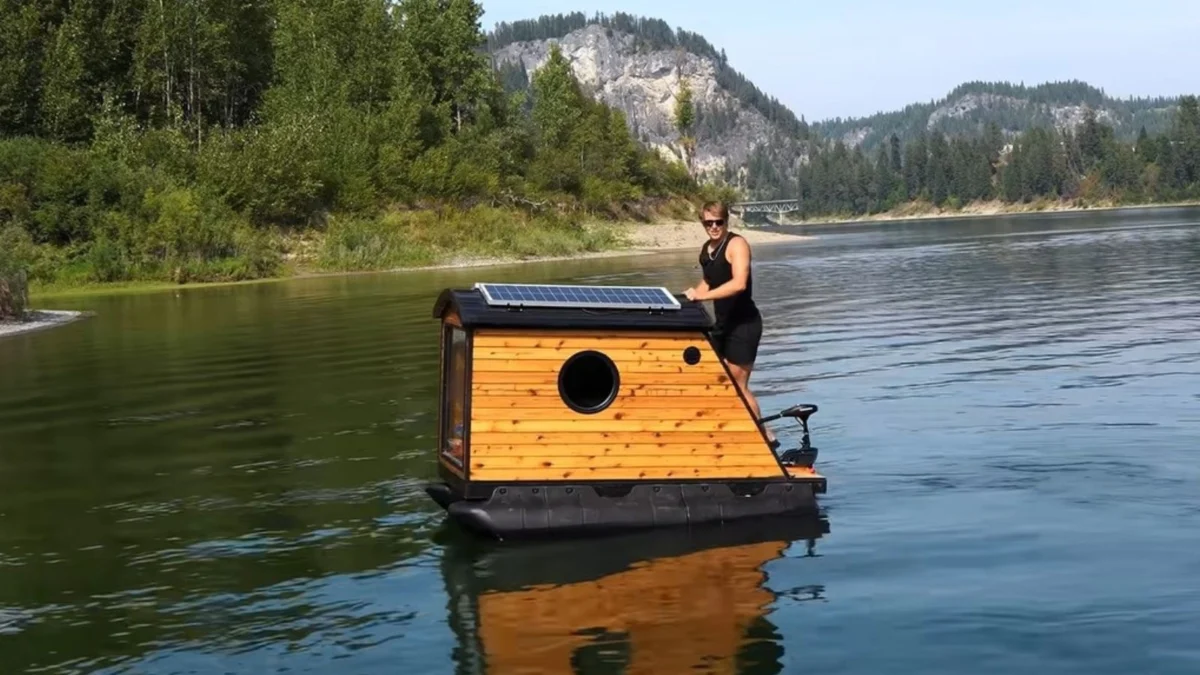
In an era defined by the pursuit of grand architecture and sprawling infrastructure, a counter-movement has emerged that celebrates the philosophy of "less is more." At the forefront of this trend is content creator David Rule, an engineer and tinkerer whose latest project, the "Tinytanic," has captured the imagination of the internet. By constructing what is arguably the world’s smallest functional houseboat, Rule has transformed the concept of micro-living from a theoretical experiment into a practical, albeit claustrophobic, reality.
The Genesis of the Tinytanic: Main Facts
David Rule, a YouTube creator commanding an audience of nearly 900,000 subscribers, recently unveiled his most ambitious—and arguably most absurd—undertaking to date. The Tinytanic, a miniature vessel measuring a mere eight feet in length and three-and-a-half feet in width, is not a scale model; it is a fully operational, river-worthy houseboat designed to accommodate a human being for extended periods.
Unlike static art installations or non-functional props, the Tinytanic is built for utility. Constructed primarily from a combination of cedar, pine, and high-grade plywood, the craft is engineered to be portable enough to fit into the bed of a standard pickup truck. With an internal ceiling height of just 42 inches, the vessel is designed for sitting and reclining, rendering vertical movement impossible for the average adult. Despite these limitations, Rule has successfully integrated the essential components of a traditional home, including a functional stove, a compact refrigerator, and a sink, effectively miniaturizing the modern lifestyle into a footprint smaller than a standard closet.
A Chronology of the 12-Mile Odyssey
The true test of any marine vessel is its interaction with the elements. Rule did not merely build the Tinytanic for display; he subjected it to a rigorous three-day expedition along the Pend Oreille River in Washington.
Day One: The Launch
The journey began at the river’s edge, where the portability of the Tinytanic was immediately validated. After offloading the vessel from his truck, Rule launched the craft into the current. The initial phase of the trip was a shakedown, testing the boat’s buoyancy and stability under real-world conditions. The river, known for its varying currents, provided an ideal environment to see if the lightweight construction would hold up against the resistance of the water.
Day Two: Adapting to the Micro-Environment
By the second day, the reality of living in a 42-inch-high space set in. Rule navigated the river, maneuvering the craft from a standing position at the rear deck—a small, exterior platform that served as the vessel’s cockpit. During this period, the YouTuber demonstrated the boat’s versatility by fishing from the deck, proving that the craft was not just a means of transport but a functional base of operations. The integration of the stove allowed Rule to prepare meals while drifting, effectively turning the craft into a mobile, floating efficiency apartment.
Day Three: Completion and Reflection
The final leg of the journey saw the Tinytanic complete a 12-mile trek. By the time the vessel reached its destination, Rule had effectively proven that extreme downsizing is not only possible but sustainable for short-term excursions. The success of the trip highlighted a triumph of ergonomic engineering, where every cubic inch was optimized for a specific purpose, leaving no room for wasted space.
Supporting Data and Technical Specifications
To understand the feat achieved by Rule, one must look at the constraints of the build. The Tinytanic is a study in material science and spatial optimization.
- Dimensions: 8 feet (Length) x 3.5 feet (Width).
- Internal Height: 42 inches.
- Primary Materials: Cedar, pine, and plywood (chosen for weight-to-strength ratios).
- Onboard Systems: Propane-based stove, 12-volt refrigeration, integrated plumbing for the sink, and a modular sleeping berth.
When compared to the average houseboat—which often spans 30 to 50 feet and includes multiple rooms—the Tinytanic represents a reduction in volume of over 90%. However, Rule’s work is part of a broader trend of extreme miniaturization. In previous projects, Rule constructed the "world’s smallest tiny house," a structure featuring 30-inch walls and a one-foot-high roof. While that structure was stationary, it featured a shower, a bed, and a galley kitchen, proving that Rule’s expertise lies in the "Tetris-like" arrangement of essential living components.
The Context of Micro-Innovation
Rule is not alone in this fascination with the "smallest possible version" of everyday objects. The last decade has seen a surge in professional and amateur builders pushing the boundaries of scale.
The Automotive Frontier
Earlier this year, the automotive world was captivated by mechanics who built the world’s "narrowest" road-legal car. Much like the Tinytanic, this project defied regulatory skepticism. By adhering to the letter of the law regarding safety and lighting, the builders proved that extreme size reduction does not necessarily preclude functionality.
The Robotic Revolution
In the scientific community, researchers have developed microscopic robots capable of autonomous thought. While these robots operate on a molecular scale, the underlying principle remains the same as Rule’s houseboat: the drive to prove that complex systems—whether for shelter or computation—can function efficiently when stripped of their excess.
Official Responses and Public Reception
While David Rule does not currently seek validation from the Guinness World Records, his projects have garnered significant attention from the architectural and engineering communities. Critics often focus on the safety and comfort aspects of such builds, yet Rule’s videos consistently highlight the intentionality behind the designs.
The public response has been largely one of fascination. In the comments sections of his platforms, engineers frequently debate the hydrodynamic stability of the Tinytanic, while design enthusiasts praise the minimalist aesthetic. Rule’s refusal to seek formal world records suggests that his motivation is not institutional recognition, but rather the pursuit of a personal creative challenge—a desire to see if he can solve the riddle of "how little is enough?"
Implications for Future Architecture
The implications of the Tinytanic and similar projects extend beyond the novelty of a YouTube video. As global urban density increases and housing affordability remains a critical issue in major metropolitan areas, the lessons learned from extreme downsizing are becoming increasingly relevant.
The Rise of Modular Living
The Tinytanic demonstrates that "living" does not require the square footage traditionally associated with domestic life. By utilizing modular components—such as the combination of a cooking, sleeping, and transport surface—Rule’s work mirrors the development of modern "micro-apartments" in cities like Tokyo, New York, and London. These units, often less than 200 square feet, rely on the same principles of multi-functional furniture and optimized vertical storage that Rule employs in his builds.
Sustainability and the "Small Footprint"
Beyond space, there is the question of environmental impact. The Tinytanic utilizes a fraction of the raw materials required for standard construction. While a houseboat of this size is not a viable long-term solution for a family of four, it serves as a proof-of-concept for the reduction of carbon footprints. If designers can refine the "Tinytanic model" for larger, more durable structures, it could offer a path toward more sustainable, resource-efficient housing solutions.
Psychological Resilience
Finally, there is the psychological dimension of the build. Living in a 42-inch-high space requires a specific temperament and an ability to embrace simplicity. Rule’s journey suggests that the human experience can be condensed without being diminished. By focusing on the essentials—food, shelter, and mobility—Rule challenges the audience to consider what they truly need to survive, and perhaps, to thrive.
Conclusion
The Tinytanic is more than a viral sensation; it is a testament to human ingenuity and the enduring appeal of the "impossible build." David Rule’s 12-mile journey down the Pend Oreille River stands as a milestone in the world of micro-engineering. Whether or not his builds ever gain official world records is secondary to the fact that he has successfully navigated a living space smaller than the average desk. In doing so, he has opened a dialogue about the future of living, the efficiency of our environment, and the sheer joy of creating something that shouldn’t work—but does. As we look toward a future where space is an increasingly precious commodity, perhaps the lessons learned from the Tinytanic are not just curiosities, but blueprints for a more compact tomorrow.