

The rumor mill surrounding Google’s upcoming flagship silicon, the Tensor G6, has reached a fever pitch. As the tech industry turns its gaze toward the Pixel 11 series, fresh leaks regarding the chip’s architecture suggest a dual-narrative: while CPU performance is poised for a monumental leap, the graphics department remains a conservative, if not polarizing, focus for the search giant.
As Google continues its transition toward vertical integration, the Tensor G6 stands as a critical milestone. It is not merely a processor; it is the engine designed to power Google’s vision of ambient, AI-first computing. However, for power users and mobile gamers, the G6 raises as many questions as it answers.
Main Facts: The Architecture of the Tensor G6
The latest technical disclosures regarding the Tensor G6 reveal a departure from the conservative core layouts that defined previous generations. By abandoning the aging Arm Cortex-X4 architecture found in the G5, Google is positioning the G6 to compete more aggressively in general-purpose computing.
CPU Configuration Breakdown
The reported core configuration for the Tensor G6 is as follows:
- 1x Arm C1-Ultra core: Clocked at an impressive 4.11GHz.
- 4x Arm C1-Pro cores: Operating at 3.38GHz.
- 2x Arm C1-Pro cores: Operating at 2.65GHz.
This architecture marks a decisive jump into the modern Arm ecosystem, mirroring the powerhouse configurations expected in the MediaTek Dimensity 9500. For the average user, this translates to a projected 40% improvement in single-core performance according to initial Geekbench 6 simulations. By shedding the reliance on the "little" cores that plagued the efficiency of the G5, the G6 is expected to deliver a much snappier experience during daily multitasking and intensive web browsing.
GPU and Graphics: The Achilles’ Heel
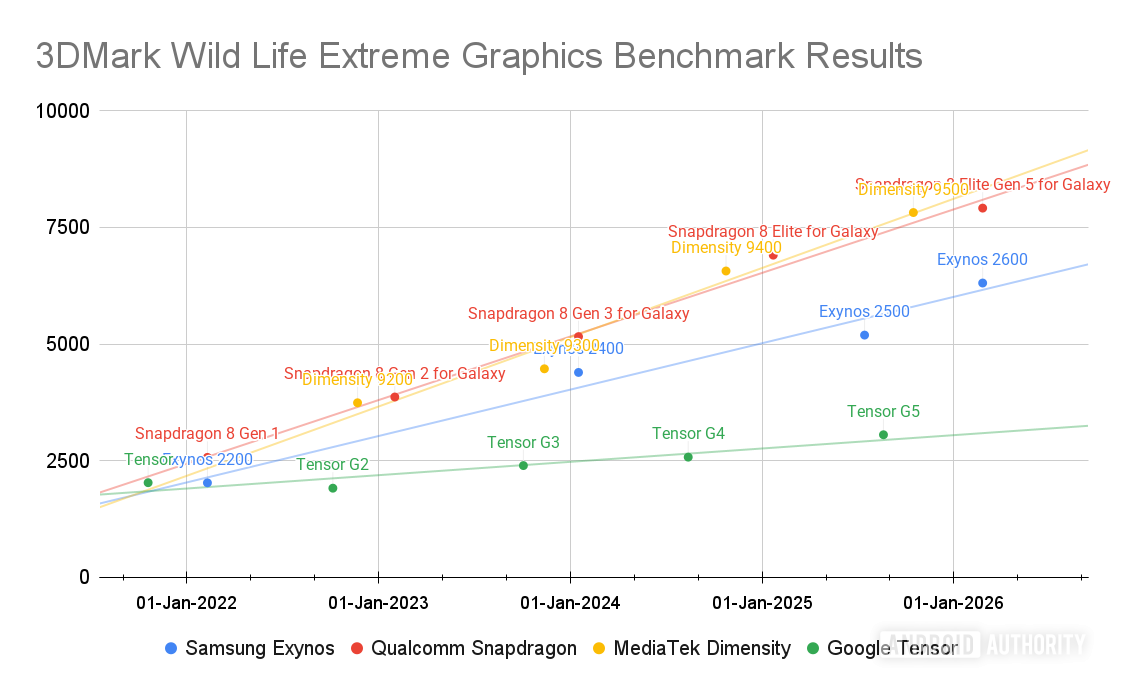
Despite the CPU gains, the GPU situation is more nuanced. The move to the PowerVR CXTP-48-1536 signals that Google is prioritizing efficiency and silicon-area conservation over raw graphical throughput. While the "P" designation suggests improvements in power-per-watt—potentially yielding a 20% efficiency boost over the previous generation—it remains a design choice that prioritizes thermal management over the "brute force" gaming performance seen in Snapdragon-powered rivals.
Chronology: The Evolution of Google Silicon
Google’s journey into custom silicon has been defined by a focus on "experience-first" design rather than benchmarking dominance.
- 2021 (The Genesis): The original Tensor chip introduced the concept of the TPU (Tensor Processing Unit), prioritizing machine learning tasks and image processing over peak clock speeds.
- 2023-2024 (The Iteration): The Tensor G3 and G4 refined the integration with the Pixel hardware, focusing heavily on battery optimization and thermal stability, though often struggling under sustained heavy loads.
- 2025 (The Shift): With the G5, Google began experimenting with more robust CPU layouts, setting the stage for the architecture currently appearing in G6 leaks.
- 2026 (The Current Horizon): The Tensor G6 arrives as the first true "PC-grade" attempt from Google, coinciding with a transition to 2nm manufacturing processes and a long-awaited departure from Samsung’s modem technology.
Supporting Data: Performance and Efficiency
When analyzing the potential of the Tensor G6, we must look at the comparative landscape of 2026 mobile chipsets.
The Competitive Landscape
The Pixel 11 is expected to compete in a crowded market dominated by the Snapdragon 8 Elite Gen 5 and the Exynos 2600. While the Tensor G6’s CPU performance is projected to be highly competitive, its reliance on a PowerVR GPU architecture suggests it will fall behind in high-fidelity mobile gaming.
The following table summarizes the strategic shift in silicon priorities:
| Metric | Tensor G5 | Tensor G6 (Projected) | Strategic Goal |
|---|---|---|---|
| CPU Core | Cortex-X4 | Arm C1-Ultra | General responsiveness |
| GPU Architecture | DXT-48-1536 | CXTP-48-1536 | Efficiency/Thermal stability |
| Manufacturing | 3nm | 2nm | Density/Power management |
| Modem | Samsung | MediaTek M90 | Connectivity reliability |
The data indicates a clear trade-off. Google is betting that the user base values a device that stays cool and efficient during AI-heavy tasks—such as live translation and real-time photo processing—more than a device that can render ray-traced shadows at 120fps.
Official Responses and Industry Context
While Google maintains a standard policy of not commenting on unreleased hardware, the implications of these leaks are well-understood by analysts. The company’s trajectory is clear: they are moving toward an ecosystem where the chip is a support mechanism for the software.
Industry experts note that the decision to incorporate the MediaTek M90 modem is perhaps the most significant change for the Pixel 11. Historically, connectivity issues and modem-related battery drain have been the primary complaints among the Pixel community. By shifting to a MediaTek solution, Google is effectively admitting that the previous partnership with Samsung’s modem division did not meet the rigorous standards required for a "flagship" experience.
Implications: What This Means for the Pixel 11
The Tensor G6 represents a maturation of Google’s hardware strategy. The implications for the consumer are multi-faceted:
1. The "AI-First" Experience
With the integration of the new "Santafe" TPU and the "Metis" image signal processor (ISP), the Pixel 11 is poised to set a new benchmark for computational photography and on-device AI. The raw CPU power increases will ensure these background AI tasks run without hindering the user interface, a common criticism of earlier Tensor iterations.
2. A New Standard for Security
The inclusion of the Titan M3 security chip suggests that Google is doubling down on privacy-centric computing. As mobile devices become the primary repository for personal identity, the combination of a high-performance CPU and dedicated security hardware makes the Pixel 11 a strong contender for enterprise and security-conscious consumers.
3. The Gaming Compromise
Gamers, however, should manage their expectations. If you are looking for a device to dominate titles like Genshin Impact or Warzone Mobile at maximum settings, the Pixel 11 may continue to play second fiddle to devices sporting Snapdragon or high-end Exynos chips. The Tensor G6 is designed for "sustained efficiency," not "peak graphical output."
4. Convergence and PC Ambitions
The push toward 4.11GHz clock speeds suggests that Google is inching closer to its rumored goal of bridging mobile and desktop experiences. While the Tensor G6 isn’t a laptop-class chip yet, it provides the headroom necessary to explore "desktop-mode" Android applications and complex multi-window multitasking that was previously impossible on a phone.
Conclusion: The Long Game
Waiting for the "perfect" chip is a fool’s errand in the rapidly evolving world of mobile technology. The Tensor G6, as it stands, is not a benchmark-killer designed to top every leaderboard in the industry. Instead, it is a specialized tool designed for the specific needs of the Android ecosystem: security, AI-enhanced photography, and fluid, efficient daily performance.
For the loyal Pixel user, the G6 represents the most significant leap forward in years. The combination of a massive CPU upgrade, the switch to a more reliable modem, and a refined focus on AI silicon suggests that Google is finally finding its rhythm in the silicon space. While the GPU may remain a point of contention for a subset of the market, the overall package looks to be a sophisticated, balanced solution for the modern, connected professional. The Pixel 11, powered by the G6, is set to be less of a hardware experiment and more of a definitive statement of Google’s future in the smartphone era.












No comments yet. Be the first to join the conversation!