

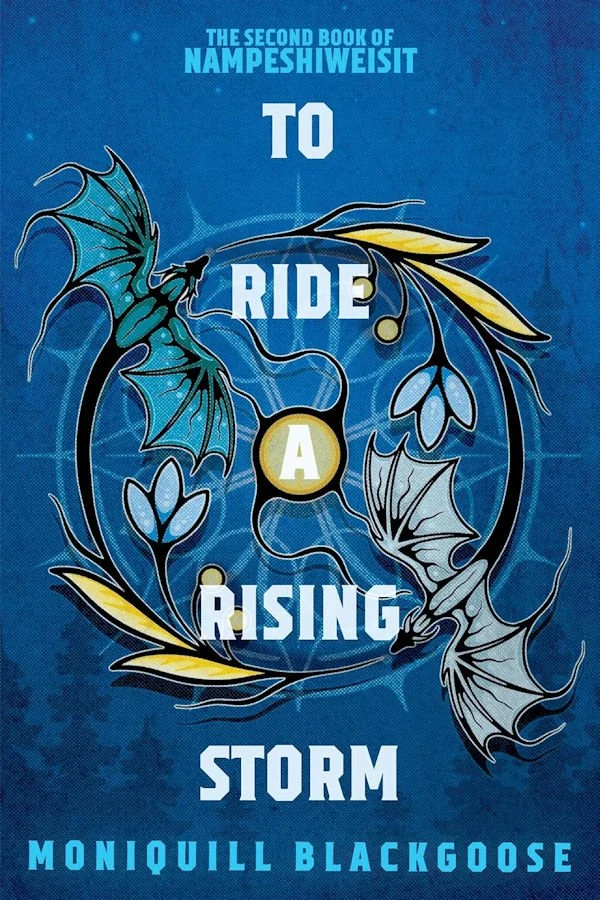
In the rapidly evolving landscape of contemporary fantasy, few series have captured the intellectual and emotional imagination of readers quite like Vesper Blackgoose’s Nampeshiweisit saga. Following the critically acclaimed success of To Shape a Dragon’s Breath, the second installment, To Ride a Rising Storm, serves as both a structural expansion and an intensification of the thematic pressures introduced in the series debut. As Anequs, the series’ resilient protagonist, transitions from a groundbreaking first year at the prestigious Kuiper’s Academy back to her home of Masquapaug, she brings with her not only the academic honors she earned against all odds but the volatile seeds of a socio-political revolution.
Main Facts: The Return of the Dragon Rider
At the heart of To Ride a Rising Storm is the fundamental clash between colonial hegemony and indigenous sovereignty. Anequs, having defied the low expectations of her Anglish professors, returns home accompanied by her dragon, Kasaqua, and her peer Theod. However, their homecoming is not the respite they anticipated.
The narrative pivot occurs when the Anglish—the imperialist force represented by the Academy—establishes a permanent presence on Masquapaug. This intrusion acts as the primary catalyst for the conflict. Anequs, whose character is defined by an unwavering commitment to her people’s right to self-governance, finds herself at a crossroads. The book masterfully depicts her struggle to reconcile her newfound academic standing with the traditional customs she seeks to protect from the "restrictive yoke" of Anglish influence. The tension is palpable, positioning the book as a high-stakes exploration of how individuals navigate the intersection of personal growth and national identity.
Chronology: A Pacing of Two Halves
The structural rhythm of To Ride a Rising Storm is deliberate. For approximately three-quarters of the novel, Blackgoose prioritizes the "slow burn" of worldbuilding and character development. Readers are invited to witness the intricate social dynamics of the indigenous communities as they grapple with the encroaching imperial presence. This portion of the book serves as a vital foundation, grounding the reader in the stakes of the conflict before the narrative velocity increases.
As the story approaches its conclusion, the pacing accelerates significantly. The final act introduces a series of escalating confrontations, culminating in a climactic conflict that fundamentally shifts the status quo. While some critics have noted that this final acceleration feels somewhat abrupt compared to the meditative pace of the preceding chapters, it serves to heighten the sense of impending crisis. The novel concludes on a cliffhanger, leaving the reader with the distinct understanding that the events of this installment are merely the precursor to an inevitable civil war in the third volume.
Supporting Data: Linguistic and Cultural Nuance
A significant element of the Nampeshiweisit series, particularly noted by readers attuned to linguistic detail, is the incorporation of German-inflected Anglish. For the Anglish forces within the story, the use of terminology such as "Frau" and the naming of dragons like "Gerhard" acts as a reflection of a rigid, colonial Western framework.
For many English-speaking readers, this serves as an "exotic flavor" that enhances the world’s immersion. However, for those fluent in German, the experience is layered with additional context. The author’s decision to use archaic, accurate German demonstrates a commitment to worldbuilding depth that goes beyond mere window dressing. It underscores the colonial nature of the Anglish, suggesting a civilization that looks backward toward a strict, disciplined tradition as a means of enforcing dominance over the "primitive" indigenous cultures they seek to subjugate.
Beyond linguistics, the book continues its commitment to an inclusive, intersectional cast. The narrative treats neurodiversity, physical differences (such as a character utilizing a writing board for communication), and LGBTQIA+ identities as normalized, matter-of-fact elements of society. Of particular note is the handling of Anequs’s polyamorous romantic interests. The book avoids the tired tropes of "love triangle" drama, opting instead to explore the organic, often difficult, process of reconciling different cultural perspectives on relationships. One partner, steeped in Anglish tradition, struggles with the reality of Anequs’s choices, while the other—more open—adapts with greater ease. This demonstrates the series’ central thesis: that change is not a flash of light, but a slow, often painful adjustment to new truths.
Official Perspectives: The Evolution of Anequs
The characterization of Anequs remains the series’ North Star. In To Ride a Rising Storm, she is no longer the underdog simply fighting to be heard; she is a political figure, a symbol of resistance, and a young woman grappling with the consequences of her own notoriety.
What makes her compelling is not her perfection, but her capacity for moral calibration. She is capable of deep empathy, yet she is prone to misjudging the motives of those entrenched in imperial power. Her growth in this installment is marked by a shift from reactive survival to proactive leadership. As she navigates the complexities of her role, she becomes a more layered, fallible, and ultimately, more human protagonist. The narrative treats her mistakes as vital plot points, proving that the world shapes the character just as much as the character shapes the world.
Implications: Colonialism and the Cost of Resistance
The overarching implication of To Ride a Rising Storm is a sober examination of the cost of resistance. Blackgoose does not shy away from the reality of bloodshed. The conflict between those who wish to maintain the status quo and those who demand autonomy is portrayed with a visceral intensity that mirrors historical anti-colonial struggles.
The introduction of a new, non-Anglish dragon and rider—who embodies a cultural path closer to that of Anequs—adds a crucial layer of comparison. By contrasting this character with Anequs, the reader is invited to consider the varying ways in which indigenous peoples survive under imperial occupation. While Anequs is forced to maneuver through the "Anglish thumb," the introduction of this new character suggests that there are multiple, perhaps conflicting, methods of resistance. This divergence in strategy sets the stage for a complex ideological debate that will likely define the remainder of the series.
Conclusion: A Worthy Continuation
To Ride a Rising Storm is a testament to Vesper Blackgoose’s growth as a storyteller. By expanding the canvas of the Nampeshiweisit series, the author has moved beyond the "school setting" tropes of the first volume and into the realm of epic political fantasy.
The novel succeeds because it refuses to prioritize action over the internal lives of its characters. It asks hard questions about what it means to belong to a culture under siege and how one maintains personal integrity while fighting a war for collective survival. With a world that continues to deepen in complexity and a cast that remains at the forefront of inclusive representation, the series is positioning itself as a cornerstone of modern fantasy. Readers left waiting at the precipice of the cliffhanger in this second volume can expect the third book to be nothing short of a total collision between the past and the future of Masquapaug.
As it stands, To Ride a Rising Storm is not merely a sequel; it is a vital expansion of a story that feels increasingly urgent, relevant, and essential. Whether one is drawn to the high-stakes dragon politics or the deeply intimate character studies, this series offers a rare depth that is difficult to find in the current market. Blackgoose is building something special, and it is a journey that, by all metrics, is only just beginning.










No comments yet. Be the first to join the conversation!