Asep Darmawan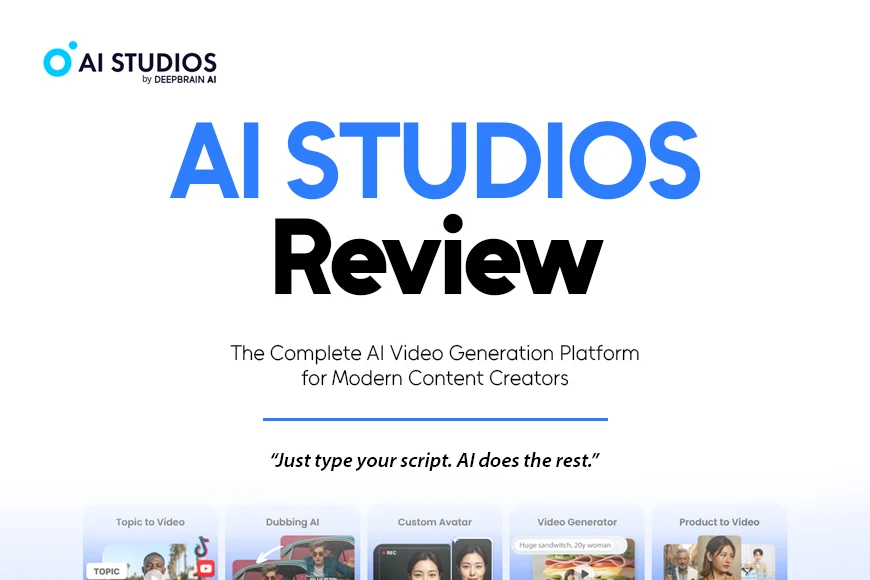
The landscape of content creation is undergoing a seismic shift. For decades, the production of professional-grade video content was gated by significant barriers to entry: the need for high-end cameras, sound-dampened studios, professional lighting rigs, skilled video editors, and specialized voice talent. Today, those physical and logistical constraints are rapidly evaporating. At the vanguard of this transformation is AI Studios, a flagship platform developed by DeepBrain AI that promises to democratize video production by distilling the entire lifecycle of content creation into a browser-based interface.
Main Facts: The "All-in-One" Production Suite
AI Studios is a B2B SaaS (Software as a Service) platform designed to bridge the gap between complex technical production and accessible generative AI. At its core, the platform allows users to generate hyper-realistic video content simply by inputting text.
The platform’s value proposition is built upon three pillars:
- AI Avatar Technology: High-fidelity digital humans that can deliver scripts with naturalistic gestures and facial expressions.
- Multilingual Versatility: Support for over 150 languages, featuring automated lip-syncing that adjusts to the specific phonetic requirements of each language.
- Conversational Integration: Beyond passive video generation, the platform offers interactive avatars capable of real-time, two-way communication.
By centralizing these technologies, AI Studios aims to serve a diverse client base ranging from independent YouTubers and digital influencers to global enterprise organizations requiring scalable internal communication tools.
Chronology of Development: From Research to Enterprise Utility
DeepBrain AI, the parent company, began its journey by focusing on deep-learning-based video synthesis. Initially, the technology was limited to research-grade facial animation. However, the trajectory of the platform has been marked by rapid iterative growth:
- Foundation Phase: Development of proprietary deep-fake technology aimed at creating "digital twins" of real people.
- Expansion Phase: Integration of Large Language Models (LLMs) to allow for intelligent, script-based content generation.
- Enterprise Integration: The shift toward professional utility, including the development of SCORM (Sharable Content Object Reference Model) support, which allowed the platform to integrate directly into Learning Management Systems (LMS).
- The Model Aggregation Era: Most recently, the platform has integrated third-party generative models—such as Kling, Veo, and Nano Banana—to offer users a "best-of-breed" approach to video synthesis, allowing creators to choose the underlying engine that best fits their visual requirements.
Supporting Data: Scalability and Economic Impact
The economic argument for adopting AI-driven video production is compelling. Traditional video production, particularly for corporate training or educational content, is characterized by high fixed costs. A single hour of high-quality training video can cost anywhere from $5,000 to $20,000 when accounting for studio time, talent fees, and post-production labor.
AI Studios disrupts this model by:
- Eliminating Recurrent Production Costs: Once a custom avatar is created, there is no need for further studio sessions. Updating a training manual or changing a script takes minutes rather than days.
- Localization Efficiency: Translating a video into 10 languages traditionally requires 10 different voice actors and extensive editing. With AI Studios, the platform handles the synthesis of audio and the adjustment of lip-syncing, reducing translation costs by an estimated 80–90%.
- Throughput: For enterprises that need to push out weekly updates or global onboarding materials, the platform provides a throughput capability that would be impossible to replicate with human-only production teams.
Official Positioning: The "Just Type Your Script" Philosophy
DeepBrain AI positions AI Studios not as a tool to replace human creativity, but as a "creative accelerator." During various demonstrations, the company has emphasized that their platform is designed to handle the "grunt work" of video production—rendering, lip-syncing, and audio-video synchronization—thereby freeing the content creator to focus on narrative structure, messaging, and branding.
From an enterprise standpoint, the focus is on reliability. The company has invested heavily in ensuring that the avatars maintain visual integrity regardless of the complexity of the script. They have moved beyond the "uncanny valley" that plagued early generative video, utilizing high-resolution training sets that capture subtle nuances like eye movement and micro-expressions, which are essential for maintaining viewer engagement.
Deep Dive: Key Features and Capabilities
The Custom Avatar Ecosystem
The ability to turn a real human into a digital twin is the crown jewel of the platform. By uploading a video sample, the AI learns the unique speech patterns, mannerisms, and facial architecture of the individual. This is a game-changer for corporate leaders who want to maintain a consistent presence in company-wide communications without needing to record every single announcement.
Interactive Conversational Avatars
This feature marks the transition of the platform from "video generator" to "AI agent." By connecting the avatar to an LLM, the system can answer questions in real-time. This has massive implications for customer support and retail, where a digital kiosk can provide personalized product advice to customers in multiple languages simultaneously.
The Multi-Model Advantage
Unlike competitors who rely on a single, proprietary video engine, AI Studios allows users to experiment with different generative models. This is significant because different models have different strengths—some are better at photo-realism, while others are optimized for artistic or stylized motion. By housing these models under one roof, the platform protects the user from "model lock-in," ensuring that the content remains at the cutting edge of AI development.
Implications: The Future of Digital Storytelling
The emergence of platforms like AI Studios signals a permanent shift in how information is disseminated.
1. The Democratization of Professionalism:
Small businesses that previously could not afford to produce professional video content can now compete on equal footing with large corporations. A local real estate agent can now generate professional market updates with a digital avatar, providing a level of polish that was once reserved for high-budget marketing firms.
2. The End of Language Barriers:
With 150+ languages supported, the platform is effectively removing the "English-first" bias of the internet. Companies can now launch global training initiatives or marketing campaigns that feel local to every region, using a single source of truth for their script.
3. The Ethical Imperative:
As AI video becomes more accessible, the responsibility of the creator becomes paramount. The technology is a tool, and as with any powerful tool, it requires a human hand to guide it. The platform still relies on the user to provide the strategy, the brand voice, and the moral compass.
Critical Analysis: Strengths and Limitations
Strengths
- Operational Efficiency: The "all-in-one" nature reduces the need for "tool fatigue," where creators must switch between five different platforms to finish one project.
- Enterprise Scalability: The inclusion of SCORM support and team-based workflows makes it a viable candidate for HR and L&D (Learning and Development) departments in Fortune 500 companies.
- Real-Time Interaction: The conversational AI component places the platform years ahead of simple text-to-video generators.
Limitations
- Human Oversight: The platform is not an autonomous "thought generator." It requires high-quality, well-structured input. Poorly written scripts will result in poor-quality videos, regardless of the AI’s capabilities.
- Creative Nuance: While the AI can mimic human speech, capturing the specific emotional cadence required for high-stakes storytelling still requires human directorial input.
Verdict
AI Studios is a sophisticated, highly capable platform that succeeds by recognizing that modern content creation is as much about logistics as it is about creativity. By solving the logistical nightmares of video production—the lighting, the sound, the translation, and the editing—it allows creators to scale their output in ways that were previously inconceivable.
For the modern professional, the question is no longer whether they can afford to produce video content, but rather how they will leverage these tools to define their brand in an increasingly digital-first world. As the technology continues to mature, AI Studios stands as a robust, enterprise-grade solution that is likely to become a staple in the toolkit of marketers, educators, and content creators globally. The future of video isn’t just about cameras; it’s about the synthesis of human intent and machine efficiency.


 Lina Hope
 Pevita Pearce