

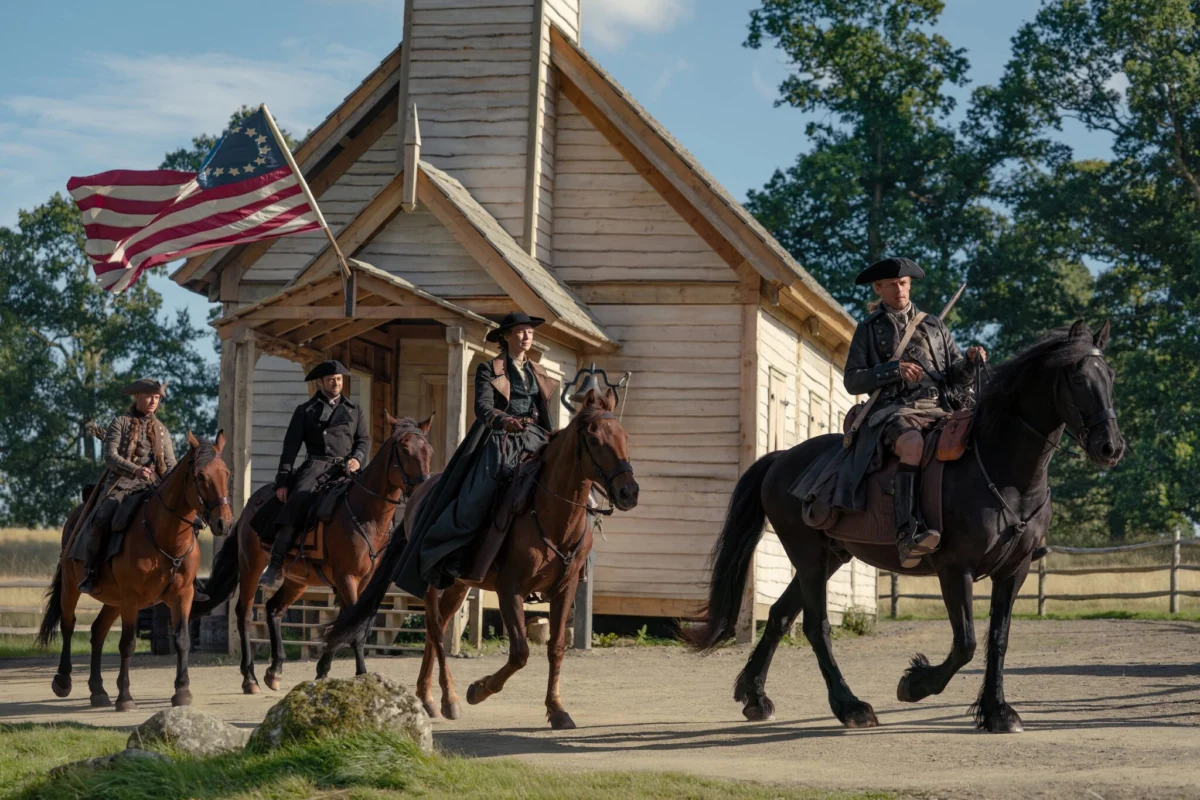
The television landscape rarely witnesses a series with the temporal complexity and cultural endurance of Starz’s Outlander. Based on the sprawling historical fantasy novels by Diana Gabaldon, the show has spent eight seasons navigating the turbulent waters of the 18th-century Jacobite rising, the American Revolutionary War, and the existential weight of time travel. As the credits rolled on the series finale, titled "And the World Was All Around Us," fans were left with a profound sense of closure that felt as much like a homecoming as it did a tragedy.
The finale, which spanned an extended runtime, served as a deliberate bridge between the series’ humble beginnings in the Scottish Highlands and the geopolitical chaos of the American colonies. It functioned not merely as a wrap-up of plot threads, but as an elegant, if occasionally heavy-handed, homage to the core tenets of the franchise: the indomitable nature of love and the haunting, inescapable pull of destiny.
The Architecture of an Ending: Main Narrative Beats
The episode opened on a somber note, with Jamie Fraser—the Highlander who transitioned from a fugitive rebel to a colonial patriarch—drafting his final will and testament. This narrative choice provided a grounding mechanism, allowing the audience to check in with the expansive Fraser clan, including children and grandchildren who have populated the later seasons of the series.

However, the episode’s pacing faced criticism for its reliance on repetitive goodbyes. The tension surrounding Jamie’s potential death at the Battle of King’s Mountain had been built up throughout the season, and by the time the finale arrived, the emotional stakes of these farewells felt somewhat diluted. Despite the show’s attempts to lean into the suspense, the narrative predictability—that the protagonists would likely survive the battle itself—meant that the focus remained squarely on the inevitable, rather than the "if."
Claire Fraser, the modern-day surgeon displaced in time, spent the episode battling the dual demons of her medical training and her prophetic knowledge of history. Her struggle to reconcile her desire to save Jamie with her deep-seated understanding that "history cannot be changed" served as the episode’s primary philosophical engine.
Chronology of a Climax: The Battle and the Aftermath
The events of the finale unfolded in a distinct three-act structure, transitioning from the domestic anxiety of the Fraser household to the brutal reality of the battlefield, and finally to a metaphysical resolution that tied the series back to its inception.

1. The Battle of King’s Mountain
The conflict was characterized by a "minimalist" approach to casualties, which underscored the show’s intent to focus on personal stakes rather than historical slaughter. The death of Hiram Crombie provided a grim reminder of the show’s penchant for swift, unceremonious violence, but it was the aftermath that truly defined the episode.
Jamie, having survived the fray, stood on the peak of the mountain in a moment of uncharacteristic, almost hubristic triumph. This vulnerability proved fatal; he was struck down by a coward’s bullet from Major Ferguson. The scene was designed to be jarring—a reminder that in the world of Outlander, the rules of honor do not always protect the virtuous.
2. The Tableaus of Grief
Claire’s reaction to Jamie’s death—a refusal to abandon his body—was the emotional anchor of the finale. Her insistence on staying with him, despite the hopelessness of his injury and the loss of her surgical supplies, served as a symbolic refusal to accept the passage of time. This act transformed the scene into a "morbid tableau," effectively freezing the characters in a state of suspended animation.

3. The Temporal Loop: A Return to Inverness
The most resonant moment for long-time fans was the visual callback to the very first episode. The appearance of "Ghost Jamie" outside Claire’s window in Inverness—the image that sparked the entire series—was finally contextualized. Whether interpreted as a manifestation of Jamie’s astral projection during a near-death experience or a purgatorial lingering of his spirit, the scene offered a poetic symmetry. By showing Jamie planting the forget-me-nots that would eventually draw Claire to the stones, the show affirmed the circular nature of their bond.
Supporting Data and Creative Choices
The finale was marked by a series of creative risks that divided the audience. On one hand, the "white-haired La Dame Blanche" power-play, in which Claire seemingly pulls Jamie back from the brink of death, was viewed by some as an exercise in sentimentality that veered into the fantastical.
Conversely, the performance of Caitríona Balfe as Claire provided a necessary weight to these scenes. Her portrayal of raw, guttural horror successfully grounded the supernatural elements in human grief. Critics noted that while the show avoided "retconning" the rules of time travel—specifically Jamie’s inability to traverse the stones—the inclusion of a "purgatorial loophole" allowed the writers to sidestep the finality of death in a way that felt consistent with the show’s established lore.

However, the juxtaposition of these events with the season’s earlier tragedies remained a point of contention. The deaths of Faith and the adult Fergus were portrayed with a cold, random brutality, which contrasted sharply with the miraculous survival of the protagonists. For some viewers, this raised questions about the narrative logic of the world: Why do the innocent die, while the central couple is granted a reprieve by fate?
Official Responses and Interpretations
In the wake of the finale, creators and cast members have remained coy about the specific metaphysical mechanics of the ending. In post-production interviews, the consensus among the production team was to leave the "ambiguity" of the final scene open to interpretation.
Is this a literal resurrection? Or is it a final, dying vision shared by two souls who have spent lifetimes defying the odds? The stars have suggested that the "ragged inhale" heard in the final moments is intended to signify the beginning of the next chapter—or the end of the current one—leaving the audience to decide whether the Frasers truly defeated mortality or merely delayed the inevitable.

Implications: The End of an Era
The conclusion of the Outlander television series carries significant implications for the legacy of the franchise. As the final novel in the series, Blessing for a Warrior Going Out, looms on the horizon, the show has effectively set the stage for a literary conclusion without forcing a definitive resolution on the television audience.
The finale succeeded in its primary goal: to honor the source material while acknowledging the medium of television. It captured the "tension" inherent in the Frasers’ existence—a life spent looking back on the foundations they built and forward into an uncertain, often hostile, future.
Key Takeaways:
- The Power of Memory: The finale reinforced that the journey of Claire and Jamie is defined as much by their separation as by their union.
- Narrative Integrity: By refusing to change the past, the show maintained the stakes that have defined the series since 2014.
- A Thematic Loop: The closure regarding the "Ghost Jamie" at the window provides a satisfying, if somewhat tragic, explanation for the inciting incident of the series.
In conclusion, "And the World Was All Around Us" served as a fitting coda for a series that redefined historical romance. While it may not have satisfied every viewer’s desire for a conventional happy ending, it stayed true to the spirit of the characters. The Frasers, having survived battle, politics, and the relentless march of time, found their way back to one another—if only in the space between heartbeats. As the screen faded to black, the lingering echo of "The Skye Boat Song" served as a final reminder: for Claire and Jamie, the story never truly ends; it only shifts into a different cadence of time.









No comments yet. Be the first to join the conversation!