Nana Wu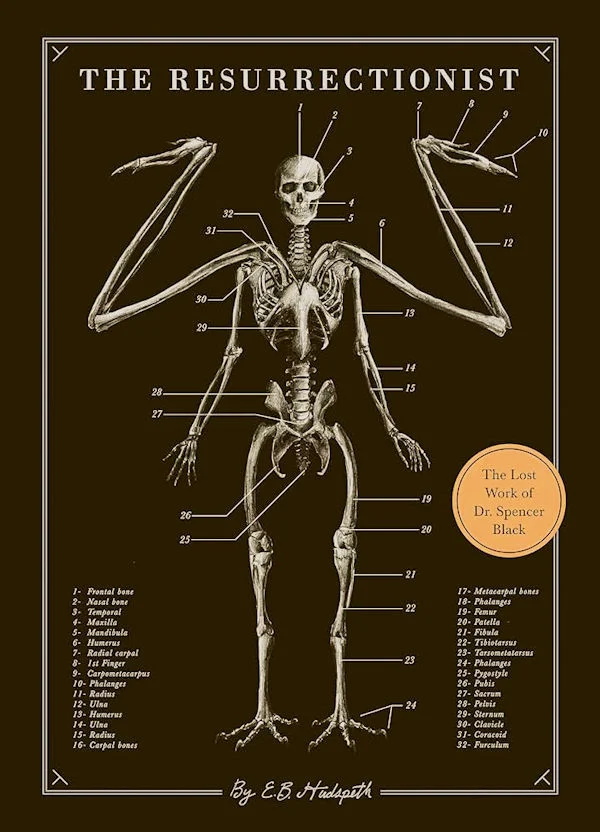
In the landscape of modern speculative fiction, few subgenres possess the visceral, haunting allure of "fictional non-fiction." It is a category defined by the blurred lines between reality and artifice—a literary space where forged field guides, lost manuscripts, and fabricated histories intersect. Standing at the vanguard of this niche is E. B. Hudspeth’s The Resurrectionist, a work that transcends the traditional novel format to become a disturbing, beautiful artifact of a mind undone.
Set against the atmospheric, gas-lit backdrop of late 1870s Philadelphia, the book chronicles the life of the fictional Dr. Spencer Black. A surgeon whose lineage is as dark as his research—born to a grave robber—Black navigates the prestigious halls of the Academy of Medicine with a radical, borderline-heretical hypothesis. He posits that the beasts of legend—the sphinx, the mermaid, the satyr—were not mere figments of ancient myth, but rather the evolutionary ancestors of the human race.
The Chronology of a Descent
The narrative arc of The Resurrectionist is a study in the erosion of sanity. To understand the impact of Hudspeth’s work, one must trace the trajectory of Dr. Black’s transformation:
- Early Life (1850s–1860s): Raised in the shadow of the cemetery, Black develops a morbid fascination with the mechanics of the body. His education at the Philadelphia Academy of Medicine provides him with the surgical precision and anatomical knowledge that would later fuel his obsessions.
- The Academic Years (1870–1875): Black begins his tenure as a respected, albeit eccentric, surgeon. His public lectures on comparative anatomy begin to hint at his unconventional evolutionary theories, drawing both fascination and ire from his peers.
- The Turning Point (1876): Following a series of professional setbacks and personal tragedies, Black retreats into total isolation. He ceases to be a traditional healer and begins to act as an "evolutionary investigator," conducting clandestine surgeries and experiments.
- The Final Act (1878–1879): The physician abandons the professional world entirely, transitioning into the role of a carnival showman. He displays "specimens" that defy biological logic, a final, public act of defiance that cements his reputation as a madman rather than a pioneer.
Anatomical Precision and the Codex Extinct Animalia
The true brilliance of The Resurrectionist lies in its bifurcated structure. The first half of the volume functions as a biographical novel, while the second half is dedicated to the Codex Extinct Animalia. This segment acts as the "proof" for Black’s theories, consisting of intricate, hand-drawn anatomical plates of various mythological entities.
These illustrations are rendered with the dry, sterile precision of a 19th-century medical textbook. From the skeletal structure of a centaur’s ribcage to the complex muscular composition of a siren’s tail, the drawings command a terrifying sense of authenticity. Hudspeth’s artistry is not merely decorative; it is a vital component of the narrative’s psychological weight.
Without the biography of Dr. Black, the Codex would remain a stunning curiosity—a coffee-table book for lovers of the macabre. However, when framed by the story of Black’s slide into madness, every sketch becomes a diagnostic tool. Each plate is a testament to a genius who has ceased to perceive the world as it is, instead projecting his own fever dreams onto the fabric of reality.
Supporting Data: The Convergence of Myth and Medicine
While the content of The Resurrectionist is entirely fictional, it draws upon a rich history of actual scientific anxiety. During the 19th century, the rapid advancement of biology—specifically the publication of Darwin’s On the Origin of Species (1859)—sent tremors through the academic community. The fear that humanity might be linked to "lesser" creatures was a pervasive social anxiety.
Hudspeth masterfully exploits this historical tension. By anchoring his "monsters" in the language of Victorian medical science, he bridges the gap between the grotesque and the clinical. The use of anatomical terminology (e.g., "dorsal processes," "cervical vertebrae") provides a veneer of credibility that makes the impossibility of the specimens feel tangible. Readers are invited to look at these creatures not as fantastical entities, but as biological anomalies that were simply "misclassified" by history.
Critical Reception and Official Perspectives
The literary community has largely lauded The Resurrectionist for its audacity. Critics frequently point to the "found footage" quality of the text, noting that the reader feels less like a consumer of fiction and more like an archivist uncovering a forbidden secret.
However, the consensus is not without its caveats. While the visual component is universally praised, some scholars of the genre have noted a structural imbalance. There is a palpable desire for a more granular exploration of Black’s decline. The transition from the esteemed surgeon at the Academy to the fringe showman happens with a swiftness that, while narratively efficient, leaves the reader yearning for a deeper psychological dive. The "unravelling" of a mind as sharp as Black’s is a rich vein of literary potential; by keeping the transition somewhat distant, Hudspeth misses an opportunity to fully inhabit the horror of that mental collapse.
Nevertheless, the work has been hailed as a masterpiece of "fictional non-fiction." It occupies a space similar to books like Codex Seraphinianus or the works of Jorge Luis Borges, where the book itself is a performance piece.
The Implications of "Fictional Non-Fiction"
What does The Resurrectionist imply about our relationship with truth and storytelling? In an era of rampant misinformation and digital fabrication, there is a certain catharsis in engaging with a "forged" history that is honest about its own dishonesty.
The implications are two-fold:
- The Re-enchantment of Science: By utilizing the cold, clinical language of medical textbooks to document the impossible, Hudspeth re-enchants the world. He reminds us that even within the rigid structures of science, there is room for the awe-inspiring and the terrifying.
- The Fragility of Expertise: Dr. Black represents the archetype of the "fallen intellectual." His story serves as a cautionary tale about the dangers of obsession. When an individual’s internal narrative becomes more important than external reality, the result is always a tragedy. The book forces the reader to ask: at what point does scientific rigor become a delusion?
Conclusion: A Permanent Resident of the Mind
E. B. Hudspeth has achieved something rare in contemporary literature: he has created an object that feels like it has a life of its own. The Resurrectionist is not merely a book one reads and shelves; it is a book one experiences as an intrusion.
For those who find themselves drawn to the strange, the scholarly, and the off-kilter, this volume is an essential addition to any library. It invites the reader to step into the gas-lit streets of 19th-century Philadelphia, to look over the shoulder of a man who saw the world as a puzzle to be taken apart, and to consider that perhaps, in the dark corners of our own history, the monsters were never really gone—they were just waiting to be classified.
Whether you are a devotee of historical fiction, an aficionado of dark art, or simply someone who appreciates a well-crafted deception, The Resurrectionist is a haunting, singular achievement that defies simple categorization. It is a reminder that the line between genius and madness is, as Dr. Black might have observed, as thin as a scalpel’s edge.


 Dwi Wanna
 Siti Muinah