
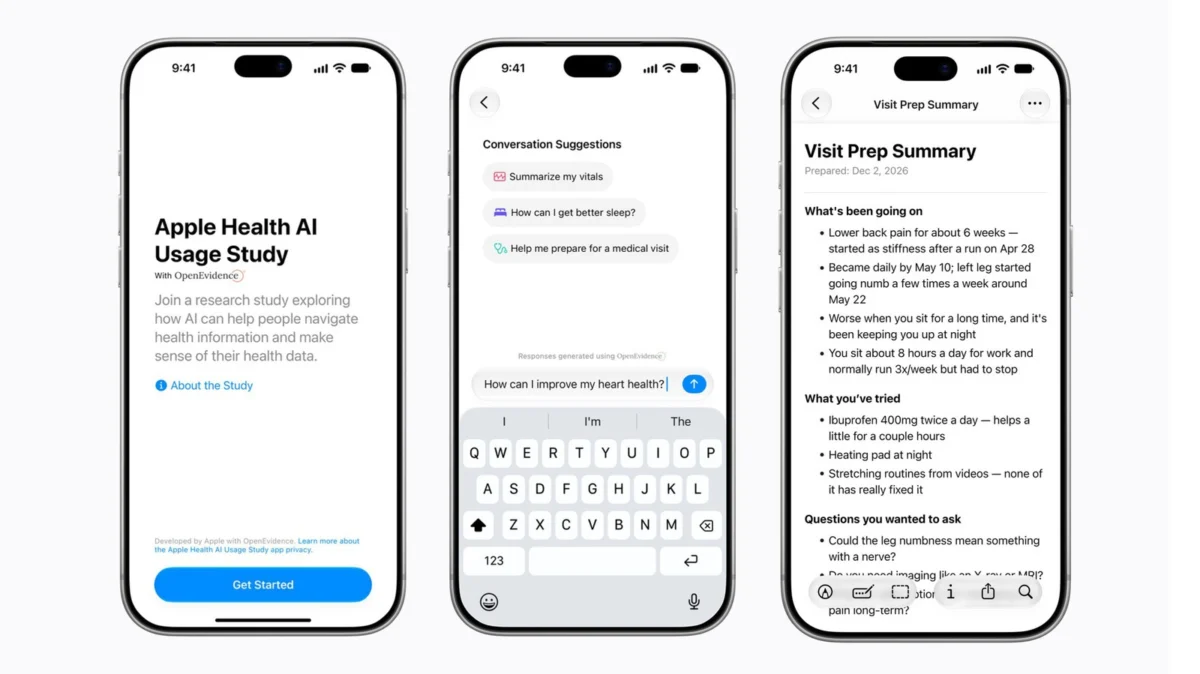
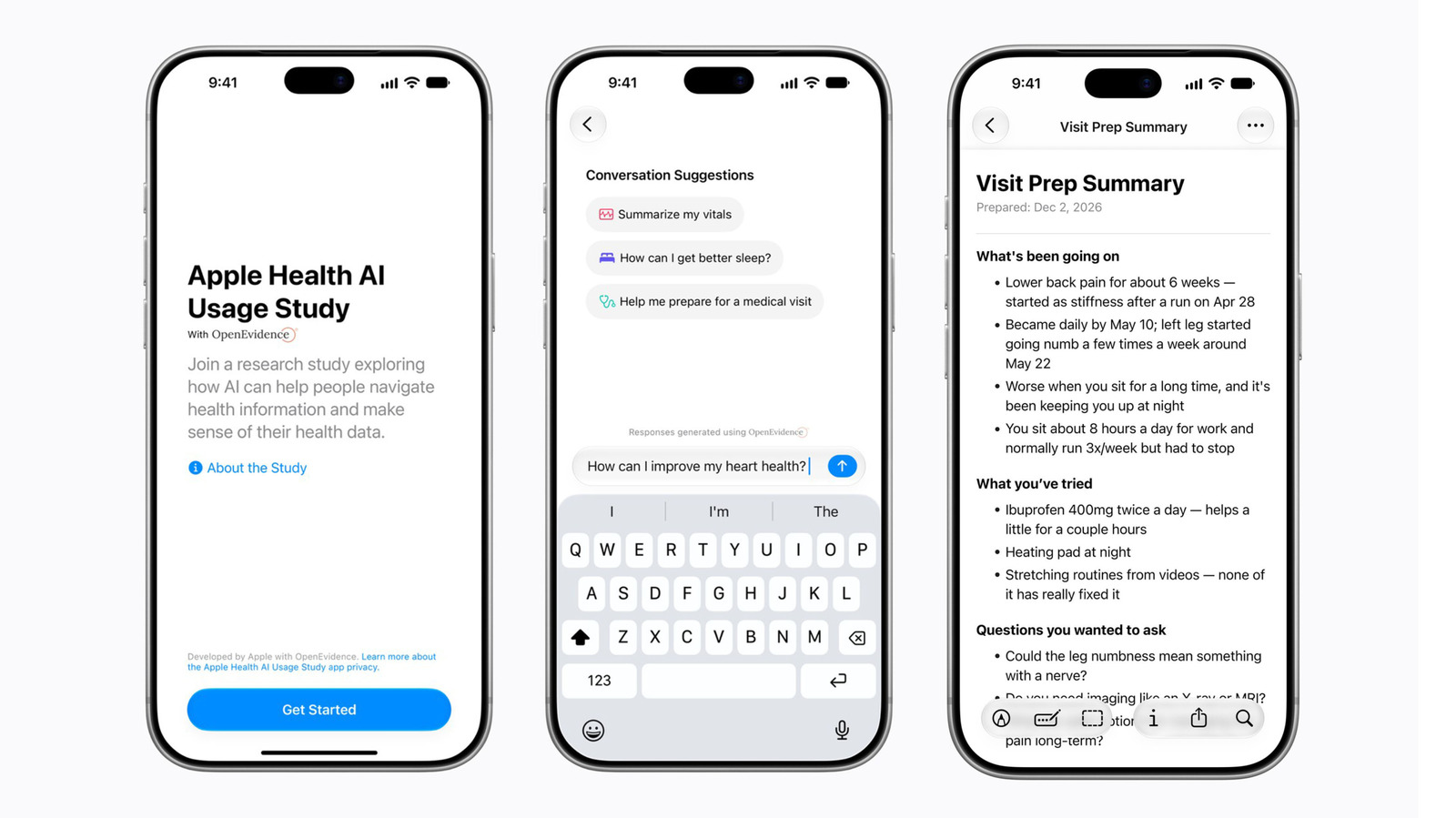
In a move that signals a significant shift in how technology giants are approaching the integration of artificial intelligence into personal wellness, Apple has officially unveiled its "Health AI Usage Study." The ambitious project, launched in partnership with the clinical AI platform OpenEvidence, seeks to bridge the gap between complex medical data and actionable consumer health insights. By inviting up to 200,000 participants to interact with a dedicated research app, Apple aims to refine how AI-driven health assistants interpret, synthesize, and communicate medical information to the average user.
The Core Objective: Humanizing Medical Data
For years, the promise of "AI in healthcare" has been stifled by a persistent problem: the tension between clinical accuracy and user accessibility. While massive databases like The New England Journal of Medicine house the world’s most reliable medical findings, they are often written in dense, academic language inaccessible to the layperson.
Apple’s new research initiative is designed to solve this by observing how real people query medical topics. Through the newly launched "Apple Health AI Study" app, participants can pose text-based questions—such as "How can I improve my heart health?" or "What are the common lifestyle factors affecting sleep quality?"—and receive responses synthesized from peer-reviewed clinical sources.
The primary goal is not merely to provide answers, but to assess the quality of communication. By allowing users to rate responses and tracking how they interact with provided clinical links, Apple hopes to develop a framework for AI that prioritizes clarity without sacrificing the "scientific rigor" that Dr. Sumbul Desai, Apple’s VP of Health, emphasizes as the foundation of the company’s philosophy.
Chronology: From Concept to Clinical Study
The journey to this study began long before the app’s public debut. While Apple has been a pioneer in health sensing for over a decade—starting with the original Health app and the subsequent evolution of the Apple Watch—this study represents a pivot from data collection to data interpretation.
- Foundation Phase: Over the last several years, Apple has systematically integrated HealthKit, allowing for the consolidation of biometric data ranging from heart rate variability to sleep stages.
- The Partnership: Apple identified OpenEvidence as the ideal collaborator. Unlike general-purpose Large Language Models (LLMs) that can suffer from "hallucinations," OpenEvidence is a platform specifically curated for medical professionals, designed to pull information exclusively from verified, high-impact clinical journals.
- Beta Development: Internal testing focused on the app’s ability to simplify jargon. Developers worked to ensure that the interface remained clean and intuitive, mirroring the minimalist design language Apple users expect.
- Public Launch: In late 2026, Apple formally announced the study, making the app available for download in the United States. This marks the commencement of a multi-month period where researchers will observe user-AI interaction patterns at a massive scale.
The Methodology: Who, How, and What
Apple has established strict parameters for the study to ensure the integrity of the data collected. To participate, users must meet specific hardware and software requirements:
- Hardware: Participants must own an iPhone 15 Pro or a more recent model, ensuring the device has the necessary neural processing power to handle the app’s requirements.
- Software: The devices must be running iOS 26 or later, which includes the latest privacy and security protocols required for handling sensitive health queries.
- Demographics: The study is currently restricted to residents of the United States who are 21 years of age or older.
A unique feature of this study is the optional integration of Apple HealthKit data. Participants can choose to sync their existing health metrics—such as activity levels, lab results, and sleep quality—with the app. By providing this context, users allow the AI to offer more tailored insights. For instance, if a user asks about heart health, the AI could theoretically provide advice that is contextually relevant to the user’s specific cardiovascular data, provided the user has granted the necessary permissions.
Official Responses and Ethical Guardrails
One of the most critical aspects of the announcement was Apple’s proactive stance on privacy and the separation of this research from its broader AI ecosystem.
In a statement accompanying the launch, Dr. Sumbul Desai, Apple’s VP of Health and Fitness, underscored the company’s commitment to responsible innovation. "We believe responsible innovation starts with scientific rigor and clinical grounding," Dr. Desai stated. "Insights from this study will help advance the broader scientific conversation and ensure that as technology evolves, we continue building trusted tools that genuinely support people wherever they are on their health journey."
Crucially, Apple has addressed common anxieties regarding the training of AI models. The company explicitly stated that:
- No AI Training: The data generated during this study—including user queries and health information—will not be used to train Apple’s general-purpose AI models or Apple Intelligence.
- No Integration: The research app operates in a "sandbox" environment. It is not connected to Siri or the standard Apple Intelligence suite, ensuring that the research study remains a distinct, controlled clinical observation.
- Confidentiality: All participant data is treated with the highest level of clinical privacy, ensuring that the personal health journey of each participant remains protected.
Implications for the Future of Healthcare
The implications of this study reach far beyond the app itself. By standardizing how AI interacts with patients, Apple is laying the groundwork for a future where "AI-assisted medicine" is a standard component of primary care.
1. Reducing the Burden on Healthcare Systems
If patients can receive accurate, clinically-grounded answers to basic health questions via an app, it may reduce the volume of unnecessary clinical visits, allowing doctors to focus on more complex, high-acuity cases.
2. Bridging the Health Literacy Gap
Many health outcomes are negatively impacted by a patient’s inability to understand their own medical data. By transforming complex, jargon-heavy research into "non-jargony" responses, Apple is effectively increasing health literacy among its user base.
3. The Gold Standard for Clinical AI
If this study succeeds, it could set a new industry benchmark. Other tech companies currently developing medical AI will likely face pressure to adopt similar methods of peer-reviewed grounding and transparent, user-centric data handling.
4. A Template for Personalized Medicine
The ability to combine user-specific data (via HealthKit) with broad clinical knowledge (via OpenEvidence) is the "holy grail" of personalized medicine. If this study proves that AI can provide safe, relevant, and actionable advice based on an individual’s personal health history, it could accelerate the development of personalized health coaching as a standard medical service.
Conclusion: A Measured Approach
Apple’s entry into this space is characteristically cautious. By framing this as a "research study" rather than a "product rollout," the company is prioritizing long-term efficacy over short-term feature acquisition.
The success of this initiative will be measured not by the number of people who download the app, but by the quality of the insights the company gathers. If Apple can demonstrate that AI, when tethered to high-quality clinical sources and used with transparency, can genuinely improve a user’s health journey, it will have successfully navigated the most difficult hurdle in digital health: moving from a gadget that tracks health to an assistant that truly understands it.
As the study progresses, the global health and technology sectors will be watching closely to see if this marriage of silicon and science can deliver on its promise of making expert health information accessible to everyone, everywhere.