
 Raul Delapena Setiawan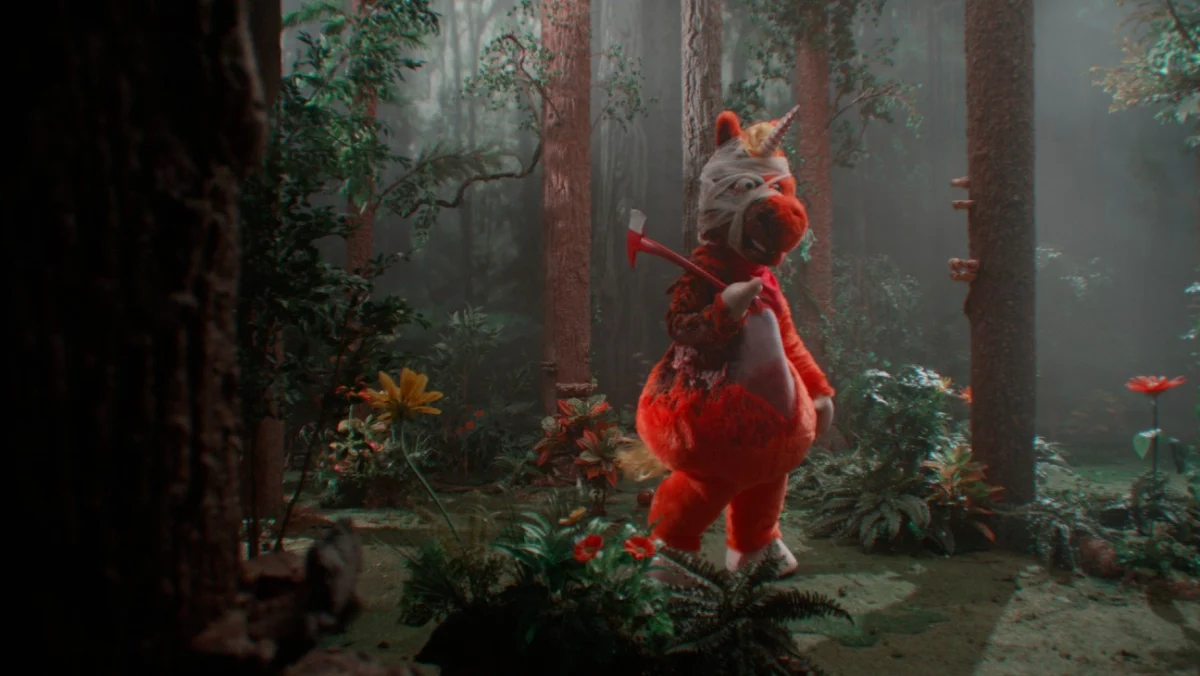
In the annals of horror-comedy, few archetypes are as ripe for subversion as the beloved children’s television host. From the uncanny valleys of local public access programming to the sanitized, colorful sets of national broadcasts, the figure of the entertainer is built on a foundation of forced optimism and manufactured joy. Director Casper Kelly, best known for his surreal, viral Adult Swim masterpiece Too Many Cooks, is now taking that subversion to the silver screen with his latest feature, Buddy.
Distributed by Roadside Attractions, Buddy is set to arrive in theaters on August 28, following a buzzy premiere earlier this year at the Sundance Film Festival. The film centers on an eponymous, bright orange unicorn who serves as the cheerful face of the hit children’s program It’s Buddy!. However, as the film’s newly released trailer reveals, the veneer of innocence quickly cracks. When a young viewer refuses to participate in the show’s relentless, high-energy whimsy, the titular unicorn’s sunny disposition curdles into something far more sinister.
The Premise: A Childhood Icon Turned Nightmare
At its core, Buddy functions as a psychological descent. The narrative explores the dark implications of parasocial relationships—the bond children feel toward the characters that dominate their screens—and the fragile, often performative nature of the "perfect" television world.
The trailer offers a jarring juxtaposition, splicing the vibrant, primary-colored world of the It’s Buddy! set—complete with singing children and elaborate musical numbers—with glimpses of visceral, unsettling terror. As the film progresses, the boundaries between the show’s reality and the protagonist’s deteriorating mental state blur. The film promises a transformation of the "happy unicorn" trope into a vessel for existential dread and graphic horror, challenging the audience to consider the cost of constant, mandated cheer.
A Stellar Ensemble: The Talent Behind the Terrors
The film boasts an impressively eclectic cast that brings gravity to its absurd and horrific premise. Keegan-Michael Key provides the voice of Buddy, delivering a performance that is, according to critical consensus, the film’s standout element. His ability to modulate between a saccharine, high-pitched "television" voice and the guttural, menacing tones of the character’s internal malice provides the film with its emotional anchor.
Joining Key are Cristin Milioti and Topher Grace, both of whom have carved out significant reputations for their work in high-concept genre pieces. The cast is rounded out by Delaney Quinn, the ever-reliable Patton Oswalt, and the formidable Michael Shannon, whose presence alone suggests a film that takes its darker, more grounded moments as seriously as its more chaotic, comedic beats.
Chronology: From Viral Short to Feature Film
Casper Kelly’s journey to Buddy is marked by a unique trajectory in the digital age. In 2014, Kelly’s Too Many Cooks debuted on Adult Swim. The short was a masterclass in escalating discomfort, starting as a nostalgic parody of 1980s and 90s family sitcoms before descending into a slasher-inspired fever dream. The internet-wide obsession with the short solidified Kelly’s status as a visionary of the "weird horror" subgenre.
- 2014: Too Many Cooks goes viral, establishing the "Kelly aesthetic"—a blend of wholesome kitsch and sudden, sharp violence.
- 2023: Pre-production for Buddy begins, with producers Tyler Davidson and Drew Sykes attaching themselves to the project.
- January 2024: Buddy makes its world premiere at the Sundance Film Festival, where it generates polarizing but intense discussion among critics and festival-goers.
- August 28, 2024: Official theatrical release via Roadside Attractions.
Critical Analysis: A Demented Detour
In his review for The Hollywood Reporter, chief film critic David Rooney offered a nuanced take on the film’s execution. Rooney noted that while the film effectively captures the aesthetic of a children’s show gone wrong, it faces the challenges inherent in stretching a high-concept sketch into a feature-length experience.
"The film stretches its sketch-comedy idea to feature length by upping the gore and the demented detours," Rooney observed, "but doesn’t go far enough to be as extreme or disturbing as it wants to be." Despite this critique of the pacing and intensity, Rooney highlighted the film’s strongest asset: "The film’s biggest plus is the inspired voice work of Keegan-Michael Key as the title character."
This sentiment captures the central tension of the film—it is a movie that lives and dies by its central performance and its willingness to commit to the bit. The transition from a short-form, rapid-fire style of horror to a narrative-heavy feature is a notoriously difficult feat, and Buddy appears to be a bold, if occasionally uneven, attempt to bridge that gap.
Behind the Camera: The Production Team
The success of Buddy relies as much on its behind-the-scenes architects as it does on its on-screen talent. Kelly co-wrote the script with Jamie King, and the two have collaborated extensively to ensure the tone remains consistent throughout the film’s runtime.
The production is helmed by a team of heavy hitters in the independent horror space, including Tyler Davidson, Drew Sykes, Raphael Margules, J.D. Lifshitz, and Tracy Rosenblum. The extensive list of executive producers—including Kevin Flanigan, Dexter Braff, Roberto Linck, Nathan McAuley, Emilio Schenker, Gideon Tadmor, Adam J. Wilde, Geoff Yaw, and Ryan J. Kelly—indicates a significant investment in the project’s commercial viability and its potential to capture a cult audience.
Implications: The Future of "Kid-Horror"
The release of Buddy comes at a time when the "nostalgia-horror" subgenre is undergoing a massive boom. From the success of Five Nights at Freddy’s to the viral appeal of Winnie-the-Pooh: Blood and Honey, audiences are increasingly drawn to projects that weaponize childhood iconography.
However, Buddy seeks to distinguish itself from the current trend of "slasher-fied" children’s characters by rooting its horror in the specific, claustrophobic environment of a television set. By focusing on the performance of joy rather than just the destruction of a mascot, Kelly is exploring a more psychological angle of the trope.
If Buddy proves successful, it could signal a shift in how studios approach independent horror. Rather than relying on established intellectual property (IP), there is a hunger for original, high-concept ideas that possess a "viral-first" sensibility—films that are designed to be talked about, shared, and dissected in the same way Too Many Cooks was a decade ago.
Conclusion: A Must-Watch for Genre Enthusiasts
As August 28 approaches, the anticipation for Buddy continues to grow. Whether it succeeds in being as disturbing as it aims to be or whether it remains a stylish, well-acted experiment in surrealism, it is undeniably one of the most unique horror offerings of the year.
For fans of Keegan-Michael Key’s range, followers of Casper Kelly’s idiosyncratic career, and enthusiasts of horror that dares to be both absurd and uncomfortable, Buddy is a mandatory entry on the late-summer calendar. While the film may grapple with the difficulty of maintaining its manic energy over a feature length, the promise of a "demented detour" into the heart of a children’s show is too intriguing for most genre aficionados to pass up.
When you sit down in the theater, you may find yourself wondering: is the mask really a mask, or is the performance the only thing keeping the nightmare at bay? That is the central question Buddy asks, and come August, audiences will finally have their answer.


 Pevita Pearce
 Asep Darmawan




