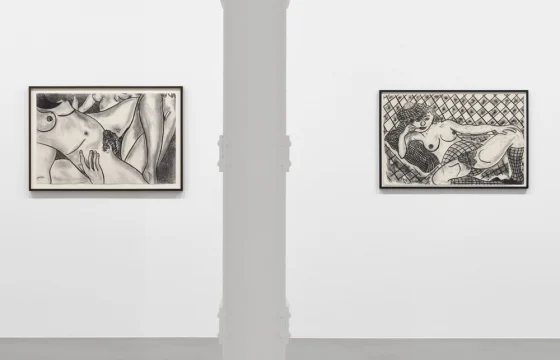
Galerie Max Hetzler in Berlin has unveiled a major retrospective that invites viewers to reconsider the intersection of fine art, erotica, and the avant-garde. Titled X-Rated (1972–1974), the exhibition spotlights a pivotal period in the career of American artist William N. Copley. Featuring a curated selection of paintings and works on paper, the show serves as the fourth presentation of Copley’s work at the gallery and is scheduled to remain on view through April 22, 2026.
At a time when global discourse regarding bodily autonomy and the boundaries of artistic expression remains highly charged, Copley’s “X-Rated” series—conceived during the early 1970s—retains a potent, subversive energy. By transforming the illicit imagery of adult magazines into stylized, vibrant, and deeply humorous narratives, Copley did not merely depict sex; he sought, in his own words, to “break through the barrier of pornography into the area of joy.”
A Life in Flux: The Genesis of CPLY
To understand the radical nature of the X-Rated series, one must first understand the idiosyncratic path of William N. Copley. Unlike many of his contemporaries who emerged through traditional academic routes, Copley entered the art world with the ambitions of a writer. His early career was defined by a unique bridge between literature and the visual arts.
In the late 1940s, Copley co-founded the Copley Galleries in Beverly Hills alongside his brother-in-law, the artist John Ployardt. This brief but seismic venture became a hub for the European Surrealists who had fled the ravages of World War II. It was here that Copley found himself in the orbit of giants: Marcel Duchamp, Max Ernst, and Man Ray. Under the guidance of dealer Alexander Iolas, Copley began to transition from patron and curator to practitioner. Adopting the succinct professional signature “CPLY,” he debuted his own work in 1951 before relocating to France, where the Surrealist influence would permanently color his stylistic development.
Despite being a generation younger than the Surrealists, Copley’s work functioned as a continuation of their ethos. He adopted their focus on the unconscious, humor, and psychology, yet he filtered these themes through a uniquely American lens. His bold black outlines and flat, figurative aesthetic drew heavily from the visual lexicon of comic strips and the burgeoning Pop Art movement, creating a hybrid style that was both conceptually rigorous and playfully accessible.
Chronology: The Evolution of the "X-Rated" Series
The X-Rated series did not appear in a vacuum; it was the culmination of decades of stylistic experimentation. The series was created between 1972 and 1975, a time when the legal and social status of adult content in the United States was in a state of flux.
- 1972–1974: Copley begins sourcing imagery from underground adult magazines. Unlike his contemporaries who might have used such imagery for shock value, Copley utilized these sources to explore complex human dynamics, sexual politics, and the inherent absurdity of desire.
- 1974: The New York Cultural Center hosts the first major exhibition of the series. Curated by the progressive director Mario Amaya, the show proved to be a critical success, defying expectations that the content would be deemed purely "offensive."
- 1975: The series concludes, marking a definitive chapter in Copley’s career.
- 2026: Galerie Max Hetzler revives the discourse surrounding these works, providing a contemporary audience the opportunity to analyze the series through the lens of modern digital culture.
The Anatomy of a Painting: Process and Technique
The X-Rated exhibition provides an unprecedented look at Copley’s creative methodology. The gallery has thoughtfully paired completed canvases with their preparatory counterparts, such as the painting Calcutta (1973) and its related sketches.
Copley’s process was disciplined, despite the seemingly "slapdash" appearance of the final results. He typically engaged in a two-stage drawing process: first, a small-scale, gestural study to capture the narrative core; second, a larger, refined version that heightened the pictorial dynamism and established the color palette. By displaying these preparatory works alongside the final paintings, the exhibition highlights Copley’s deliberate construction of his scenes. The figures are never meticulously rendered; instead, they are treated with a schematic, rhythmic loose-handedness that prioritizes the energy of the interaction over anatomical accuracy.
This stylistic choice has often led critics to compare Copley to Henri Matisse. Both artists used the nude as a primary subject, and both utilized bold, flat backgrounds that forced the viewer to confront the image as a structural design rather than a realistic depiction. However, where Matisse often leaned into the decorative and the idealized, Copley remained resolutely direct. He did not hide the sexual act; he codified it within a landscape of geometric patterns and vibrant color.
Official Responses and Critical Reception
When the X-Rated series first debuted in 1974, the cultural landscape was arguably more resistant to explicit imagery than it is today. Yet, the critical response was unexpectedly warm. Peter Schjeldahl, writing for Art in America, described the presentation as a "uniformly gorgeous exhibition," noting that it represented a "highly satisfying development in Copley’s work."
The success of the 1974 show is largely attributed to the curatorial vision of Mario Amaya. By framing the works within an institutional space—the New York Cultural Center—Amaya neutralized the "smut" label that might have been applied to the work in a different context. The titles of the pieces, borrowed from iconic films like The Exorcist and Les Quatre Cent Coups, added a layer of intellectual detachment. As Copley noted, “That’s what makes sex so much fun: since nobody really understands it, the possibilities for originality are endless.” By linking these works to cinema, he created a dissonance: the titles suggest a narrative, but the images force the viewer to create their own meaning.
Implications: The Subversive Legacy
What does it mean to view the X-Rated series in 2026? In an era where images of all types are available at the click of a button, Copley’s work has lost none of its subversive charge. The "X-Rated" paintings are not merely depictions of physical intimacy; they are critiques of how we consume, categorize, and moralize pleasure.
By removing the taboo of the "adult magazine" and placing it into the realm of high art, Copley challenged the artistic neutrality of his era. He rejected the moralistic constraints that demanded art remain "clean" or "elevated," choosing instead to embrace the messy, funny, and often confusing nature of human sexuality.
The exhibition at Galerie Max Hetzler is more than a retrospective of a mid-20th-century painter; it is an interrogation of the viewer’s own relationship with the image. As we navigate a world that is simultaneously more image-saturated and more strictly policed in its digital discourse, Copley’s X-Rated series serves as a reminder that art has the power to reclaim the narrative of pleasure. Through his blend of pop-cultural savvy, Surrealist roots, and a fearless commitment to the human condition, William N. Copley continues to invite us to step into that "area of joy"—if we are brave enough to look.