

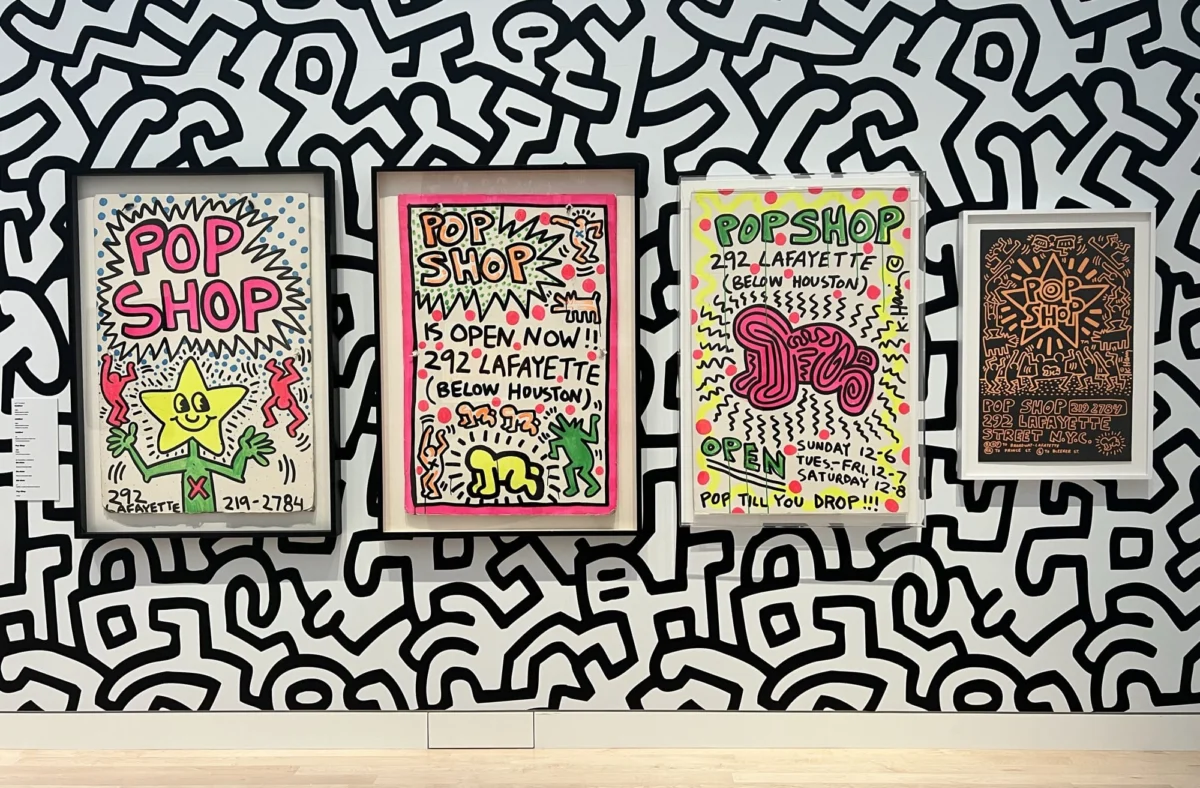
New York City in the 1980s was a landscape defined by grit, neon, and a relentless, pulsating creative friction. It was a place where subway cars served as moving canvases, cloaked in vibrant graffiti, and Times Square was a neon-soaked epicenter of human energy rather than the sanitized, LED-lit tourist hub it is today. This was the era that birthed the kinetic legacies of hip-hop and New Wave, the rise of MTV, a radical shift in fashion, and the explosion of Pop Art.
Central to this cultural upheaval was Keith Haring (1958–1990), an artist whose decisive, confident lines became the visual shorthand for a generation. A new, expansive exhibition at the Crystal Bridges Museum of American Art, titled Keith Haring in 3D, invites audiences to step away from the two-dimensional reproductions often found on T-shirts and postcards to encounter the artist’s work in its true, sculptural, and tactile form.

The Genesis of an Urban Visionary
In 1978, just as the United States was bracing for the economic turmoil of an impending recession, a 20-year-old Keith Haring arrived in Manhattan to enroll at the School of Visual Arts. He entered a city that was raw, desperate, and overflowing with aesthetic potential.
"I arrived in New York at a time when the most beautiful paintings being shown in the city were on wheels—on trains—paintings that traveled to you instead of vice versa," Haring famously reflected in writings archived by the Keith Haring Foundation. This realization became the bedrock of his philosophy: art should not be sequestered within the ivory towers of galleries or museums. It belonged to the public, finding its way into the daily lives of citizens as a catalyst for curiosity and conversation.

Haring’s career was ignited by his interaction with the subway system. As the MTA struggled during the recession, advertising budgets plummeted, leaving vast swathes of empty, black-papered billboards throughout station platforms. To the young artist, these were not eyesores; they were ready-made canvases. Working with chalk and black paint, he produced iconic figures—angels, UFOs, snakes, and the seminal "Radiant Baby"—in rapid, fluid motions, often finishing his work before the police could intervene.
A Chronology of Artistic Evolution
- 1978: Haring moves to New York City to attend the School of Visual Arts, immersing himself in the city’s underground scene.
- 1980–1985: The "Subway Drawings" period. Haring produces hundreds of temporary chalk works in transit stations, documenting the pulse of the city.
- 1982: Charlie Ahearn’s Wild Style is released, canonizing the hip-hop movement and street art culture that Haring moved within.
- 1986: Haring opens the Pop Shop in SoHo, a controversial retail-meets-art space intended to democratize his work and make it accessible to the masses.
- 1988: Haring is diagnosed with AIDS, leading to an intensification of his work regarding mortality, activism, and human connection.
- 1990: Keith Haring passes away at the age of 31.
- 2026: Keith Haring in 3D opens at Crystal Bridges Museum of American Art, reframing the artist’s legacy through his sculptural and multimedia output.
The Philosophy of "Art Everywhere"
Haring was never merely a "graffiti artist," though he deeply respected the technical precision and underground ethos of contemporaries like Fab 5 Freddy, Lady Pink, and Jean-Michel Basquiat (who worked under the moniker SAMO). He admired the "hip and streetwise" nature of their interventions.

His transition from 2D subway drawings to the 3D works showcased at Crystal Bridges represents a natural evolution of his desire to occupy space. The exhibition, curated by Glenn Adamson in collaboration with collector Larry Warsh, rejects a chronological, linear narrative. Instead, it invites viewers to meander through an open, porous floor plan. Visitors are encouraged to walk around steel sculptures, ceramic vessels, and found objects—including an embellished 1963 Buick Special—that demonstrate Haring’s "all-over" approach to creation.
"If something had a surface, it could be art," the exhibition suggests. By removing the wall-to-wall traditional hanging of frames, the curators force a direct, physical encounter with the objects. Whether it is an inflatable "Radiant Baby," an altarpiece created following his AIDS diagnosis, or the "totem" sculptures inspired by Pacific Northwest indigenous traditions, the viewer is forced to acknowledge the weight, texture, and physical presence of Haring’s imagination.

Supporting Data: The Warsh Collection
The exhibition owes much of its depth to the foresight of Larry Warsh, a long-time collaborator and collector who understood that Haring’s genius lay in his ubiquity. Warsh collected not only the finished works but the fragments of the artist’s life: painted jackets, a headboard, a refrigerator tagged by graffiti peers, and even an illustrated steel I-beam salvaged from Haring’s Broome Street studio.
These items serve as primary source data for the era. The inclusion of a papier-mâché elephant, which bears Haring’s signature black-and-white lines but conceals an earlier, pink-toenailed version by Basquiat, offers a rare glimpse into the collaborative, often messy nature of the 80s downtown art scene. This "magpie" approach to collecting—rescuing the mundane to preserve the profound—allows Keith Haring in 3D to serve as both a retrospective and an archeological study of a lost, pre-digital New York.

Official Responses and Critical Discourse
The legacy of Keith Haring is currently subject to rigorous academic and critical re-evaluation. While his work is among the most recognized in the global canon, he has faced contemporary criticism for the "sanitization" of his art through extreme commercialization—a process he famously and controversially championed during his life.
Curator Glenn Adamson addresses these nuances head-on. In his recent contributions to Artforum, Adamson explores the ethics of Haring’s appropriation of cultural symbols, specifically his use of African masking traditions and Pacific Northwest totemic forms. By placing these works in a 2026 context, the museum invites an uncomfortable but necessary dialogue about cultural appropriation, the role of the artist as an agent of change, and the responsibilities of institutions when exhibiting works by artists who operate across cultural boundaries.

Furthermore, the exhibition highlights the profound impact of the AIDS crisis. Haring’s shift from the playful, colorful cartoons of the early 80s to the more visceral, somber, and spiritual works created in his final years provides a poignant arc to the show. It reminds the audience that his "art everywhere" mantra was not just an aesthetic choice; it was an urgent, desperate attempt to communicate with humanity while his own time was running out.
The Implications of Accessibility
The Pop Shop serves as a key touchstone for the exhibition. By opening a retail store in 1986, Haring circumvented the traditional gallery gatekeepers, mirroring the entrepreneurial spirit of Claes Oldenburg’s The Store (1961). In today’s social media-saturated world, this DIY approach feels like a precursor to the modern "influencer" economy, but for Haring, the motivation was purely egalitarian.

"It’s about participation on a big level," Haring said of his shop. The implication of his career is that art is not a luxury; it is a fundamental component of public discourse. By presenting his works as three-dimensional objects, the Crystal Bridges exhibition challenges the modern viewer to reclaim this sense of participation.
Conclusion
Keith Haring in 3D is more than a retrospective; it is a manifestation of an "all-over" energy that defined an artist and a decade. By moving away from the flat, two-dimensional surfaces that have defined his commercial reputation, the exhibition allows Haring’s work to breathe, occupy space, and challenge the viewer.

As the Crystal Bridges Museum of American Art unveils its expanded facilities this weekend, this exhibition stands as a testament to the idea that art is not something you merely observe—it is something you encounter, walk around, and live within. The show will remain in Bentonville, Arkansas, through January 25, 2027, offering a rare opportunity to witness the evolution of a man who turned the entire city into his masterpiece.









No comments yet. Be the first to join the conversation!