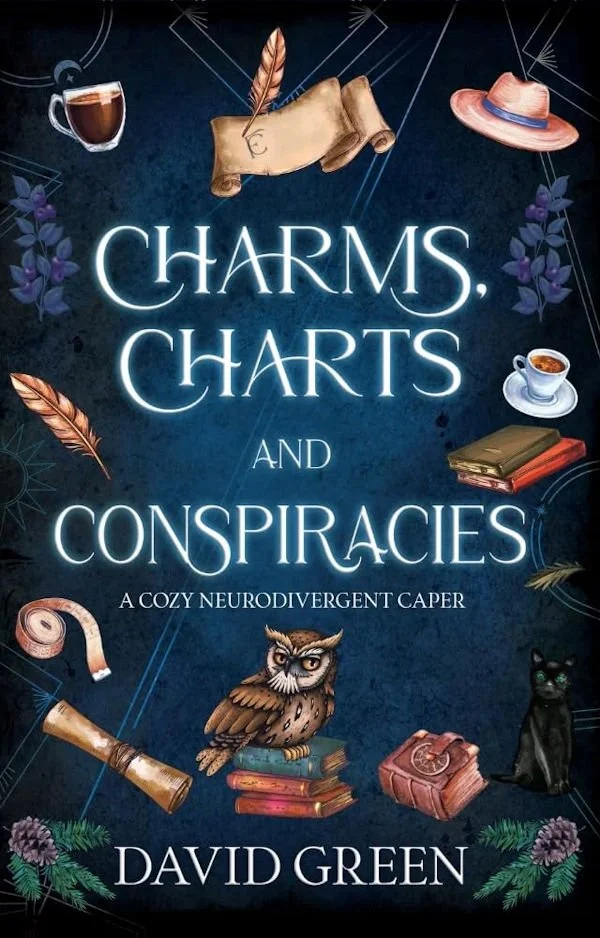
The landscape of modern fantasy is currently witnessing a paradigm shift. Moving away from the high-stakes, world-ending catastrophes that defined the genre for decades, the "cosy fantasy" subgenre has emerged as a sanctuary for readers seeking connection, warmth, and grounded, relatable character growth. Standing at the vanguard of this movement is the highly anticipated sequel, Charms, Charts, and Conspiracies, the follow-up to the celebrated Magic, Maps, and Mischief. Set to release on July 7th, this novel promises to deepen the emotional landscape of the city of Barrow’s Hill while expanding the internal journey of its most beloved protagonist, Greton of Willow.
The Core Narrative: A Life Disrupted
At the heart of the story remains Greton, an elderly, autistic mapmaker whose quiet, regimented existence in Barrow’s Hill is the anchor of the series. Having finally found his place among a supportive found family and his constant avian companion, an owl of remarkable character, Greton’s world is suddenly upended.
The arrival of a rival mapmaker in the city serves as the catalyst for a cascade of personal and professional crises. For an individual who finds solace in order and predictability, the intrusion of competition—coupled with the high-pressure demands of local social obligations like extravagant dinner parties—becomes a crucible. As Greton struggles to navigate these shifting social currents, he finds himself ensnared in a far more dangerous web: a conspiracy involving the nefarious Cartographers’ Guild, misplaced mages, and forbidden excavations beneath the hill.
Chronology of the Conflict
The narrative progression of Charms, Charts, and Conspiracies follows a deliberate, intensifying arc:
- The Arrival of the New: The status quo is disrupted by the opening of a competing map shop, forcing Greton to confront his deep-seated insecurities regarding his value and place in the world.
- The Social Strain: Greton attempts to integrate into the higher-society functions of Barrow’s Hill, where his sensory sensitivities and social challenges are brought to the fore.
- The Unfolding Conspiracy: Greton discovers that the Cartographers’ Guild is operating with renewed, illicit influence, using restricted ruins beneath the city for mysterious, exclusionary purposes.
- The Framing: As the stakes rise, Greton finds himself the target of a smear campaign. The mystery shifts from a professional rivalry to a direct threat against his reputation, culminating in a period where, as the text notes, "even Greton was beginning to suspect himself."
- The Resolution of Belonging: Through the unwavering support of his found family, Greton moves toward a realization that his worth is not transactional, leading to the dismantling of the conspiracy and his personal fears alike.
Supporting Data and Thematic Analysis
The strength of Charms, Charts, and Conspiracies lies in its refusal to treat its characters as archetypes. Instead, the author utilizes the mystery plot as a vessel to explore profound psychological themes.
The Representation of Neurodivergence
One of the most praised aspects of the series is its authentic portrayal of autism. Rather than relying on tropes, the prose captures the visceral experience of sensory overload. When Greton is thrust into a chaotic ballroom, his internal experience is described with harrowing clarity: "His previously well-fitted suit clung to him. Itched. Pinched. His boots cramped his toes… And his thoughts? They raged like a blizzard in the Northern Wastes."
Crucially, the book avoids the harmful misconception that autistic individuals lack emotion. Instead, it posits that Greton’s lifelong suppression of his intense emotional internal state has come at a significant personal cost. This nuanced perspective adds a layer of intellectual maturity to the genre that is both refreshing and necessary.
The Power of Found Family
The relationship dynamics in the novel, particularly between Aria and Petra, serve as a masterclass in emotional intelligence. The characters are portrayed as capable of self-reflection, sincere apology, and, most importantly, unconditional love that is not predicated on "fixing" one another. The scenes between Aria and Greton—where they navigate their relationship through communication rather than conflict—provide the emotional heartbeat of the story.
Implications of the "Cosy" Evolution
The success of Charms, Charts, and Conspiracies suggests that readers are increasingly gravitating toward narratives that prioritize "small" stakes. By keeping the mystery personal—framing the protagonist within his own community—the stakes actually feel higher than those of traditional epic fantasy. When the protagonist is a person who has spent their life feeling like an outsider, the threat of losing one’s community is a profound, high-stakes tragedy.
Furthermore, the integration of LGBTQIA+ themes, specifically the asexual representation, is handled with a subtlety that marks a departure from more didactic styles of inclusion. The story treats these elements as matter-of-fact aspects of life, reinforcing the idea that belonging is a fundamental right, not a reward for conformity.
Critical Reception and Official Insights
Early reviewers and those fortunate enough to receive Advance Reader Copies (ARCs) have noted that this installment surpasses its predecessor in both warmth and thematic depth. The shift from the slightly darker tone of Magic, Maps, and Mischief to the radiant, inclusive atmosphere of this sequel demonstrates the author’s growing confidence in the world-building of Barrow’s Hill.
The narrative voice, characterized by its "tea-and-warmth" aesthetic, manages to balance the darker elements of the conspiracy plot with the restorative power of friendship. The inclusion of non-human characters like Roger (the "bestest boy" owl) and Jasmine the cat serves to ground the high-fantasy elements, ensuring that even at its most suspenseful, the story never loses its sense of place.
Final Thoughts: Why Barrow’s Hill Matters
As the literary world prepares for the release on July 7th, Charms, Charts, and Conspiracies stands as a testament to the idea that fantasy does not need to be sprawling to be impactful. It is a story about the ledger of the heart—the realization that, for those who truly love us, there is no ledger. There is no transaction.
By the time the reader closes the cover, the loss of the world of Barrow’s Hill is palpable. It is a rare achievement to create a fictional setting that feels more like a memory than a fabrication. Whether you are a fan of the first book or a newcomer to this world, the journey of Greton of Willow is one that offers more than just entertainment; it offers a blueprint for empathy, patience, and the courage to accept help when it is offered.
For those who have been seeking a sequel that respects its characters, deepens its themes, and remains steadfast in its warmth, the wait is nearly over. As the mysteries of the City on the Hill begin to unravel, one thing remains certain: in the world of Greton of Willow, kindness remains the most powerful charm of all.
Interested readers can secure their copy of the novel ahead of its July 7th debut by preordering here.