

By Staff Reporters
Updated: April 16, 2026, 2:28 p.m. UTC
In the rapidly evolving landscape of social media, reliability is the bedrock upon which user loyalty is built. On Thursday, April 16, 2026, that foundation shook for users of Bluesky, the decentralized social networking platform that has increasingly positioned itself as a primary alternative to Elon Musk’s X. Beginning in the early hours of the morning, the platform experienced a significant service disruption that rendered both its mobile application and web interface largely inaccessible for a substantial portion of its global user base.
The incident, which saw thousands of users reporting connectivity issues, serves as a stark reminder of the technical hurdles inherent in scaling a burgeoning platform. While the service has since been restored, the outage highlights the ongoing challenges that Bluesky faces as it attempts to maintain stability amidst its continuous growth.
The Chronology of the Disruption
The trouble began shortly after sunrise in North America. By approximately 6:30 a.m. ET, monitoring services began to detect a sharp, vertical spike in user-submitted reports regarding platform instability. These reports spanned both the iOS and Android applications, as well as the desktop web interface.
6:30 a.m. ET: The Spike
The first indicators of trouble were recorded by Downdetector, an outage-tracking service, which identified a "thousand-strong" surge in complaints within a matter of minutes. Users attempting to refresh their feeds were met with error messages, spinning loading icons, or, in some cases, complete connection timeouts.
6:42 a.m. ET: Official Acknowledgment
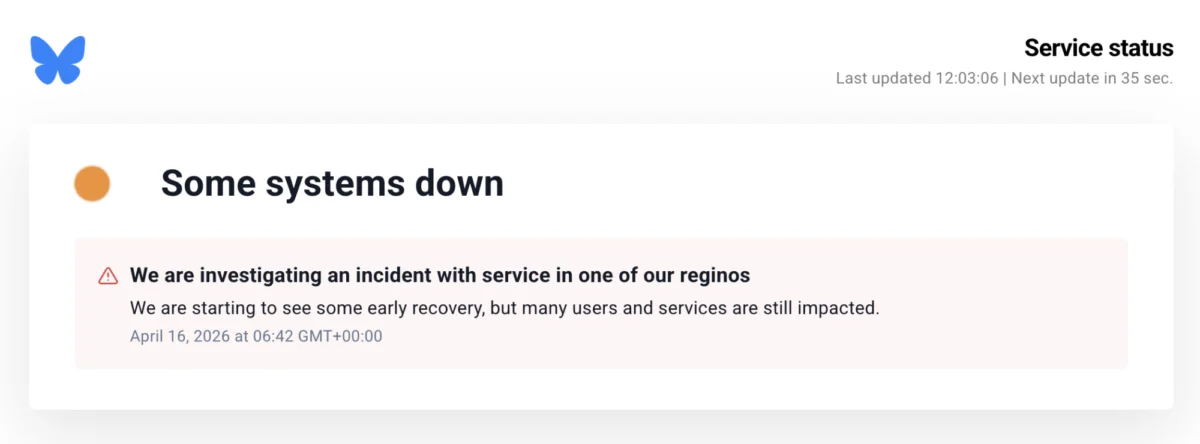
Recognizing the scale of the disruption, Bluesky’s engineering team updated their official status page (status.bsky.app) just twelve minutes after the initial surge in user reports. The message was concise but clear: the platform was "investigating an incident" and confirmed that "some systems [were] down." This proactive communication was a critical step in managing user frustration, providing a single source of truth during a period of uncertainty.
8:00 a.m. – 11:40 a.m. ET: The Recovery Phase
As the morning progressed, the team provided incremental updates. In a brief statement, representatives noted, "We are starting to see some early recovery, but many users and services are still impacted." By 11:40 a.m. UTC (approximately 7:40 a.m. ET), the platform began to show signs of life. While the site and app had returned to a functional state, residual loading issues persisted for many, indicating that the recovery process was gradual rather than instantaneous.
2:28 p.m. ET: Full Restoration
By mid-afternoon, the company confirmed via its status page that all systems were fully operational. While the platform was back to its standard capacity, the company remained tight-lipped regarding the specific technical root cause of the outage, leaving the tech community to speculate on the nature of the failure.

Supporting Data and Technical Context
The outage provides a rare glimpse into the infrastructure of a platform that relies on the AT Protocol, a decentralized framework that differs significantly from the monolithic architecture of traditional social media sites like X or Meta’s Threads.
Downdetector’s data—which is owned by Ziff Davis, the same parent company as Mashable—showed that the majority of reports were concentrated in North America and Western Europe. These regions represent the highest density of active users for the platform, suggesting that the issue may have been tied to centralized server clusters or API gateway failures that manage the flow of data between users and the network.
When a platform experiences a "thousand-strong" spike in reports within a short window, it generally points to a systemic failure rather than a localized internet service provider issue. The fact that the status page itself remained reachable while the main application failed suggests that the core identity and database services remained intact, but the front-end application layer—the "face" of the social network—was struggling to communicate with the back-end servers.
Official Responses from Bluesky
Throughout the incident, Bluesky maintained a transparent, albeit brief, communication strategy. When contacted by Mashable, a company spokesperson provided a standard statement:
"We are experiencing some service interruptions and our team is working on the issue. You can find the latest updates at status.bsky.app or the Bluesky Server Status account."
This approach aligns with the company’s broader philosophy of open communication. By directing users toward a dedicated status account rather than relying solely on the platform itself, Bluesky ensured that even when the primary feed was down, their community management team could reach the user base. However, the company has yet to release a detailed "post-mortem" report—a common practice in the tech industry where engineers explain exactly what went wrong and how they plan to prevent it from recurring. For many power users, the absence of this technical breakdown leaves questions regarding the long-term robustness of the platform.
Implications for the Social Media Landscape
The outage at Bluesky is more than just a temporary inconvenience; it is a signal of the growing pains inherent in the social media "migration" era. Since the acquisition of Twitter by Elon Musk and its subsequent rebranding to X, millions of users have sought alternatives. Bluesky has emerged as a top contender due to its focus on user control, moderation, and an open-source ethos.
The Cost of Growth
As Bluesky gains users, the technical pressure on its servers increases exponentially. Scaling a social network is notoriously difficult; it requires balancing the influx of new data with the need for high-speed, real-time performance. For a platform that markets itself as a more stable and user-friendly alternative to the chaotic environment of X, an outage—even a brief one—can be damaging to its reputation.

The Reliability Paradox
Users who left X often cite technical instability and frequent changes to the user experience as primary drivers for their departure. When they encounter similar instability on a new platform, it creates a "reliability paradox." If the alternative is no more reliable than the original, the incentive to stay diminishes.
Decentralization vs. Stability
Bluesky’s reliance on the AT Protocol is a double-edged sword. While it allows for greater user autonomy and potential portability, it also introduces layers of complexity. If a node or a core service experiences latency, it can ripple across the network in ways that are harder to diagnose than on a traditional, centralized platform. Thursday’s outage suggests that as the platform grows, the company must invest heavily in site reliability engineering (SRE) to ensure that its infrastructure can match its ambitions.
Looking Ahead: The Future of Bluesky
As of Thursday afternoon, the platform appears to be functioning normally. The team’s ability to resolve the issue within a few hours suggests that their internal monitoring and response systems are effective, even if the outage itself was disruptive.
For the average user, the outage is a blip in the daily scroll. But for the leadership at Bluesky, it is a critical data point. Moving forward, the company will likely face increased scrutiny regarding its uptime statistics. As the platform looks to exit its growth phase and cement itself as a household name in the social media space, the ability to maintain 99.9% uptime will become the defining metric of its success.
In the fast-paced world of digital communication, where users are accustomed to instant gratification and near-constant availability, the "all systems operational" notification from Bluesky is not just an update—it is a promise. Whether they can keep that promise during the next phase of their expansion remains the central question for the future of the platform.
For now, the digital doors are open again, the feeds are flowing, and the Bluesky community is back to its familiar rhythm of debate, humor, and conversation. The incident serves as a reminder that even in a decentralized future, the machines behind the message still require constant, careful attention.












No comments yet. Be the first to join the conversation!