


In the modern digital landscape, social media has graduated from a simple brand awareness tool to a sophisticated repository of real-time market intelligence. Yet, despite its evolution, many social media teams find themselves locked in a perennial struggle to justify their budgets to skeptical executive boards. For organizations to truly capitalize on the digital age, they must transition from viewing social media as a cost center to recognizing it as a strategic framework that informs company-wide decision-making.
The Evolution of Social Media Value: Beyond the "Like"
The traditional perception of social media value is often tethered to vanity metrics—likes, shares, and follower counts. While these metrics provide a superficial pulse of brand reach, they fail to capture the profound depth of data available through social intelligence.
Today, the true value of social media lies in its ability to act as a direct, unfiltered line of communication between a brand and its audience. By leveraging social intelligence—the process of gathering and analyzing insights about customers, competitors, and industry trends—brands can pivot from reactive content creation to proactive business strategy. Whether it is identifying a latent product feature request in a comment section or spotting a shift in consumer sentiment before it hits mainstream news, social media provides a competitive advantage that, if siloed, is effectively wasted.
Chronology of a Paradigm Shift: From Silos to Synergy
For many years, social media teams functioned in isolation, sequestered within marketing departments. This "siloed" approach created a disconnect between the data captured online and the strategic decisions made in the boardroom.
- Phase 1: The Awareness Era. Early social media strategy focused almost exclusively on visibility. Success was measured by audience size and reach.
- Phase 2: The Engagement Era. As platforms matured, the focus shifted to fostering community and interaction. Metrics evolved to prioritize engagement rates and sentiment.
- Phase 3: The Intelligence Era (Current). Today, leading organizations have entered an era where social media is integrated into the broader business intelligence (BI) ecosystem. Social data is now being fed into CRMs, product development roadmaps, and customer support workflows to drive bottom-line growth.
This shift has not been instantaneous. It required the development of robust attribution models and the adoption of enterprise-grade social management platforms, such as Sprout Social, which allow teams to connect social performance directly to revenue-generating outcomes.
Supporting Data: The Case for Integration
The urgency of breaking down these organizational silos is supported by compelling industry data. According to the 2026 Social Intelligence Report, a staggering 67% of industry professionals now categorize social intelligence as mission-critical to their company’s future growth.
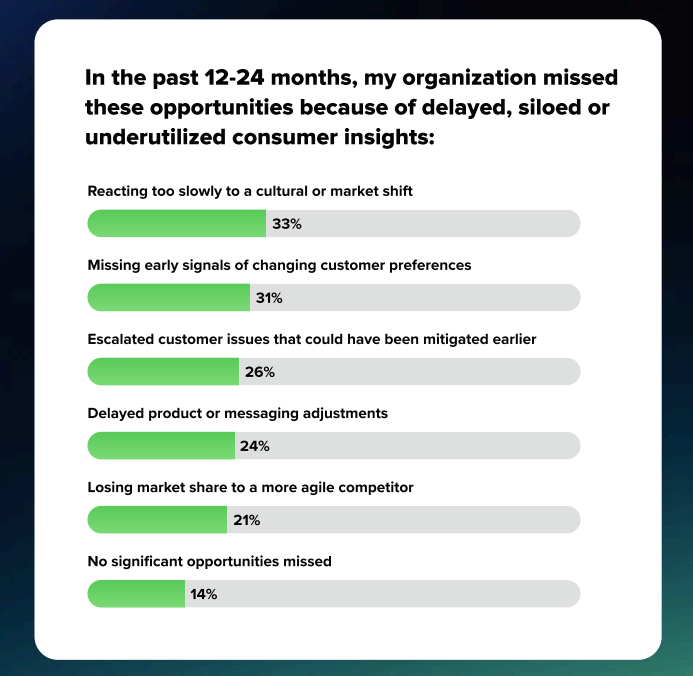
However, a significant gap remains. When data is trapped within marketing tools, it loses its cross-departmental utility. The report highlights that organizations failing to integrate social insights across their business structure miss out on critical opportunities for growth, ranging from misaligned product launches to missed market trends.

Furthermore, quantitative evidence underscores the financial impact of this integration. Organizations that move toward a multi-touch attribution model—tracking the influence of social touchpoints throughout the entire customer journey—often see significant improvements in pipeline visibility. In internal studies, shifting to such a model revealed a 5,800% increase in measurable pipeline impact, proving that social media is not just a top-of-funnel tool, but a conversion-driving powerhouse.
Official Perspectives: The Executive View
The challenge of proving value is often rooted in a communication mismatch. Executives, tasked with the bottom-line health of the company, often find it difficult to translate "social engagement" into "revenue growth."
Olivia Jepson, Social Media Intelligence Manager at Sprout Social, notes that last-touch attribution—which credits only the final click before a purchase—is fundamentally insufficient. "Social teams are driving revenue," Jepson asserts. "But last-touch attribution only tells part of the story. Strategic discussions about how social impacts the entire funnel—spanning top-of-funnel engagement and reach metrics to down-funnel demand—are essential for building a more effective reporting infrastructure."
For teams to earn the trust of leadership, they must speak the language of the C-suite. This involves presenting data that links social performance to KPIs (Key Performance Indicators) such as customer acquisition costs, lead quality, and product feedback loops.
How to Quantify and Communicate Social Value
To move the needle, social teams must adopt a five-step framework to demonstrate their business impact:
1. Strategic Goal Alignment
Before selecting metrics, teams must identify the broader business goals they aim to influence. Whether it is supporting a sales team’s outreach through targeted user-generated content or providing product teams with Reddit-sourced feature requests, social media should be mapped directly to company-wide priorities.
2. Defining Qualitative and Quantitative Metrics
A balanced reporting strategy requires a mix of metrics.
- Quantitative Metrics: Numerical performance indicators such as conversion rates, click-through rates, and customer support response times.
- Qualitative Metrics: Sentiment analysis, competitive landscape snapshots, and community health indicators that reflect the brand’s intangible equity.
3. Implementing Holistic Analytics Tracking
True ROI can only be measured when social data is unified with other business systems. Integrating social data into Salesforce or other BI tools allows for a "single source of truth." By utilizing UTM tagging and multi-touch attribution, teams can trace the journey of a customer from a social post to a closed contract, providing undeniable proof of social’s contribution to the bottom line.
4. Establishing Benchmarks
Data is meaningless without context. Organizations must establish baselines based on industry standards and historical performance. Reports like the 2025 Content Benchmarks Report provide the necessary yardsticks to determine whether a brand’s performance is outpacing the industry or falling behind.
5. Calculating ROI with Precision
Finally, social teams must calculate their ROI. This involves factoring in hard costs (software, labor, ad spend) against the revenue or cost-savings generated by social activities. When an organization can demonstrate a clear, calculated return—such as the 529% ROI achieved by integrating advanced social intelligence—the conversation with finance departments shifts from "why is this costing so much?" to "how much more can we invest to scale these results?"
Implications: The Future of the Social-First Organization
The implications of this transition are clear: the companies that succeed in the next decade will be those that treat social media as a core business function rather than an auxiliary marketing task.
By proactively sharing social intelligence, social teams can position themselves as the "ears" of the organization. When an insight from a social channel triggers a change in a product roadmap or helps a sales team win a key account, the social team transforms from a support role into a strategic driver of competitiveness.
Ultimately, communicating the value of social media is an exercise in data storytelling. It is the ability to take the raw, chaotic, and authentic feedback of the public and synthesize it into a narrative that aligns with the business’s overarching mission. By moving beyond vanity metrics and focusing on full-funnel business impact, social marketers can secure the resources, trust, and influence necessary to drive their brands forward in an increasingly connected world.











