By Cora Buhlert
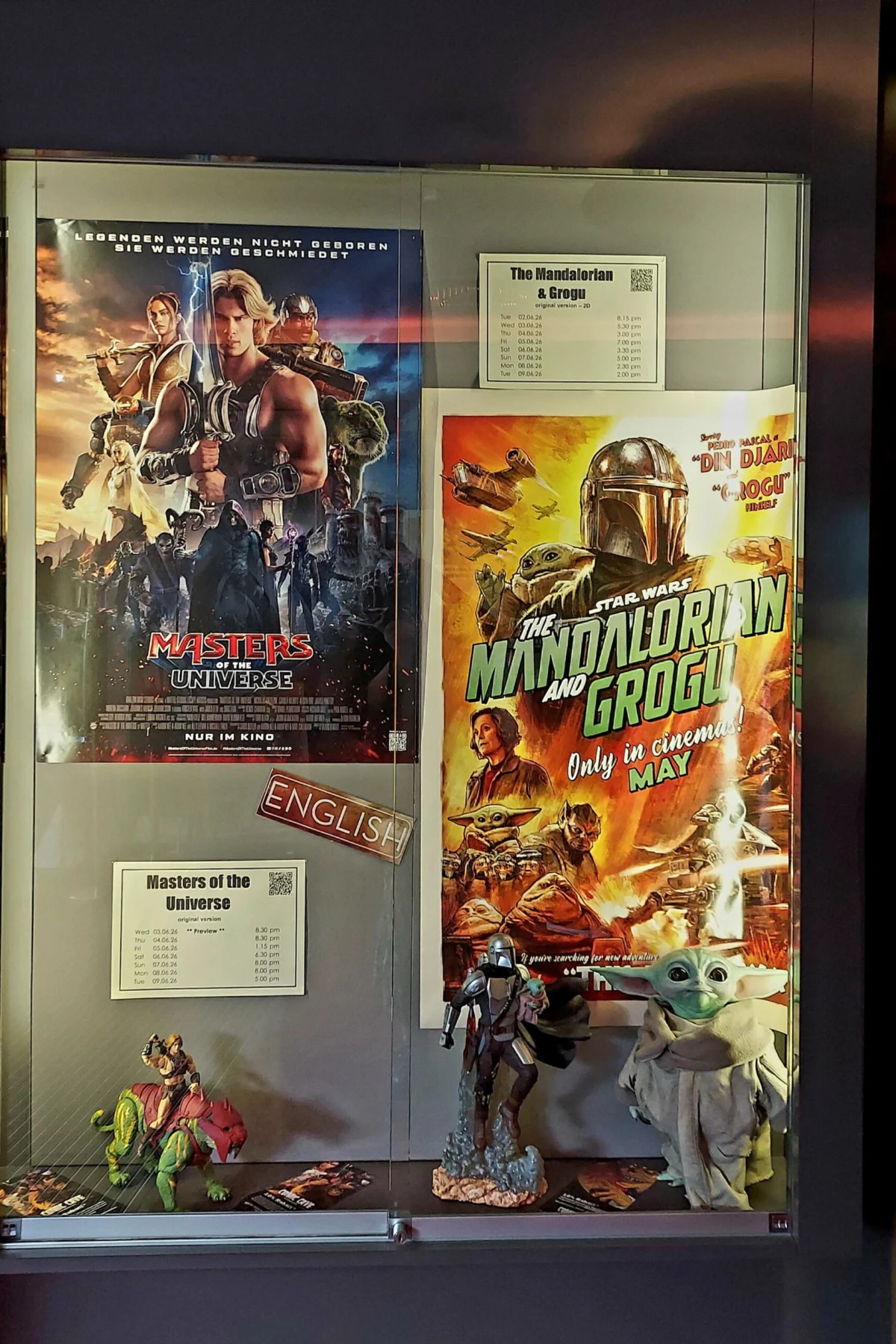
On Wednesday, June 3, 2026, I navigated the notorious traffic of Hamburg to reach the historic Savoy Movie Theater in the St. Georg neighborhood. While many local cinemas offer a closer commute, the Savoy remains the premier destination for cinephiles in Northern Germany, boasting one of the region’s largest screens and, crucially, a commitment to screening international films in their original language with subtitles. For a property as steeped in English-language nostalgia as Masters of the Universe, the prospect of a German dub—which often struggles with the nuanced, campy vernacular of the franchise—was simply not an option. I needed to experience the film in its intended form, and the Savoy provided the perfect stage.
The Narrative Arc: A Prince of Two Worlds
The film opens on a note of poignant vulnerability. We are introduced to Adam, the Crown Prince of Eternia, during what is undoubtedly the most harrowing day of his youth. Following a series of humiliating defeats at the hands of larger, more aggressive peers in combat training and a devastating rebuke from his father, King Randor, Adam’s home of Eternos is besieged by the forces of Skeletor.
In the ensuing chaos, the young prince is whisked away to Earth—the ancestral home of his mother, Queen Marlena (formerly NASA astronaut Marlena Glenn)—carrying with him the Sword of Power. However, cosmic instability forces the blade from his grasp, depositing Adam into an Oklahoma lake and effectively exiling him from his destiny for fifteen years.
When we reconnect with Adam as an adult, he is a man adrift, toiling away in an HR department in Oklahoma City. The film deftly balances his mundane, earthbound struggles with his lingering, deep-seated yearning for a home he barely remembers. When he finally reunites with his sword, the arrival of interdimensional forces brings a storm of destruction to his quiet life, propelling him back to Eternia. Yet, the return is far from triumphant; he finds a kingdom broken by fifteen years of Skeletor’s tyranny. The resistance expects a savior, but they are confronted with a man who, to them, appears clumsy and unrefined. The ensuing journey is not merely about wielding a sword, but about earning the mantle of the Champion of Grayskull.
A Visual and Sonic Masterpiece
Director Travis Knight has achieved what many thought impossible: a live-action adaptation that feels genuinely authentic to the source material. Masters of the Universe rejects the modern industry trend of "murkovision"—the pervasive, desaturated gray tones that dominate contemporary blockbusters—in favor of a vibrant, Technicolor-inspired palette. Production designer Guy Hendrix Dyas has masterfully bridged the gap between the tactile, plastic aesthetic of the 1980s toys and the expansive world-building of the Filmation era.

The film is a physical production feat, utilizing tangible sets that give the world a sense of weight and history, even when bolstered by CGI. While the digital effects occasionally falter in their fidelity, the overall visual language remains consistently bright and imaginative.
Complementing this visual feast is a soaring, thunderous score by Daniel Pemberton. By blending the symphonic grandeur of composers like John Williams and Danny Elfman with the high-octane rock sensibilities of Highlander and Flash Gordon, Pemberton has crafted an auditory experience that is inseparable from the film’s success. The inclusion of needle drops—ranging from Queen’s "Princes of the Universe" to the 4 Non-Blondes’ "What’s Up"—is handled with a surprising degree of narrative synergy, anchoring the film in both its retro-cultural roots and its modern emotional core.
Character Dynamics and Performance Analysis
The casting of Nicholas Galitzine as Adam/He-Man was a point of initial skepticism for many, given his background in romantic comedies. However, Galitzine delivers a transformative performance, capturing Adam’s earnestness and vulnerability just as effectively as he portrays the formidable, raw strength of He-Man.
Equally compelling is Idris Elba’s portrayal of Duncan (Man-at-Arms). The script takes a daring risk by depicting the legendary warrior as a washed-up, alcoholic recluse. Watching a hero who was once the bedrock of Eternian stability hit absolute rock bottom is a harrowing, yet necessary, component of his arc. Elba’s ability to oscillate between the battle-hardened commander and the broken, emotionally stunted mentor provides the film with its most grounded emotional stakes.
Camila Mendes, playing Teela, provides the film’s beating heart. Her chemistry with Galitzine is palpable, and her portrayal of a warrior struggling with the weight of her father’s decline adds a layer of depth rarely seen in such genre films.
On the antagonist’s side, Jared Leto’s Skeletor is a revelation. Eschewing the temptation to make the villain purely grounded or "realistic," Leto leans into the grandiosity, sadism, and camp of the character. He is both terrifying and hilarious, channeling the spirit of Frank Langella’s classic performance while adding a touch of the malicious glee seen in the more recent Netflix iterations.

Implications: The Box Office Battle
Despite its quality, Masters of the Universe faces a difficult road. It is entering a crowded summer box office, pitted against established franchises and surprise indie hits. There exists a vocal, cynical contingent of both "anti-woke" critics and intellectual gatekeepers who seem pre-determined to see the film fail.
The box office narrative is being shaped by speculative, often flawed methodologies that label the film a "bomb" before it has even found its audience. This is a recurring issue for high-concept, genre-bending films like John Carter or Dungeons and Dragons: Honor Among Thieves—movies that offered genuine heart and spectacle but suffered from unfair, early-cycle negative press.
If we wish to see a resurgence of "Sword and Planet" cinema, audiences must vote with their wallets. A successful opening weekend for Masters of the Universe would not only secure sequels but would signal to studios that there is a hunger for colorful, sincere, and respectful adaptations of our shared cultural history.
Closing Thoughts and Post-Credits Teasers
The film ultimately succeeds because it understands that He-Man was never truly about muscles or violence; it was about a kid who felt invisible finding the courage to be seen. It is a story about the messy, complicated relationships between parents and children, and the universal desire to be the best version of oneself.
For those heading to the theater, a word of advice: do not leave when the credits roll. There are three post-credits scenes, one of which elicited a massive, spontaneous round of applause in our screening. The final teaser, in particular, sets the stage for a continuation that we desperately need to see. Masters of the Universe is, quite simply, the film I have been waiting for since 1987. It is a joyful, earnest, and deeply respectful celebration of the power of imagination. Whether you are a lifelong fan or a newcomer to the realm of Eternia, it deserves your attention—and your support—on the big screen.