Ali Ikhwan
Pride Month serves as a vibrant annual tapestry—a celebration of identity, history, and the ongoing fight for liberation. While the festivities are often defined by parades and communal gatherings, the month also offers an introspective opportunity to deepen our engagement with queer narratives. Books remain the most powerful vessels for these stories, allowing us to traverse borders, eras, and realities while centering the voices of those who have historically been relegated to the margins.
As we look toward the 2026 Read Harder Challenge, the literary landscape is richer than ever. To help you navigate your reading list this June, we have curated a selection of essential queer titles that satisfy specific challenge prompts, ranging from the harrowing depths of historical gothic to the cozy, imaginative frontiers of outer space.
The Intersection of Activism and Art: Nonfiction as Resistance
Task #5: Read a nonfiction book about resistance
Featured Our Work is Everywhere: An Illustrated Oral History of Queer and Trans Resistance by Syan Rose
Resistance is rarely a monolithic act; it is a collective, messy, and deeply creative process. Syan Rose’s Our Work is Everywhere acts as a vital archival project, bridging the gap between historical struggle and contemporary activism. The book functions as an intimate oral history, where readers are invited into the living rooms and community spaces of queer and trans artists, healers, and grassroots organizers.
The beauty of this collection lies in its format. It is not a dry academic tome but a living, breathing testament to the ingenuity of the LGBTQ+ community. Rose captures the raw vulnerability of people discussing what fuels their passion and what ignites their anger. Through detailed illustrations that accompany each narrative, the book explores critical themes such as mutual aid, the radical redistribution of wealth, the reclamation of ancestral wisdom, and the transformative power of queer tarot. It is an essential read for anyone looking to understand how modern resistance is rooted in the creative labor of those who dare to build alternative worlds.

Gothic Echoes and Sapphic Suspense
Task #6: Read a gothic novel published in the last ten years
Featured The Salvage by Anbara Salam
The gothic genre has long been a home for queer subtext, providing a perfect framework for themes of obsession, isolation, and the uncanny. Anbara Salam’s The Salvage (2025) revitalizes the genre with a distinctly sapphic lens. Set against the high-stakes backdrop of the Cuban Missile Crisis, the story follows marine archaeologist Marta Khoury.
Tasked with exploring a mysterious Victorian shipwreck off a remote Scottish isle, Marta expects to find relics of the past. Instead, she finds herself trapped by the elements, isolated from a world on the brink of nuclear catastrophe. Salam expertly weaves the anxiety of the 1960s with the classic gothic tropes of haunting figures and disappearing artifacts. It is a slow-burn psychological thriller that questions the reliability of memory and the weight of the history we choose to salvage.
The Fluidity of Reality: Magical Realism and Fabulism
Task #14: Read a work of magical realism or fabulism
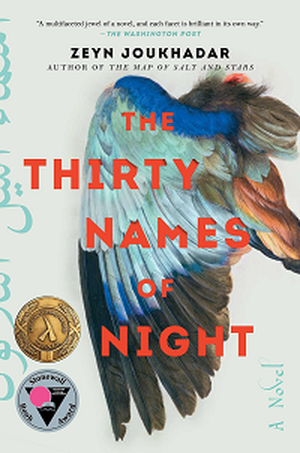
Featured The Thirty Names of Night by Zeyn Joukhadar
In The Thirty Names of Night, Zeyn Joukhadar crafts a narrative where the boundaries between the living and the dead, the human and the avian, are porous. The novel, a recipient of the Stonewall Book Award and the Lambda Literary Award for Transgender Fiction, is a masterful exploration of grief and heritage.

The story unfolds in two timelines: one following a young Syrian American trans boy in contemporary New York City, and another tracing the mysterious life of Laila Z, a bird painter who disappeared decades ago. As the protagonist unravels the secrets of his mother’s death, he finds himself in a continuous dialogue with the past. The prose is lush and ornithological, treating the act of naming one’s identity as a sacred, magical process. It is a deeply hopeful meditation on how we maintain connections to our ancestors while forging a path in a world that often demands we be anything but ourselves.
Dystopian Cults and the Future of Human Connection
Task #17: Read a book about a cult or cults
Featured Simplicity by Mattie Lubchansky
As we look toward the year 2081, Mattie Lubchansky’s Simplicity offers a satirical and chilling vision of the future. The protagonist, a trans man and scholar, ventures outside the safety of a walled New York City to document the lives of a remote cult. What begins as an academic endeavor quickly devolves into a nightmare of disappearing members and hallucinatory reality.
Critics have lauded the book as an “ecosexual call to action,” balancing biting social commentary with heart-wrenching human drama. Lubchansky uses the trope of the cult to examine our modern obsessions with optimization, purity, and the desperate search for community in a collapsing world. It is a provocative, brilliant, and deeply relevant work that challenges readers to examine what they are willing to believe in—and at what cost.
Frontiers of the Imagination: Queer Voices in Science Fiction
Task #20: Read a book set in space
Featured Moss’d in Space by Rebecca Thorne
The “cozy sci-fi” subgenre has gained significant traction, providing a soft landing in the cold vacuum of space. Following her success with Can’t Spell Treason Without Tea, Rebecca Thorne returns with a story that blends interstellar adventure with a unique, sentient twist.
When the protagonist, Torian, purchases a spaceship covered in mysterious, sentient moss, she believes she has found the key to a fresh start. Her ex-captain, Amelia, remains skeptical, and rightfully so. The moss is not merely decorative; it is a complex, grudging computer with a score to settle against its former creator. Thorne’s narrative is a masterclass in character-driven world-building, exploring themes of autonomy, reconciliation, and the unconventional families we form in the most unlikely of places.
Translation and the Global Queer Experience
Task #21: Read a genre (SFF, horror, mystery, romance) book in translation
Featured The Route of Ice & Salt by José Luis Zárate (Trans. David Bowles)
Literature in translation is a gateway to perspectives that might otherwise remain locked behind linguistic barriers. José Luis Zárate’s The Route of Ice & Salt, originally published in 1998, finally arrived to English-speaking audiences through a successful grassroots campaign.
The novel serves as a queer re-imagining of the journey that brought Dracula to England. Told from the perspective of the ship’s captain, the story is a gothic masterpiece that confronts the intersection of queer desire and societal repression. Zárate uses the metaphor of the “monster” to interrogate the real-world horrors of homophobia and the way fear is used to pathologize the “other.” It is a dark, visceral, and necessary work that demands readers sit with the discomfort of historical persecution.

Task #23: Read a book by an African author
Featured Fairytales for Lost Children by Diriye Osman
Diriye Osman, a British Somali writer and artist, delivers a genre-bending debut that challenges the singular narrative often forced upon queer African experiences. The collection illuminates the lives of young queer Somalis across the diaspora, navigating the complexities of faith, family, and exile.
Osman’s writing is intimate and unflinching, capturing the pain of rejection alongside the quiet joy of finding one’s chosen kin. His own illustrations are woven throughout the text, transforming the book into a multimedia experience. It is a profound exploration of belonging and the search for home in a world that often refuses to acknowledge your right to exist.
Implications for the Reader
Engaging with these books is more than a passive consumption of entertainment; it is an act of intellectual and emotional cultivation. By intentionally choosing to read authors from diverse backgrounds and genres, we expand our capacity for empathy and our understanding of the human condition.
The 2026 Read Harder Challenge provides the framework, but the reader provides the intention. Whether you are navigating the dystopian ruins of Simplicity or the ethereal, bird-filled pages of The Thirty Names of Night, each of these titles serves as a bridge to a different way of seeing the world. As Pride Month draws to a close, let these stories be the beginning, rather than the end, of your commitment to reading widely, reading bravely, and reading to change the world.

 Nila Kartika Wati
 Siti Muinah