Basiran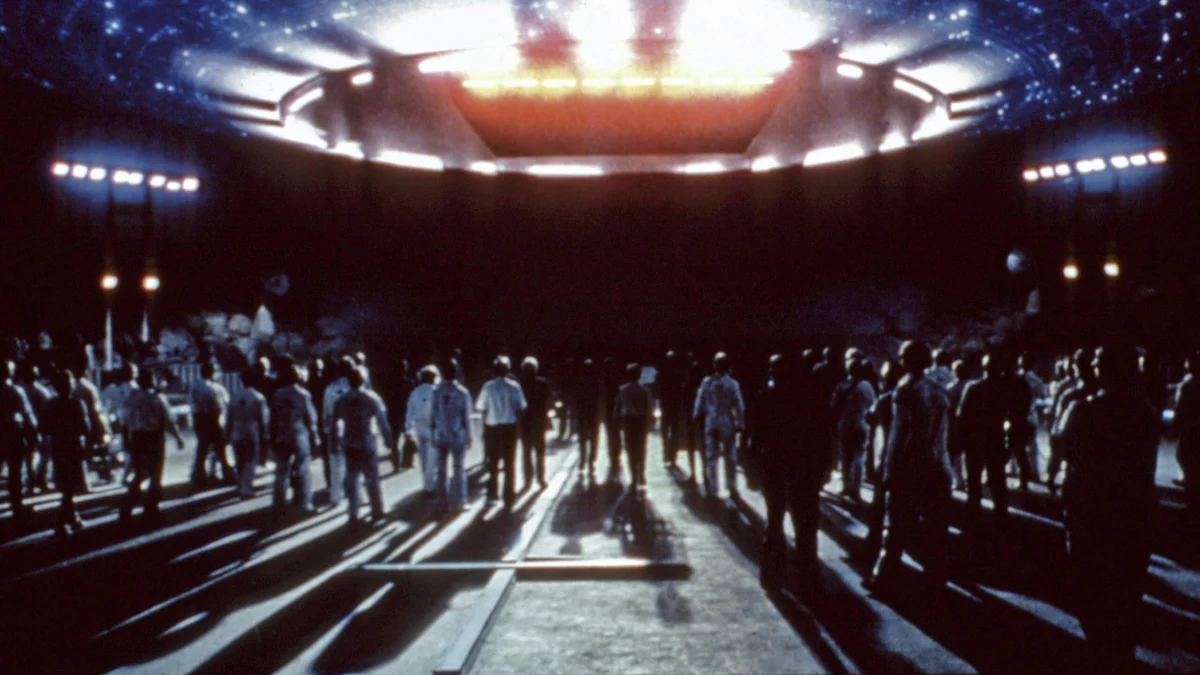
By [Oli Welsh]
Published Jun 14, 2026, 8:02 AM EDT
(Note: This article is based on a personal blog I wrote 10 years ago to entertain nobody but myself. So if you’re one of the 10 people who read it, that’s why parts of it seem familiar.)
[Image: Columbia Pictures via Everett Collection]
A crowd of people walks toward a UFO
Steven Spielberg’s 1977 UFO epic, Close Encounters of the Third Kind, stands as a monumental achievement in cinematic science fiction, a film that continues to resonate with audiences nearly five decades after its initial release. Renowned for its unparalleled blend of awe and psychological intensity, the movie explores humanity’s first verifiable contact with extraterrestrial intelligence, not as a war or an invasion, but as a transcendental experience that is both nightmarish and ecstatic. Its presence is still felt today, not least in Spielberg’s new film, Disclosure Day, demonstrating the enduring power of its themes.
However, despite its critical acclaim and lasting influence, Close Encounters is also, in some ways, an evolutionary dead end for sci-fi, thanks in large part to a "little film" Spielberg’s friend George Lucas released just six months earlier: Star Wars. This paradoxical position – profoundly influential yet charting a path largely unfollowed – is precisely what makes Close Encounters so uniquely arresting and perpetually relevant.
A Legendary Bet and Divergent Paths
The tale of Close Encounters cannot be told without acknowledging its famous rivalry and camaraderie with Star Wars. Famously, Lucas thought Spielberg’s movie would do better at the box office, leading them to make a bet by swapping profit points on each other’s movies. Both films were massive hits, but history unequivocally shows who won that bet financially. Star Wars exploded into a global phenomenon, birthing a sprawling franchise that redefined blockbuster cinema. Spielberg, ever astute, already sensed his vision of sci-fi as a kind of ecstatic thriller was no match for Lucas’ space fable, which offered a more traditional hero’s journey wrapped in mythic archetypes and dazzling space opera.
The immediate impact of Star Wars was to steer Hollywood towards grand, serialized narratives and epic space battles. Close Encounters, by contrast, offered a deeply personal, often unsettling, and ultimately spiritual journey into the unknown. Its true blockbuster legacy was, perhaps, more internal for Spielberg, guiding what he did next: Raiders of the Lost Ark (with Lucas), eventually Jurassic Park, and especially E.T. the Extra-Terrestrial. These films absorbed elements of Close Encounters – the sense of wonder, the focus on ordinary individuals facing extraordinary circumstances, the blend of childlike innocence and mature themes – but none replicated its precise, audacious formula. They are all parts of Close Encounters, but not the whole.
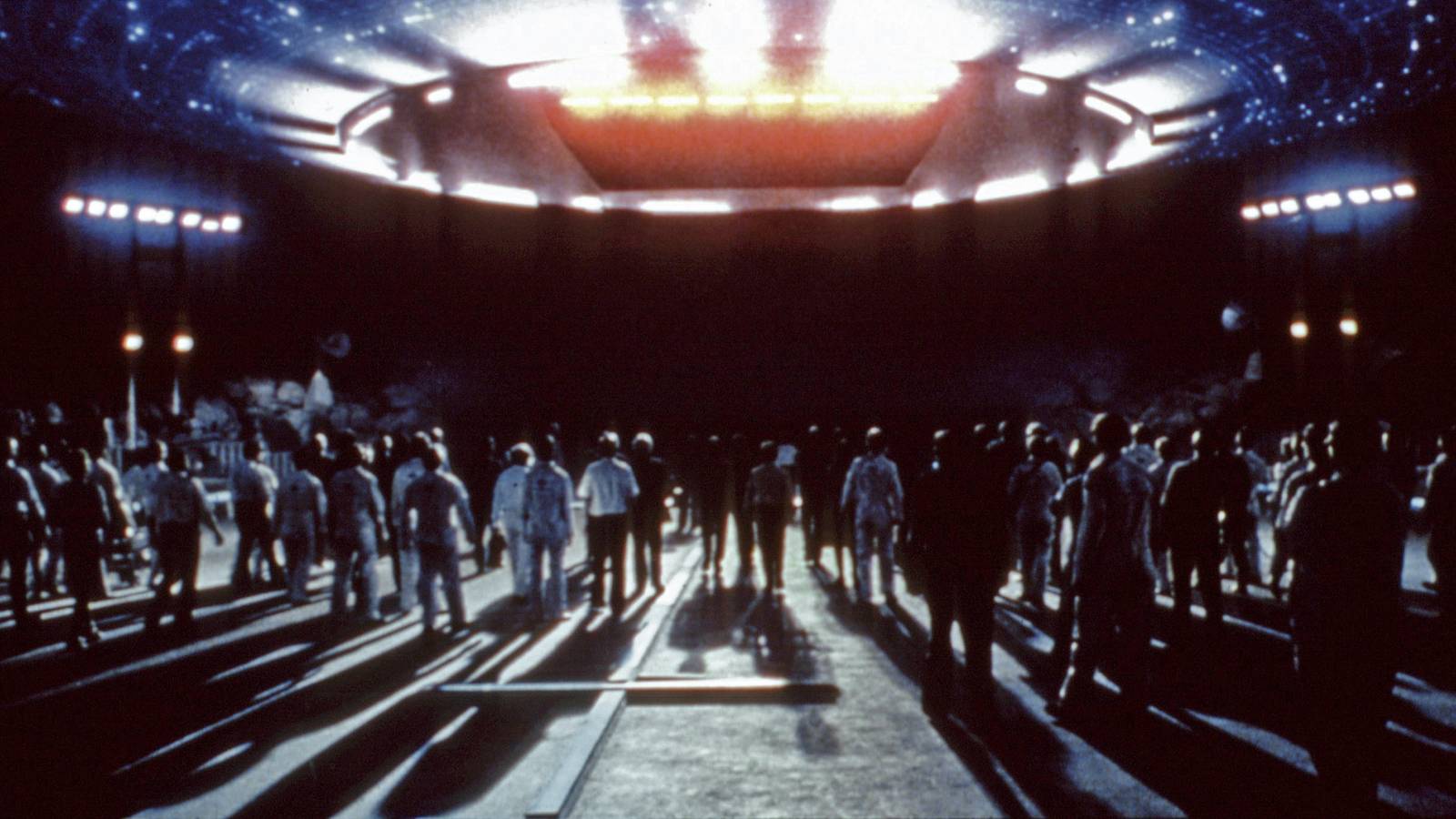
This might be why Close Encounters can still seem so arrestingly weird. It shouldn’t be. Its imagery is scored into the popular imagination, from the iconic five-tone musical motif to the imposing silhouette of Devils Tower. It’s been exhaustively documented and picked apart, not least by Spielberg himself, who has performed very public surgery on it in three distinct edits over the span of 20 years, and offered up reams of lucid commentary on everything to do with its making, from his close identification with Richard Dreyfuss’ character to the freewheeling technical improvisation behind its still-dazzling special effects.
Genesis of an Epic: Spielberg’s Personal Vision
The journey to Close Encounters began years before its 1977 release, rooted deeply in Steven Spielberg’s childhood fascination with UFOs and his desire to craft a more optimistic alien contact story than the prevalent invasion narratives. After the phenomenal success of Jaws (1975), Spielberg had the clout to pursue his passion project. The initial concept, titled "Watch the Skies," evolved through various script iterations. Early drafts by Paul Schrader explored themes of government conspiracy and paranoia, but Spielberg eventually took over sole screenwriting credit, shaping the narrative into a more personal, empathetic exploration of wonder and obsession.
Spielberg’s vision was clear: to portray aliens not as monsters but as beings capable of communication and benevolence, albeit with a profound, almost terrifying, otherness. This required meticulous attention to detail in visual effects, sound design, and narrative pacing. The production was ambitious, pushing the boundaries of what was technically feasible at the time. Douglas Trumbull, a pioneer in visual effects known for his work on 2001: A Space Odyssey, was brought in to create the iconic spacecrafts and the breathtaking climax. Miniature models, advanced motion control photography, and innovative lighting techniques were employed to render the UFOs with a luminous, otherworldly quality that remains impressive even today.
Casting was equally crucial. Richard Dreyfuss, fresh off Jaws, embodied the everyman protagonist, Roy Neary, whose transformation from a mundane power company worker to an obsessed visionary is central to the film. Spielberg saw much of himself in Roy – the creative compulsion, the single-minded pursuit of a grand idea. French New Wave director François Truffaut was cast as Claude Lacombe, the empathetic scientist leading the international investigation. His presence lent an intellectual gravitas and an unexpected warmth to the scientific endeavor, subtly bridging the gap between artistic introspection and blockbuster spectacle. Melinda Dillon, as Gillian Guiler, provided the emotional core, her desperate search for her abducted son grounding the film’s more abstract themes in raw human feeling.
Narrative Audacity and Thematic Depth
Close Encounters is the definition of a known quantity, yet it still has the power to unsettle and surprise. It’s typical of Spielberg, yet completely unique. Outside of The Fabelmans, it still stands as Spielberg’s most personal film: the culmination of the impulse that drove him to make homebrew sci-fi movies as a teen, and rightfully one of few for which he retains the sole screenwriting credit, no matter how many other writers had a hand in the script.
As a director, Spielberg is famed for his open emotional communion with the audience, and Close Encounters finds him at his least calculating, his least guarded. The movie focuses on Dreyfuss’ Roy, a power company worker who has a close encounter with what appears to be a UFO and becomes obsessed. But Roy’s story is washed along in a tide of other events as mysterious happenings and alien sightings become more and more common. At the same time, a mother (Melinda Dillon) seeks her abducted child, while French scientist Claude Lacombe (François Truffaut) attempts to marshal a global response to a historic event.
Conventional plot structure goes out the window. The film does have three acts, but they’re wildly unbalanced: a portmanteau compilation of mysterious happenings is followed by a paranoid psychological thriller and then a rapturous lightshow, which doesn’t resolve the film’s storylines so much as obliterate them. This is still one of the most striking things about it. While Hollywood storytelling generally seeks to process any event in terms of the characters’ personal lives, Close Encounters goes to the trouble of setting these stories up before ultimately treating them as irrelevant in the face of the transcendent force of its own spectacle. (Which, I suppose, they would be.)

This narrative audacity is a testament to Spielberg’s confidence and artistic conviction. Roy Neary’s journey, though initially relatable, quickly descends into a manic obsession that alienates his family and pushes him to the brink of sanity. His compulsive urge to sculpt Devils Tower from mashed potatoes and mud, an almost primal response to an implanted vision, is both darkly comedic and deeply disturbing. It speaks to the human need to understand and replicate the incomprehensible, even at great personal cost. Gillian Guiler’s parallel quest for her son, Barry, offers a more direct emotional hook, a mother’s universal love driving her into the heart of the mystery. Lacombe, the detached yet compassionate scientist, represents humanity’s organized, rational attempt to bridge the cosmic divide, but even his scientific rigor gives way to a profound, almost spiritual, acceptance of the unknown.
The Unsettling Tone: Fear and Wonder Intertwined
[Photo: Columbia Pictures via Everett Collection]
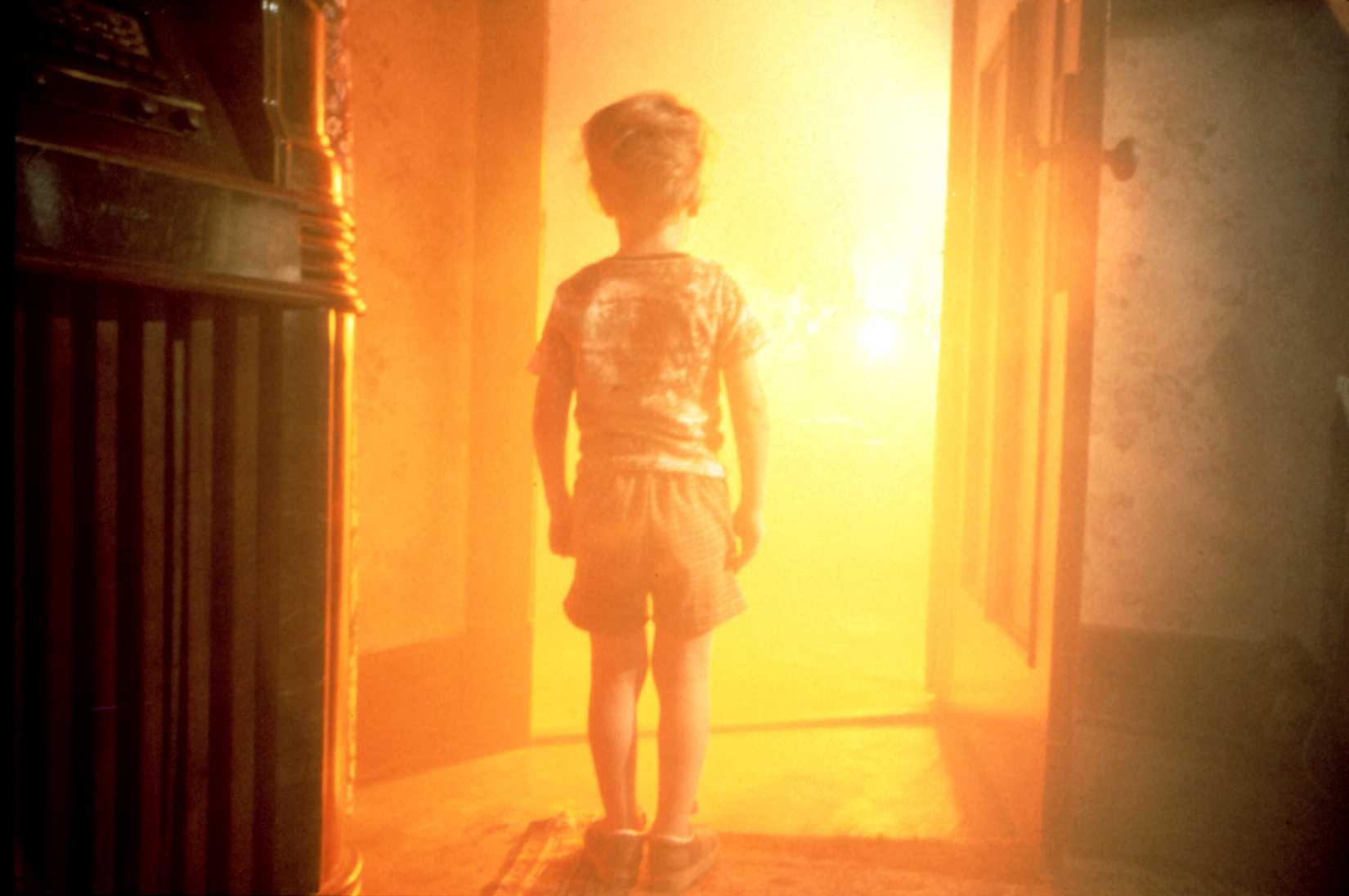
A small boy stands in front of a bright yellow light
And then there’s the tone. Spielberg made a career out of his ability to elicit fear and wonder by treating them as inseparable, but I don’t think he has ever done it as unsettlingly as in Close Encounters. The film is at once nakedly optimistic and absolutely terrifying. It frames the international effort to make contact with the aliens as an ominous conspiracy, yet portrays it from within as a peaceful convocation of curious, well-meaning scientists. It never really questions Dreyfuss’ unthinking quest to see more (which stands in for Spielberg’s, and ours) nor does it turn away from his disturbing mental collapse and the havoc it wreaks on his family. The UFOs are playful things – tumbling, darting splashes of hazy neon colour – but they’re introduced with alarming scenes of boiling clouds and inanimate objects shaking themselves apart. The blunt peak of Devils Tower looms darkly over the film, refusing to appear beautiful or meaningful, instead serving as a stark, almost menacing, beacon.
This seamless fusion of fear and wonder is perhaps the film’s greatest achievement. The initial encounters are marked by chaos and destruction: power outages, vibrating appliances, the terrifying abduction of a child. The sheer sensory overload, particularly in the scene where the aliens interact with the police cars, is designed to evoke both primal fear and an undeniable curiosity. The visual splendor of the alien ships, with their intricate lights and graceful movements, is juxtaposed with the potentially catastrophic implications of their arrival. The government’s attempts to control information and evacuate populations under false pretenses amplify the sense of paranoia, yet the film ultimately reveals this to be a protective, albeit heavy-handed, measure rather than outright malevolence.
The Disquieting Symphony: Sound and Score
[Photo: Columbia Pictures via Everett Collection]
Richard Dreyfuss looks at an image of a mountain on his TV, with a huge mud model of it behind him
If anything, the soundtrack is more disquieting than the visuals. Dialogue is layered over dialogue in a cacophonous gabble, giving a sense of breathless excitement but also meaningless confusion. This deliberate sonic tapestry immerses the viewer in the chaos and sensory overload experienced by the characters, particularly Roy, as his world is upended. It mirrors the fragmented nature of the information being received, the desperate attempts to make sense of something utterly beyond human comprehension.
John Williams’ iconic score seesaws brilliantly between romantic swells and atonal chaos. The masterful musical conversation he orchestrates between humans and aliens, the most memorable moment in the film, is allowed to pass through joyful harmony into a frenzied delirium that’s too much to bear. Too much information. The five-tone motif, initially a simple, child-like tune, becomes a complex language, evolving from tentative exchanges to a full-blown, emotionally overwhelming symphony. This progression perfectly encapsulates the film’s journey: from initial mystery to overwhelming revelation, where the beauty and complexity of the alien presence can be both exhilarating and utterly disorienting. Williams’ score is not merely accompaniment; it is an active participant in the narrative, communicating what words and images alone cannot.
The Enduring Legacy and Official Responses
Spielberg’s continuous re-editing of Close Encounters speaks volumes about his profound connection to the material. The original theatrical release (1977) was followed by the Special Edition (1980), which added a controversial scene inside the mothership, a compromise forced by studio pressure to deliver "more." Later, the Collector’s Edition (1998) removed the mothership interior and restored other excised scenes, representing Spielberg’s most definitive cut. This public "surgery" highlights an artist’s ongoing dialogue with his work, striving for the perfect expression of a deeply personal vision. Each version offers a slightly different emphasis, demonstrating Spielberg’s evolving perspective on Roy’s journey and the nature of first contact.
For a film in which nothing very bad happens, Close Encounters is often nightmarish. It’s built on emotional clashes: hope and terror, joy and madness, suspicion and awe. But none of these is really a contradiction. And I think that’s what gives Close Encounters an elemental power that hasn’t faded. Spielberg is always so placid and controlled in public, but the manic Roy is his most truthful avatar. Made by a man allowed to act out his personal fantasy at ridiculous expense, Close Encounters of the Third Kind is about the fear we feel when we get exactly what we want.
Critical responses at the time were largely positive, though some critics found its open-endedness frustrating compared to Star Wars‘ clear narrative. Over the decades, however, its reputation has solidified. It is consistently ranked among the greatest science fiction films and Spielberg’s best works, lauded for its visionary direction, groundbreaking effects, and profound thematic resonance. Audiences, too, have embraced its unique blend of wonder and psychological depth, recognizing it as a film that dares to explore the spiritual implications of extraterrestrial contact without resorting to easy answers.
Implications and Continued Relevance
The implications of Close Encounters extend beyond its immediate box office performance or its influence on Spielberg’s subsequent career. It carved out a unique space in the sci-fi landscape, demonstrating that alien contact could be about profound communication and shared experience, not just conflict. While Star Wars launched an era of space opera, Close Encounters quietly championed a more grounded, human-centric approach to the cosmos, inspiring films that explored the mystery and wonder of the unknown rather than its dangers. Its influence can be seen in later "benevolent alien" films, albeit rarely with the same blend of raw emotion and intellectual curiosity.
Today, as discussions around artificial intelligence, climate change, and humanity’s place in the universe intensify, the themes of Close Encounters remain remarkably pertinent. The film’s exploration of obsession, the search for meaning beyond the mundane, and the overwhelming nature of transcendent experience continues to provoke thought and emotion. Spielberg’s new film, Disclosure Day, serves as a powerful testament to his ongoing fascination with these very questions, proving that the spirit of Close Encounters continues to evolve and inform his artistic endeavors.
Ultimately, Close Encounters of the Third Kind is more than just a UFO movie; it is a cinematic meditation on human yearning, the allure of the unknown, and the profound, often unsettling, beauty of cosmic connection. Its unique blend of the personal and the universal, the terrifying and the sublime, ensures its place not just as a classic, but as an ever-relevant touchstone in the ongoing human quest to understand our place in the vast, mysterious universe. It remains a film that challenges, enthralls, and reminds us that some encounters are so powerful, they can obliterate everything we thought we knew, leaving us forever changed.


 Lina Irawan
 Sagoh
Sagoh