Lina Hope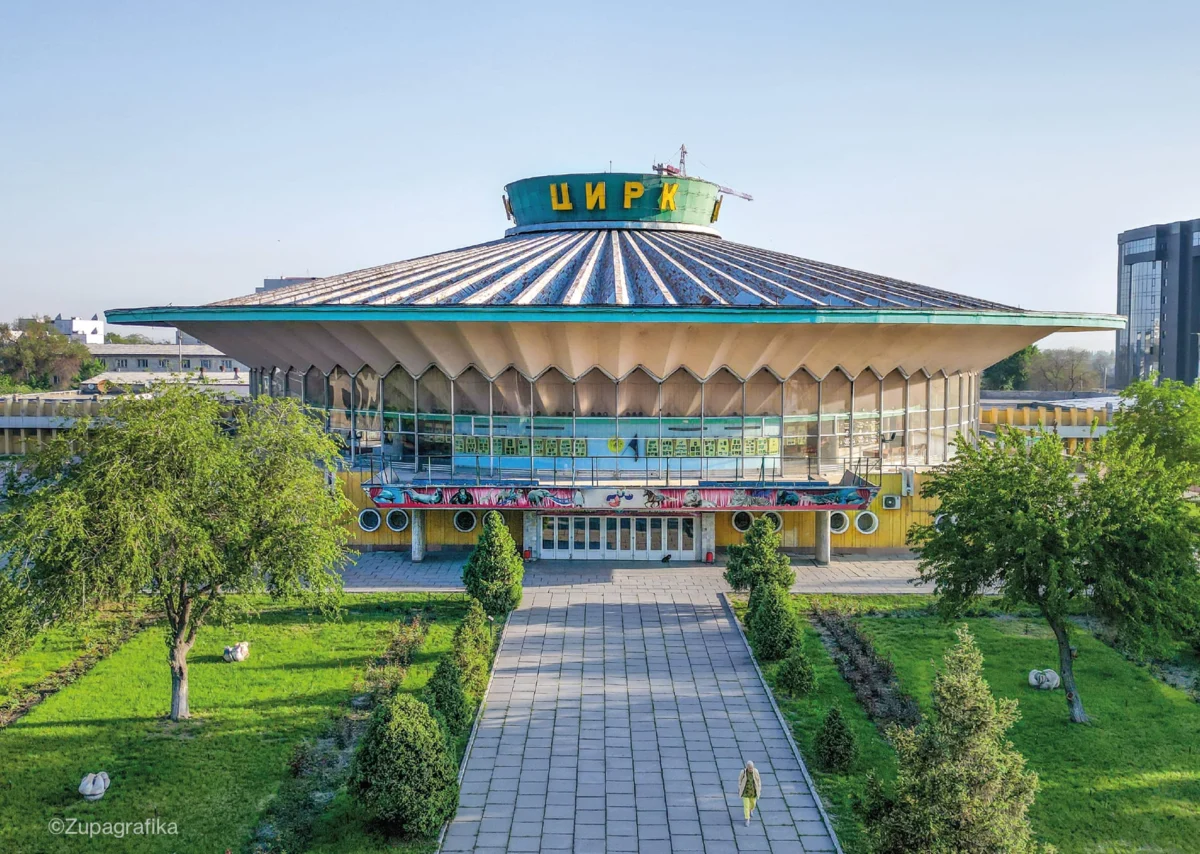
When the average observer imagines a circus, the mind’s eye conjures the quintessential "big top"—a nomadic, striped canvas tent housing a traveling troupe of acrobats, clowns, and animal performers. It is a world of ephemeral magic, packed into wagons and dismantled at a moment’s notice. However, in the former Soviet Union, the concept of the circus underwent a radical transformation. It was stripped of its wandering nature and anchored into the very bedrock of the socialist state.
Following the nationalization of circuses in 1919, the Soviet government identified the art form as a potent tool for mass mobilization. By the mid-20th century, the ephemeral tent had been replaced by permanent, monumental arenas—architectural marvels of concrete and steel that served as temples to both ideological propaganda and high-wire spectacle. Today, a new book, Cirk, published by Zupagrafika, offers an immersive exploration of these enduring monoliths, documenting a legacy where socialist modernism meets the thrill of the ring.
The Evolution of the State-Run Spectacle
The transition of the circus from a private, roving enterprise to a state-managed institution was not merely a matter of logistics; it was a deliberate pivot in cultural policy. By 1919, the newly formed Soviet leadership had begun consolidating the performing arts—theater, opera, and cinema—into a singular, state-sanctioned apparatus. The circus, with its immense popularity among the working class, was a primary target for this consolidation.

The Soviet authorities recognized that the circus was a uniquely "democratic" form of entertainment, accessible to the proletariat regardless of literacy or social standing. By standardizing training and performances, the government could ensure that the themes presented under the dome aligned with the goals of the Communist Party. The circus became a laboratory for human excellence, where the physical mastery of the acrobat served as a metaphor for the strength and discipline of the Soviet citizen.
Chronology: The Rise of the Concrete Arena
The architectural legacy of this era is best understood through a timeline of expansion and design ambition:
- 1919–1920s: The Nationalization Phase. The initial state takeover of existing circus troupes and the establishment of centralized bureaucratic control over all performances.
- 1930s–1940s: Standardization. Efforts were made to professionalize the art form, creating state-funded schools to train performers in standardized techniques, ensuring uniformity in ideological expression.
- 1950s: The Shift to Permanence. Moving away from the temporary tent, the USSR began to commission permanent buildings. This allowed for more complex stage mechanics, improved acoustics, and year-round operation.
- 1960s–1970s: The Brutalist Zenith. During the height of the Space Race, architectural design turned toward the futuristic. Architects began to favor monumental, geometric, and daringly experimental forms. The "circus as a flying saucer" became a common trope in architectural discourse, signaling technological supremacy.
- 1980s: The Late-Soviet Consolidation. The final wave of massive, state-of-the-art arenas was completed, solidifying the presence of these buildings in urban centers from Kyiv to Tashkent.
- 1991–Present: Post-Soviet Persistence. Following the dissolution of the USSR, these buildings became relics of a defunct political system, yet they remain central hubs of public life in many post-Soviet states.
Architectural Philosophy: Power Through Geometry
The arenas featured in Cirk are not merely performance venues; they are statements of intent. Architects were tasked with creating spaces that felt both massive and modern. The choice of Brutalism—a style characterized by raw, exposed concrete and bold, repetitive forms—was significant. It projected an image of stability and progress.

These buildings were intentionally designed to contrast with the surrounding urban sprawl. In cities like Bishkek, Kyrgyzstan, or Dnipro, Ukraine, the circus building often stands as a geometric anomaly—a rounded, floating mass of concrete that seems to defy the gravity of the surrounding traditional architecture. This was not accidental. The design aimed to create a sense of wonder, aligning with the state’s fixation on being a pioneer of the future. When a citizen walked into one of these arenas, they were entering a space that felt lightyears ahead of their daily, often drab, living conditions.
Supporting Data: A Geography of Performance
The scale of the Soviet circus project was immense. According to records compiled by researchers at Zupagrafika, the state constructed dozens of permanent, purpose-built arenas across the sprawling territory of the USSR and its satellite states.
| City | Venue | Notable Feature |
|---|---|---|
| Moscow | Great Moscow State Circus | Iconic circular design with advanced rigging systems. |
| Bishkek | Kyrgyz State Circus | Futuristic, disc-shaped architecture surrounded by greenery. |
| Chișinău | Chisinau State Circus | Once a jewel of Moldovan architecture, known for its sculptural façade. |
| Dnipro | Dnipro State Circus | A prime example of brutalist efficiency and winter-ready engineering. |
| Tashkent | Tashkent State Circus | A blend of traditional motifs and modern brutalist volume. |
These structures were designed with sophisticated engineering. They incorporated revolving rings, underground animal housing, and climate control, allowing for performances that would have been impossible under a canvas tent. The data suggests that these venues were not just local attractions but central nodes in a network of cultural exchange that spanned the entire Eastern Bloc.

Official Responses and Ideological Implications
While the buildings are now celebrated as architectural icons, their history is inextricably linked to the ideological control of the Soviet period. During the mid-20th century, the state did not view the circus as a benign diversion. Official government archives from the era describe the circus as an "agitation and propaganda institution."
A 1964 directive from the Ministry of Culture, for example, emphasized that circus performances must "promote the spirit of socialist collectivism and the joy of labor." This pressure created a unique artistic tension. Performers had to balance the inherent risks and thrills of their craft with the expectation that they represented the "New Soviet Man." Consequently, the architecture itself had to accommodate both the spectacle of the animal trainer and the gravitas of the state orator.
Modern critics argue that these buildings represent a "totalitarian aesthetic," where the audience was physically surrounded by the power of the state. Yet, there is a countervailing argument that the architecture fostered a sense of community and shared wonder that survived the fall of the regime. Today, many of these buildings are protected as heritage sites, though their upkeep remains a point of contention in nations grappling with the legacy of their Soviet past.

The Legacy of Cirk
The publication of Cirk by David Navarro and Martyna Sobecka serves as an essential archive for this disappearing chapter of architectural history. Beyond the historical analysis, the book provides a tactile connection to these structures through its signature pop-out paper models. By allowing the reader to reconstruct the buildings of Bishkek or Moscow on their own desks, Zupagrafika invites a deeper engagement with the structural ingenuity of these arenas.
"These arenas combined socialist modernism, experimental engineering, and choreographed spectacle," note the authors. "Together, they reveal a lesser-known chapter of postwar modernist architecture shaped by ideology and mass entertainment."
As these buildings face the threats of neglect, modernization, or demolition, the work of documenting them becomes increasingly urgent. They are more than just concrete shells; they are the physical remnants of a time when the state believed it could design the very nature of human entertainment. Whether viewed as tools of oppression or as triumphs of modernist design, these permanent circuses remain as a testament to a unique, and perhaps never-to-be-repeated, convergence of architecture and the performing arts.

In the final analysis, the story of the Soviet circus is a cautionary tale about the intersection of culture and power. Yet, it is also a story of beauty found in the most unlikely places—a legacy of concrete saucers that still invite the public to look up and wonder, long after the ideology that built them has faded into the history books.


 Siti Muinah
 Laily UPN