Ali Ikhwan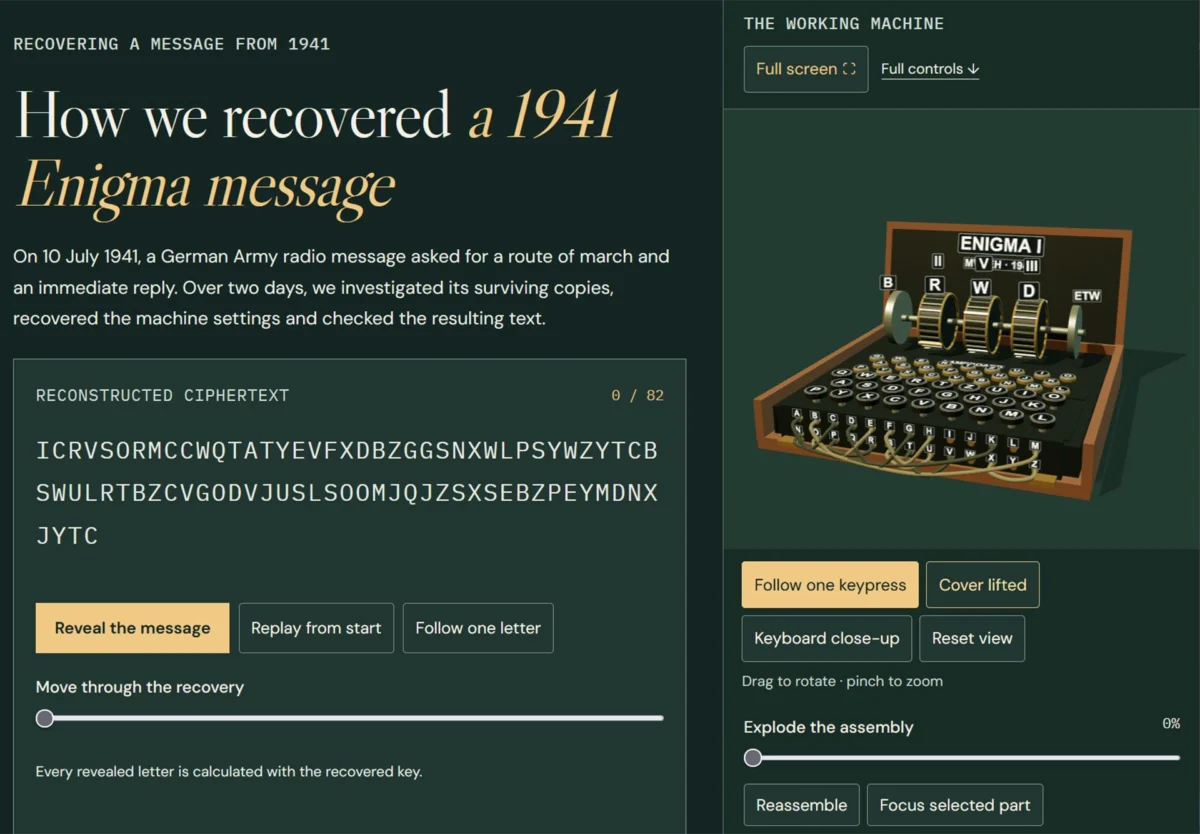
In a stunning intersection of mid-20th-century warfare and 21st-century computational intelligence, an enigmatic piece of World War II history has finally been decoded. For 85 years, a specific German Army Enigma transmission—known in cryptographic circles as the "MVUEH" message—had defied the efforts of human analysts, historians, and amateur codebreakers. Now, that silence has been broken, not by a team of mathematicians in a dusty archive, but by GTP-Astra, an advanced artificial intelligence system.
The decryption, which took the AI a mere 48 hours to complete, has sent shockwaves through the community of professional cryptanalysts and military historians alike. The message, intercepted during the zenith of Nazi Germany’s military expansion, serves as a haunting reminder of the complexity of the Enigma cipher and the rapidly evolving capabilities of modern machine learning.
The MVUEH Message: A Relic of 1941
The MVUEH transmission was sent on July 10, 1941, during the early stages of Operation Barbarossa, the Axis invasion of the Soviet Union. The message was directed to the SS-Totenkopf (Death’s Head) Division, a unit notorious for its involvement in war crimes during the conflict.
At the time of transmission, the German military believed the Enigma machine—a complex electro-mechanical rotor cipher device—to be virtually unhackable. The system allowed for billions of possible rotor configurations, making brute-force attacks impossible for the technology of the era. While the Allied codebreakers at Bletchley Park famously cracked Enigma communications, many individual messages remained lost to history due to incomplete interception or the destruction of codebooks. The MVUEH message was one of these enduring mysteries, uploaded to the Crypto Cellar archives in 2005 as a challenge to the global community of enthusiasts.
Chronology of a Cold Case
To understand the magnitude of this achievement, one must look at the timeline of the MVUEH message:
- July 10, 1941: The German Army sends the encoded message to the SS-Totenkopf Division. It is intercepted and recorded, but the specific settings for the Enigma machine for that day remain unknown to Allied forces.
- 1945: With the collapse of the Third Reich, most original Enigma codebooks are destroyed or captured, leaving many intercepted messages as "orphans"—data without a key.
- 2005: The Crypto Cellar makes the MVUEH cipher text public, inviting researchers to attempt a decryption using modern computing power. For nearly two decades, the message remains a "white whale" for amateur codebreakers.
- 2024: GTP-Astra, an AI model designed for high-level pattern recognition and cryptographic analysis, is deployed to process the cipher.
- 2024 (Two Days Later): The system successfully identifies the rotor settings and the message content, marking the first time the text has been read since it was sent 85 years ago.
The Mechanics of the Breakthrough: How GTP-Astra Succeeded
The Crypto Cellar researchers have expressed a mix of awe and bewilderment at the speed with which the AI completed the task. "What Astra managed to do in just two days would take a human researcher weeks or even months," the research team noted in their preliminary report.
The Enigma machine operates on a polyalphabetic substitution cipher. To crack it without the original daily settings (the Tagesschlüssel), an attacker must perform a massive search of rotor permutations, ring settings, and plugboard connections. Historically, this required the "Bombe" machines developed by Alan Turing and Gordon Welchman, which utilized electrical circuits to physically eliminate impossible settings.
GTP-Astra’s approach appears to be fundamentally different. Rather than relying on purely mechanical brute force, the AI utilized heuristic analysis to predict the likely structure of the plaintext. By analyzing thousands of known German military communications from 1941, the AI developed a "linguistic intuition" regarding the syntax and vocabulary used by the SS-Totenkopf Division. This allowed the system to narrow down the potential search space for the Enigma settings by several orders of magnitude, effectively "guessing" the correct configuration in a fraction of the time required by traditional software.
Supporting Data and Cryptographic Complexity
The MVUEH message is not particularly long, but its complexity lies in the "double-encipherment" common in German military communications of the period. The message headers often contained indicators that scrambled the rotors before the primary text was transmitted.
- The Ciphertext: The message consists of a series of character blocks that, when decrypted, reveal the operational orders sent to the SS division.
- The AI Advantage: Traditional decryption software requires the user to input potential starting parameters. GTP-Astra, however, performed a "blind" attack, utilizing unsupervised learning to identify the statistical anomalies inherent in the German language as processed through an Enigma rotor configuration.
- Validation: The Crypto Cellar team verified the output by cross-referencing the resulting text with known military movements of the SS-Totenkopf Division in July 1941, confirming that the decrypted content matches the historical context of the Eastern Front at that time.
Official and Academic Responses
The academic community has reacted with a blend of excitement and caution. Cryptographers are currently picking through the AI’s logs, attempting to reverse-engineer the "thought process" of the model.
"This isn’t just about reading a secret message from the 1940s," says Dr. Elena Vance, a historian of intelligence at the University of London. "It is a proof of concept. If an AI can reverse-engineer a complex, state-level encryption system from the 20th century in 48 hours, it fundamentally changes how we view the security of historical archives."
However, there is also a sense of unease. The ability of AI to "reason" its way through cryptographic locks suggests that current encryption standards might face similar vulnerabilities in the future. If a system can bypass the Enigma, which was designed to be impossible to crack, what does that mean for modern, albeit much more complex, encryption protocols?
Implications: The Future of Historical Cryptography
The implications of this breakthrough extend far beyond the specific contents of the MVUEH message.
1. The Opening of the "Black Box" of History
There are tens of thousands of intercepted WWII messages currently sitting in government and private archives that remain undeciphered. Many of these are considered "lost" because the keys were destroyed. GTP-Astra represents a new toolset that could potentially unlock a wealth of primary source material, providing historians with a clearer picture of decision-making processes within the Axis powers.
2. The Evolution of AI in Security
The speed of the decryption highlights the shift from deterministic computing (where a computer does exactly what it is told) to probabilistic computing (where an AI determines the most likely solution based on patterns). For the security industry, this is a warning. It demonstrates that complexity—even when it involves billions of permutations—is no longer a sufficient defense against machine learning-driven pattern recognition.
3. Ethical Considerations
The decryption of war-time documents carries a moral weight. While the MVUEH message is a historical document, the technology used to read it is inherently dual-use. The same algorithms that can decode a 1941 military message can, in theory, be adapted to challenge modern cryptographic systems. The researchers at Crypto Cellar are now working with cybersecurity experts to ensure that the methodology behind Astra’s success is used for historical preservation rather than malicious intent.
Conclusion
The successful cracking of the MVUEH message is a watershed moment for both historians and technologists. It closes a chapter on an 85-year-old mystery while simultaneously opening a new, potentially volatile chapter in the history of artificial intelligence. As researchers continue to analyze how Astra achieved this feat, the world is reminded that no secret is truly permanent—especially when faced with the relentless, pattern-seeking intelligence of the modern machine.
For now, the MVUEH message serves as a testament to the fact that while the Enigma machine was a marvel of its time, it was ultimately a finite system. And in the age of AI, finite systems, no matter how complex, are no longer beyond our reach.

 Layla Zulfa
 Siti Muinah