By Editorial Staff
As the science fiction community prepares for the 84th World Science Fiction Convention, known as "LAcon V," scheduled for August 27–31 at the Anaheim Convention Center, the focus is typically on the glitz of new releases, Hugo Award anticipation, and the high-energy networking that defines the genre’s premier annual event. However, amidst the frantic scheduling of modern programming, a dedicated contingent of readers and critics, led by longtime fandom luminary John Hertz, is carving out space for an essential endeavor: the re-examination of the foundational texts that shaped the field.
Hertz, a veteran voice in the science fiction community, has announced a series of informal yet rigorous discussion groups dedicated to three distinct "classics" of the genre. These sessions aim to look past the surface of 20th-century pulp and paperback staples to determine which works possess the longevity required to remain vital in an increasingly complex contemporary landscape.
The Definition of a Classic: A Philosophical Framework
The project is grounded in a specific, provocative definition of what constitutes a "classic" in literature. Hertz posits: "A classic is a work that survives its own time. After the currents which might have sustained it have changed, it remains, and is seen to be worthwhile for itself."
This framework invites attendees to move beyond nostalgia. The goal of the LAcon V discussions is to strip away the historical context that often shields older works from criticism, testing whether the prose, the ideas, and the narrative stakes hold up for a modern reader. By inviting participants to bring their own definitions and interpretations, the sessions aim to transform the act of reading from a passive consumption of history into an active, critical engagement with the evolution of the genre.
Chronology and The Selection: Three Pillars of Mid-Century SF
The three selections for this year’s discussions represent a fascinating cross-section of the post-war era, spanning from the late 1940s to the dawn of the 1960s. Each book serves as a case study for different facets of science fiction’s development.
Robert A. Heinlein: Sixth Column (1949)
Perhaps the most contentious selection, Heinlein’s Sixth Column—originally published as The Day After Tomorrow—offers a window into the intersection of hard science, military strategy, and, inevitably, the prejudices of the era. The narrative follows a group of scientists who find themselves behind enemy lines, using their technical ingenuity to dismantle an occupying force.
Hertz encourages attendees to engage with the book’s dual nature. While the text is ostensibly a "gadget-heavy" thriller, it serves as a platform for deeper sociopolitical questions. A central point of the upcoming discussion will be the thorny issue of the book’s racial dynamics. Critics have long debated whether the work is inherently racist or, conversely, contains anti-racist undercurrents—specifically regarding the character of Frank Mitsui. By re-reading the text with a modern lens, participants will be forced to grapple with the dissonance between Heinlein’s ingenuity-driven narrative and the cultural blind spots of 1949.

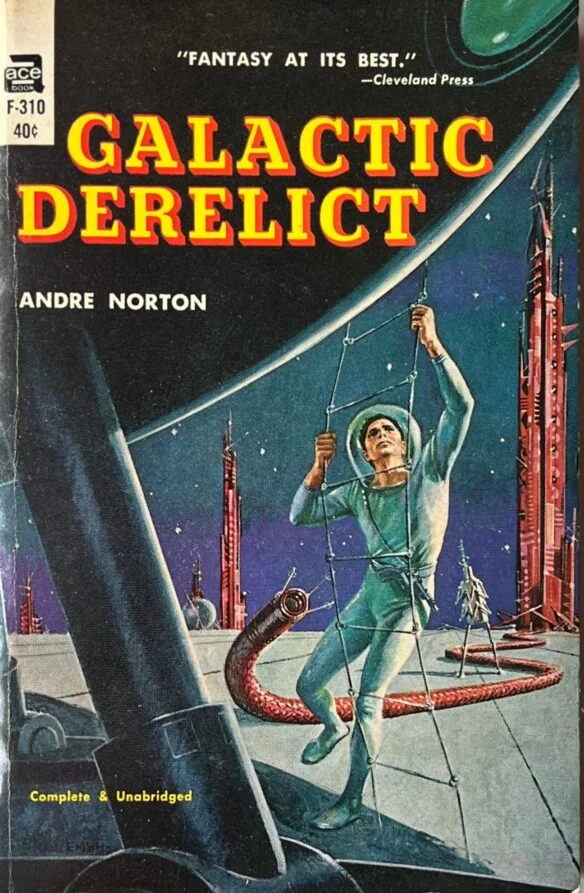
Andre Norton: Galactic Derelict (1959)
Moving into the Silver Age of science fiction, Norton’s Galactic Derelict provides a masterclass in the "knowledge fiction" subgenre. The narrative centers on an Apache protagonist, a character choice that warrants significant investigation given the time of publication.
The story is one of exploration and survival, where characters are forced to interface with alien technology that they only partially comprehend. Norton’s strength lies in her ability to marry the tactile details of discovery with the cognitive experience of her characters. As the story unfolds, the reader is essentially participating in the same puzzle-solving process as the cast. The discussion will likely revolve around the nature of "Lost Art"—the idea that science fiction can serve as a repository for technical and philosophical speculation that transcends the boundaries of the hard sciences.
A.E. Van Vogt: Slan (1951)
Rounding out the trio is Van Vogt’s Slan, a quintessential tale of the "outsider" archetype. The story of an undaunted protagonist navigating a world that fears and persecutes him remains a foundational text for the "superpowered outcast" trope.
The discussion at LAcon V will focus on the stylistic execution of the novel. Van Vogt’s work is often praised for its high-stakes intrigue and complex plotting, but the upcoming session aims to highlight the often-overlooked poetic density of his prose. As anecdote-collector Lee Gold famously noted regarding Van Vogt, the author’s impact on the reader is deeply personal, often leaving an impression that defies simple summary. Participants will be encouraged to look past the plot mechanics to examine how Van Vogt uses language to construct a sense of isolation and wonder.
Logistical Challenges and The "Concom" Reality
One of the most notable aspects of this initiative is the organizational hurdle. As of this writing, there has been no official confirmation from the LAcon V committee regarding the scheduling of these sessions.
Industry veterans are well aware of the internal pressures of organizing a Worldcon. The committee, tasked with managing thousands of attendees, international guests, and complex technical requirements, often operates at maximum capacity. Hertz acknowledges this, noting that the committee is likely "scrambling" to manage the event’s logistics.
However, the organizers remain undeterred. Even if these discussions are not formally integrated into the printed program, they will proceed. Participants are encouraged to look for signage and announcements at the convention, and to monitor digital forums and social media channels for updates on times and meeting locations. This "guerrilla" approach to programming—where fans create their own value independent of official schedules—is a hallmark of the resilient, self-organizing culture of fandom.
Supporting Data and The "Knowledge Fiction" Paradigm
To understand why these specific books were chosen, one must look at the broader evolution of the genre. Theodore Sturgeon once famously quipped that "Science fiction is knowledge fiction," a sentiment that Hertz and his fellow organizers intend to test.

If we categorize these works by their primary thematic drivers, a clear pattern emerges:
- Technocratic Ingenuity: Sixth Column prioritizes the application of science to solve political/bureaucratic crises.
- Discovery and Immersion: Galactic Derelict focuses on the process of learning and the psychological toll of encountering the unknown.
- The Individual vs. The System: Slan explores the existential struggle of the extraordinary individual against a hostile, normative society.
By comparing these three approaches, the LAcon V sessions hope to demonstrate how different "flavors" of science fiction have historically informed the way we view our own reality.
Implications for the Future of Fandom
The push to re-read these classics is not merely an exercise in nostalgia. It carries significant implications for the future of the field. As modern science fiction continues to diversify in terms of authorship and subject matter, the "canon" of the mid-20th century is being subjected to unprecedented scrutiny.
Some critics argue that these works should be left in the past, citing the dated social attitudes and tropes that are now recognized as problematic. Others argue that by engaging with these texts—warts and all—we gain a clearer understanding of the genre’s DNA. By hosting these sessions at a major event like LAcon V, the organizers are creating a bridge between the historical foundations of the genre and the critical discourse of the present.
Whether these discussions will lead to a broader reappraisal of the mid-century canon or simply serve as a space for like-minded readers to share their enthusiasm remains to be seen. Regardless, the initiative serves as a reminder that science fiction, at its core, is a dialogue. It is a conversation that began decades ago and continues to evolve, provided there are readers willing to look back at the past with a critical eye, an open mind, and a desire to see what still holds true.
For those planning to attend LAcon V, the invitation is open: bring your re-reads, bring your critiques, and be prepared to defend your own definition of what makes a work "classic." Even if the committee doesn’t provide the room, the fans are providing the substance.