

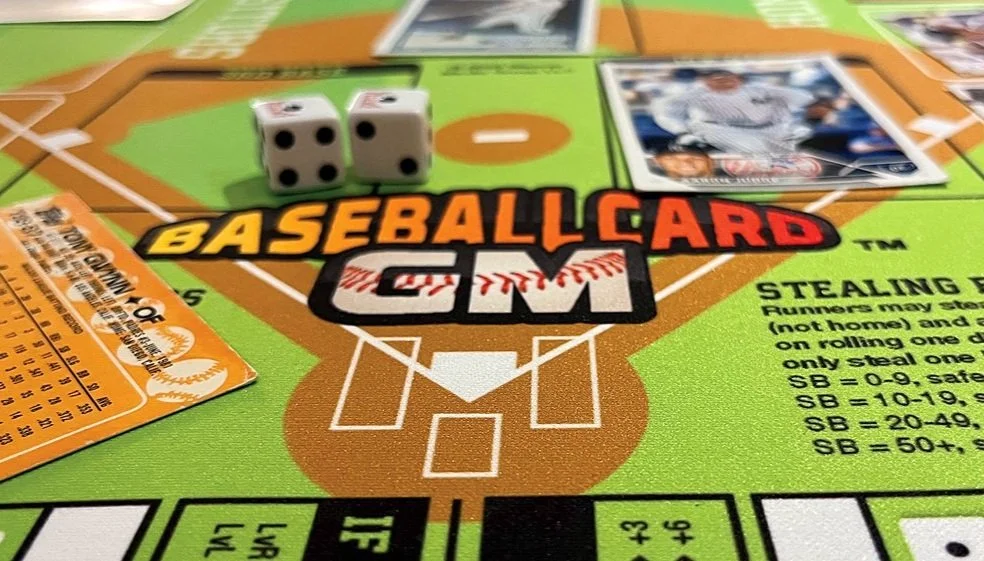
For decades, the standard lifecycle of a baseball card has been depressingly predictable: a brief moment of excitement upon pulling a shiny rookie card from a pack, followed by years of dark, stagnant storage in a plastic binder, a cardboard shoebox, or a forgotten closet shelf. Collectors have long held onto these relics, clinging to the vague, aspirational hope that their collection might one day serve as a retirement fund.
Baseball Card GM, the brainchild of designers Matthew and Garrett Weaver and published by Weaver Media Group, dares to challenge this stagnation. By asking the provocative question, "What if you actually had fun with these cards?" the designers have crafted a bridge between the stagnant world of collectibles and the vibrant, high-stakes world of tabletop gaming. It is a transformation that turns dust-covered cardboard into a living, breathing simulation of America’s Pastime.
Main Facts: The Anatomy of a New Kind of Game
At its core, Baseball Card GM is a sports simulation game that leverages the most abundant resource in the hobby: the physical baseball card. Unlike complex board games that require proprietary decks or expensive expansions, this game utilizes the player’s own collection. Whether you possess a binder full of modern-day superstars, a collection of 1980s legends, or a box of "junk wax" era cards that have been sitting in your attic since the Clinton administration, you have everything you need to play.
The game is designed for 1-2+ players and offers a brisk, 30-minute play cycle. By utilizing the actual statistics printed on the back of the cards—such as batting average, home runs, ERA, and stolen bases—the game creates a dynamic interaction between the player’s roster and the game’s mechanics. The primary interface is a neoprene playmat, which functions as the board, the rule reference, and the statistical conversion chart. Players roll two dice, cross-reference the result with the player’s stats on the card, and determine the outcome of the at-bat.
Chronology: The Evolution of a Tabletop Experience
The development of Baseball Card GM was rooted in the desire to solve the "collectibility paradox"—the irony that the most cherished items in a hobby are often the least utilized.
- Conceptualization: The Weaver team sought to create a system that was accessible to casual fans while retaining the depth that stat-obsessed baseball fans crave.
- Prototyping: Early iterations focused on balancing the "dice-to-stat" ratio. The goal was to ensure that a legendary hitter like Ted Williams felt significantly more threatening at the plate than a league-average journeyman, without making the math so cumbersome that it slowed the game to a crawl.
- The Neoprene Shift: The move to a high-quality neoprene mat was a pivotal design choice. By condensing the entire rule set and reference guide onto the play surface, the designers effectively removed the "rulebook barrier," allowing players to jump from box to bench in minutes.
- Refinement: Following initial feedback, the designers introduced a modular rule set. The "beginner guide" allows for casual play, while advanced rules—covering bullpen management, platoon splits (lefty/righty matchups), and drafting strategies—were layered in to allow the game to grow with the player’s expertise.
Supporting Data: Why the System Works
The brilliance of Baseball Card GM lies in its mathematical simplicity. By mapping real-world stats to dice probabilities, the game creates an organic flow that mimics a real baseball broadcast.
- Pacing and Flow: A typical half-inning takes approximately two to three minutes. By stripping away unnecessary components and relying on the player’s own card stats, the game avoids the "downtime death spiral" that plagues many sports simulation games.
- The "Junk Wax" Utility: One of the most significant impacts of the game is its ability to provide value to lower-tier cards. In the collector’s market, these cards are often worthless; in Baseball Card GM, they become the backbone of a team’s depth chart. This has led to a secondary market shift where players are hunting for specific stat-profiles rather than just player names.
- Component Economy: The game’s minimalist approach—two dice, a mat, and some tokens—is a masterclass in efficiency. It signals to the player that the game is not about the packaging, but about the data contained on the cards they already own.
Official Perspectives and Philosophy
In discussions regarding the game’s design, the Weaver Media Group has emphasized that Baseball Card GM is intended to be a "sandbox" rather than a rigid simulation. Unlike digital video game simulators that calculate every variable behind a black box, this tabletop experience puts the agency squarely in the hands of the "General Manager."
"The game is a conversation between the collector and the card," says the development team. By allowing players to construct their own leagues—whether that means a tournament of 1990s sluggers or a draft of modern-day pitching staffs—the game facilitates a personalized narrative. This design philosophy acknowledges that for many, baseball is not just about the final score, but about the "what-if" scenarios: Could the 1927 Yankees beat the 2024 Dodgers? With Baseball Card GM, that question is no longer hypothetical; it is a Friday night activity.
Implications for the Hobby and Industry
The success of Baseball Card GM suggests a burgeoning trend in the tabletop industry: the "integration of assets." As TCGs (Trading Card Games) like One Piece and Yu-Gi-Oh continue to dominate the market, Baseball Card GM offers a unique alternative. It validates the collector’s existing investment rather than requiring them to start a new, expensive hobby from scratch.
The Collector’s Renaissance
For the aging collector who has moved away from the hobby, this game offers a compelling reason to return to their storage bins. It shifts the value proposition of a baseball card from "future investment" to "present-day entertainment." This shift is likely to ripple through local game stores and hobby shops, as retailers look for ways to move bulk inventory that has historically been difficult to sell.
The Family Connection
The game’s accessibility has profound implications for intergenerational play. Because the game relies on basic arithmetic and logical, stat-based decision-making rather than complex, text-heavy card effects, it is remarkably family-friendly. It provides a structured, quiet, and engaging way for parents to teach children about baseball statistics and the history of the sport.
The Verdict: A Sandbox for the Stat-Obsessed
Baseball Card GM is not a game for the player who wants a deep, 12-hour-long managerial simulation where they control the pitch-by-pitch location of a fastball. If that is your expectation, the simplicity of the dice-rolling mechanic may feel too streamlined. However, for the baseball fan who wants to feel the rhythm of a game, engage with their collection, and experience the thrill of a bottom-of-the-ninth rally, it is an essential addition to the tabletop shelf.
Why it Succeeds:
- Low Barrier to Entry: If you have cards, you have the game.
- High Agency: The draft and roster-building phase is where the "real" game happens.
- Speed: It captures the drama of a baseball game without the three-hour time commitment.
- Nostalgia Factor: It breathes life into cards that would otherwise never see the light of day.
Ultimately, Baseball Card GM succeeds because it respects the lore of baseball. It understands that the sport is fundamentally built on the tension between the batter and the pitcher. By letting the dice and the player’s stats dictate the outcome, the game creates organic, memorable moments that feel earned rather than scripted.
Whether you are a casual fan looking to spice up a rainy Sunday or a dedicated collector looking for a way to justify your overflowing binders, Baseball Card GM is a rare, refreshing example of how to modernize a classic hobby. It reminds us that at the end of the day, these cards were meant to be held, shuffled, and played—not just stored away in the dark. It is, quite simply, a game-changer for the baseball card community.











No comments yet. Be the first to join the conversation!