

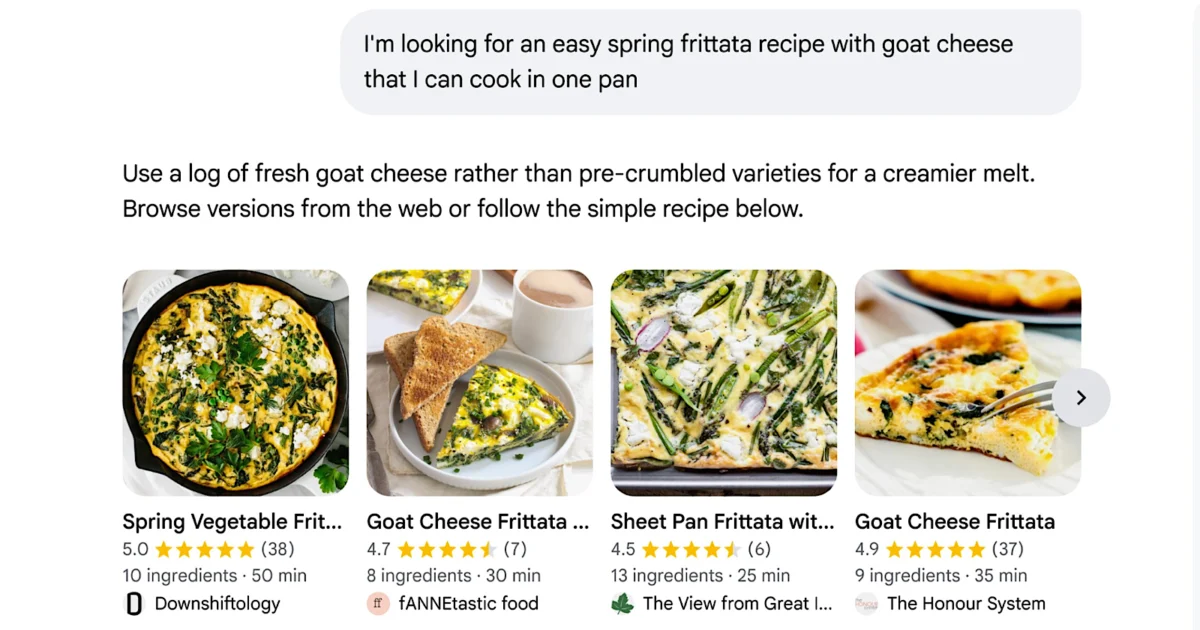
In a move designed to bridge the growing divide between generative AI and the web’s creator ecosystem, Google has unveiled a significant update to its AI Mode. For users searching for culinary inspiration, the interface will now prioritize direct links to recipe websites at the very top of AI-generated responses. This strategic pivot, announced by Robby Stein, Google’s VP of Product for Search, aims to provide users with immediate access to authoritative content while offering recipe publishers a more prominent digital storefront within the AI-driven search experience.
This update is not merely a cosmetic change; it represents a fundamental recalibration of how Google’s AI treats proprietary content. By surfacing creator names, star ratings, and ingredient counts directly in the response, Google is attempting to mitigate long-standing criticisms regarding the erosion of traffic to original content creators.
The Evolution of Recipe Discovery: A Chronology
To understand the significance of this update, one must look at the trajectory of Google’s search evolution over the past year.
March 2026: The Foundation of the Recipe Panel
The journey began in March 2026, when Google first introduced a dedicated recipe panel within its AI-enhanced search results. At the time, the functionality was relatively passive; users could tap on a suggested dish, which would then trigger a slide-out panel containing links to relevant websites and a summarized overview of the preparation process. While this was an improvement over standard AI text blocks, publishers argued that it still sequestered the user within the Google ecosystem, often bypassing the actual website where the recipe lived.
June 2026: The "Top-of-Response" Integration
Following a period of intense feedback from the creator community—a period during which Google’s search executives actively engaged with SEOs and food bloggers—the company pivoted. On June 30, 2026, Robby Stein announced the current iteration. The update moves the recipe discovery mechanism from a secondary, clickable panel to a primary position at the top of the AI response. By integrating rich metadata—such as ratings and ingredient counts—directly into the AI-generated interface, Google is essentially "fast-tracking" the user to the source material.
The Mechanics of the Update: What Has Changed?
The technical implementation of this change centers on visual hierarchy and data transparency. When a user queries a recipe-related topic, the AI no longer forces the user to read through a block of generated text to find the source. Instead, the "above-the-fold" real estate is now reserved for:
- Prominent Hyperlinks: Direct, easy-to-click pathways to the original recipe page.
- Visual Thumbnails: High-quality imagery provided by the publisher to entice clicks.
- Metadata Enrichment: Displaying the creator’s name, the aggregate user rating, and the total ingredient count.
This structured approach serves a dual purpose. For the user, it reduces "search friction" by providing essential decision-making data before they even leave the search page. For the publisher, it provides a "branded" presence that acknowledges their intellectual property, potentially increasing click-through rates (CTR) compared to standard, non-attributed text links.
Analyzing the Impact on Search Engine Optimization (SEO)
For recipe bloggers and digital publishers, the implications of this update are profound. Historically, the concern has been that AI summaries—which aggregate and synthesize information from multiple sources—would render the original websites obsolete. If an AI provides the instructions, why would a user visit the site?
The Role of Structured Data
While Google has not explicitly mandated the use of specific schema markup for this new treatment, the data points displayed (ratings, ingredient counts) strongly correlate with existing Recipe Structured Data. Industry experts suggest that sites failing to implement robust schema markup will likely be excluded from this "top-tier" treatment. Consequently, technical SEO is moving from a "nice-to-have" to a mandatory requirement for visibility in the AI-first era.
The Publisher’s Dilemma
Despite the upgrade, the sentiment among publishers remains cautious. The "Inspired Taste" feedback, shared publicly following the announcement, highlights a critical distinction: visibility is not the same as attribution. While the new links provide a clearer pathway to the source, publishers remain concerned that AI models continue to generate summaries that may "misrepresent" the nuances of a recipe. The fear is that the AI might distill a complex culinary process into a simplified version that lacks the context, tips, and personal expertise that drive value for the original creator.
Official Responses and the "Feedback Loop"
The transparency surrounding this update is, in itself, a departure for Google. In previous years, major algorithmic changes were often rolled out with little warning or explanation. In this instance, Robby Stein has been vocal about the role of user and creator feedback.
"We just launched a new visual treatment making it even easier to discover and visit recipe pages with AI Mode," Stein noted in his social media announcement. He framed the move as part of a "continued work" cycle, implying that this is a living project.
Google’s willingness to engage with creators—even those critical of its platform—suggests that the company is keenly aware of the antitrust and reputational risks associated with AI-driven content scraping. By involving the creator community in the design of the interface, Google is attempting to create a "social contract" that keeps the web ecosystem healthy while moving toward an AI-centric future.
Implications for the Future of Search
The recipe update serves as a "canary in the coal mine" for other industries. If Google can successfully integrate recipe metadata into AI responses, it is highly probable that similar treatments will be rolled out for:
- E-commerce: Integrating product specifications, pricing, and availability.
- Travel: Linking to booking engines, hotel ratings, and itinerary guides.
- Local Services: Highlighting service providers, certifications, and customer testimonials.
The broader implication is that Google is moving away from the "Blue Links" model toward an "Entity-First" model. In this new paradigm, the search engine doesn’t just return pages; it returns structured objects (a recipe, a product, a service) that can be interacted with immediately.
Conclusion: A Delicate Balancing Act
The update to AI Mode for recipes is a tactical victory for publishers, but it is not a final resolution. As long as AI systems rely on the vast body of human-created content to train their models, the friction between AI utility and publisher profitability will persist.
For the SEO community, the lesson is clear: the future of search is visual, data-rich, and heavily reliant on structured metadata. While the "recipe war" is far from over, Google’s latest move indicates a realization that for AI to be truly useful, it must act as a gateway to human expertise, rather than a replacement for it.
As we look toward the remainder of 2026, the industry will be watching closely to see if this model of "prominent attribution" becomes the gold standard for all vertical-specific AI queries. If successful, it may provide a roadmap for a sustainable AI-web relationship, where the convenience of generative answers and the viability of independent content creation can coexist.
For now, the ball remains in the court of the creators. Those who prioritize high-quality structured data and lean into the visual nature of the new SERP (Search Engine Results Page) are likely to thrive, while those who ignore these shifts may find themselves marginalized in the new AI-driven landscape.











